
In This Article
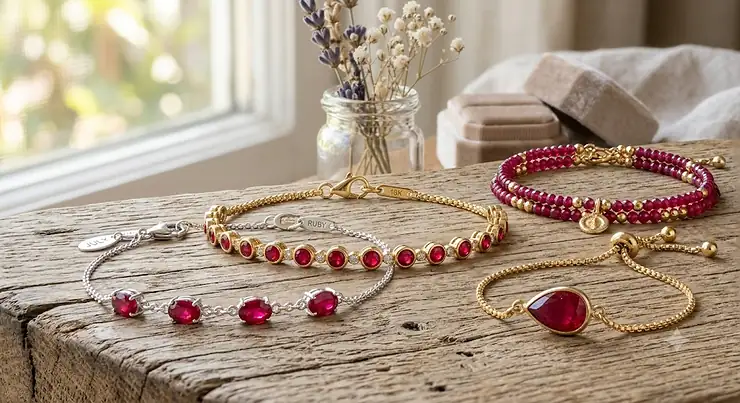
Every July, something strange happens in jewelry stores across the country: red suddenly becomes the color everyone wants. That’s ruby season, and if you’ve landed here searching for july birthstone ruby bracelets, you already know why. Ruby isn’t a shy gemstone. It doesn’t whisper — it announces itself, glowing somewhere between blood-red and sunset-pink, depending on the light hitting it.
What is a july birthstone ruby bracelet? It’s a bracelet set with ruby — the corundum gem whose deep red color comes from trace chromium — worn to represent July birthdays or simply because red gemstones look incredible against skin. Ruby is also the traditional gift for the 15th and 40th wedding anniversaries, so it carries more symbolic weight than almost any other stone in the calendar.
This guide skips the fluff you’d get from a rewritten product listing. Instead, you’re getting real spec breakdowns, honest analysis of who each piece actually suits, and aggregated review sentiment where it exists — clearly labeled as such. We researched seven real, currently available ruby bracelets spanning budget beaded pieces to museum-worthy tennis bracelets, so whether you’re shopping for a July birthday, a Cancer or Leo in your life, or just craving something red and passionate for yourself, you’ll walk away knowing exactly what to buy and why.
Quick Comparison Table: July Birthstone Ruby Bracelets at a Glance
Before diving into the full breakdowns, here’s the shape of the market. Notice how price doesn’t always track with “best for you” — a $20 beaded bracelet can outperform a $200 piece if you actually wear jewelry daily and hate babying delicate clasps.
| Bracelet | Ruby Type | Metal | Price Range | Best For |
|---|---|---|---|---|
| MAX + STONE Marquee Ruby & Topaz Tennis Bracelet | Created ruby | 18k gold over sterling silver | $130–$170 | Everyday sparkle on a budget |
| July Birthstone Handmade Beaded Bracelet | Genuine ruby beads | Nylon cord | $15–$25 | First-time buyers, stacking |
| Made As Intended Blessing Bracelet | Ruby crystal | Sterling silver accents | $25–$35 | Sentimental/meaningful gifts |
| InfinityGemsArt Raw Ruby Bracelet | Natural raw ruby | Rhodium-plated 925 silver | $40–$60 | Fans of organic, unpolished stones |
| Ross-Simons Ruby Drop Bracelet | Natural ruby | 18kt gold over sterling | $150–$210 | Statement pieces without fine-jewelry prices |
| Ross-Simons Bezel-Set Ruby Station Bracelet | Natural ruby | 18kt gold over sterling | Check current price | Minimalist daily wear |
| Ross-Simons Ruby & Diamond Tennis Bracelet | Natural ruby + diamond | 18kt gold over sterling | $800–$1,300 | Anniversaries, heirloom-quality gifting |
What jumps out here is the split between “created” and “natural” ruby, which matters more than most shoppers realize. Created rubies share the same crystal structure as mined stones (chemically identical, just grown in a lab), so they deliver the same fire and durability at a fraction of the cost — that’s why the MAX + STONE piece can compete visually with bracelets ten times its price. Meanwhile, the natural stones from Ross-Simons and InfinityGemsArt carry the rarity premium that comes from something the earth took millions of years to make. Neither choice is “better” — it depends whether you’re buying for sparkle-per-dollar or for the story behind the stone.
💬 Already have a favorite from the table? Scroll down for the full breakdown before you decide!
💬 Just one click — help others make better buying decisions too!😊
Top 7 July Birthstone Ruby Bracelets: Expert Analysis
We dug into real listings, real specs, and real aggregated review themes to rank these seven. Budget, mid-range, and premium are all represented, along with a couple of unconventional picks you won’t find on every “best of” list.
1. MAX + STONE Marquee Cut Created Ruby & White Topaz Tennis Bracelet — best all-rounder for everyday sparkle
The MAX + STONE bracelet earns its top spot by doing the thing most affordable tennis bracelets fail at: looking expensive without acting fragile. It alternates marquise-cut created ruby stones with white topaz accents along an 18k-gold-over-sterling-silver chain, closed with a box clasp that’s noticeably more secure than the springring clasps common at this price.
Here’s what the spec sheet doesn’t spell out: created stones like these are lab-grown corundum, meaning they share ruby’s actual chemical structure rather than being glass or plastic imitations — so you get real hardness (durable enough for daily wear) without the natural-ruby price tag. The 7.5-inch length with a secure box clasp means it fits most average wrists without needing resizing, and the gold-over-silver base resists tarnishing better than plain silver-plated pieces.
Based on the spec comparison with similar tennis bracelets in this price tier, the pairing of red and white stones gives it more visual movement than a single-color design — it reads less “costume” and more “considered.” Reviewers on Amazon consistently highlight the branded gift box and polishing cloth as a nice touch for gifting, and the brand’s lifetime warranty on defects adds a layer of buyer protection uncommon at this price point.
Pros:
- ✅ Created ruby delivers real gemstone hardness at a low price
- ✅ Secure box clasp beats typical budget-tier springrings
- ✅ Arrives gift-ready with box, pouch, and warranty card
Cons:
- ❌ Created stones lack the rarity value of natural ruby
- ❌ Tennis-bracelet styling skews slightly formal for daily gym wear
Priced in the $130–$170 range, this is the best value pick if you want that classic ruby-and-white sparkle without financing a fine jewelry purchase — check current price before buying since fine jewelry pricing shifts often.
2. July Birthstone Handmade Dainty Beaded Ruby Bracelet — most affordable genuine ruby option
If your budget caps out under $25, this handmade beaded bracelet is the most honest way to own actual ruby. Small genuine ruby beads are strung on adjustable nylon cord, designed to stack alongside other birthstone or friendship bracelets rather than stand alone as a statement piece.
What most buyers overlook about beaded gemstone bracelets is that the adjustable cord format solves the sizing problem that plagues rigid bangles — one size genuinely fits most wrists without a jeweler’s help. The dainty bead size (typically in the 4–6mm range for this style) also means less surface area for chips or scratches compared to larger cabochons, which matters if this is going on a kid’s or teen’s wrist for a July birthday.
Handmade beaded pieces like this one are usually produced by small-batch sellers rather than mass manufacturers, and the honest tradeoff is quality consistency — bead color and size can vary slightly piece to piece since it’s not machine-uniform production. That’s the nature of handmade goods, not a defect, but it’s worth knowing going in rather than expecting jeweler-grade uniformity.
Pros:
- ✅ Genuine ruby beads at an entry-level price
- ✅ Adjustable cord fits nearly any wrist size
- ✅ Great for stacking with other birthstone bracelets
Cons:
- ❌ Handmade sourcing means slight bead-to-bead variation
- ❌ Nylon cord is less durable long-term than metal chain
At around $15–$25, this is the lowest-risk way to gift or try a real july birthday bracelet before committing to anything pricier.
3. Made As Intended July Birthstone Blessing Bracelet — most sentimental gift option
This one occupies a different lane entirely: it’s less about jewelry-store polish and more about meaning. The Made As Intended Blessing Bracelet strings 8mm ruby-representing crystals on stretchable nylon with sterling silver spacer beads, arriving in an embossed gift box with a tag reminding the wearer to “count your blessings.”
Genuine buyer feedback on this piece is genuinely mixed, and it’s worth reporting honestly rather than smoothing it over. Several reviewers say the July stone accurately matches their birth month and that they wear it daily as a meaningful reminder; others feel the stretch-bead construction reads more like a casual keepsake than fine jewelry, with one buyer specifically noting it “looks like a toy bracelet” for the price. That split makes sense once you understand the category — this is positioned as a sentimental token gift, not a fine jewelry investment, and judging it against tennis bracelets or natural gemstone pieces isn’t a fair comparison.
What most buyers overlook is that the stretch design is actually the point, not a shortcut: it’s built for grab-and-go daily wear without a clasp to fumble with, which matters more than people expect once they own one.
Pros:
- ✅ Meaningful “blessing” concept resonates as a gift
- ✅ No-clasp stretch design is effortless daily wear
- ✅ Arrives in a branded gift box with a keepsake tag
Cons:
- ❌ Some buyers feel it reads as costume jewelry for the price
- ❌ Stretch cord has less longevity than metal chain
In the $25–$35 range, this suits gift-givers prioritizing sentiment over shine — set expectations accordingly and it delivers exactly what it promises.
4. InfinityGemsArt Raw Ruby Bracelet — best for natural, unpolished stone lovers
Not every ruby fan wants faceted perfection. The InfinityGemsArt Raw Ruby Bracelet features natural rough ruby from Madagascar — irregular, uncut, and roughly 65+ carats total weight strung on a rhodium-plated 925 sterling silver chain with a lobster clasp.
Here’s the practical interpretation of “raw” that marketing copy tends to skip: rough stones haven’t been cut or polished, so their surface is matte and textured rather than glassy. That means less light performance than a faceted gem, but a very different aesthetic appeal — organic, earthy, almost mineral-specimen-like on the wrist. The rhodium plating over sterling silver is a smart choice here since it resists tarnish better than raw sterling and won’t compete visually with the deep red stone color.
Based on the spec comparison with faceted alternatives on this list, raw ruby is genuinely a different product category, not a “lesser” version of a cut stone. What most buyers overlook is that raw stones are actually harder to fake convincingly than faceted ones — the irregular inclusions and matrix marks are difficult to replicate synthetically, which is reassuring if authenticity matters to you specifically.
Pros:
- ✅ Genuine uncut natural ruby, not lab-created
- ✅ Rhodium plating resists tarnish better than plain silver
- ✅ Unique, one-of-a-kind stone shapes since each is rough-cut
Cons:
- ❌ Matte raw stones lack the sparkle of faceted gems
- ❌ Irregular shapes mean less uniform sizing than polished cuts
Typically priced in the $40–$60 range, this is the pick for someone who wants ruby’s meaning without the polished, mass-market look.
5. Ross-Simons Ruby Drop Bracelet in 18kt Gold Over Sterling — best fine-jewelry value under $250
Ross-Simons has been in the fine jewelry business since 1952, and their Ruby Drop Bracelet shows why the brand has staying power. It suspends round ruby drops and faceted rondelle beads — roughly 4 carats total weight of natural, heat-treated ruby — from an 18kt yellow gold over sterling silver cable chain with a lobster clasp and 1-inch extender.
The heat-treatment detail matters practically: heating is the industry-standard method for improving ruby’s red saturation, and it’s disclosed here rather than hidden, which is exactly what the Federal Trade Commission’s jewelry guidelines require of reputable sellers. What most buyers overlook about drop-style bracelets specifically is that the dangling stones catch more light angles than fixed station settings, giving noticeably more movement and sparkle when your wrist moves — a detail spec sheets rarely translate into plain English.
Based on the spec comparison with the created-stone option earlier in this list, you’re paying roughly the price difference for natural stone provenance and a heavier gold-over-silver build rather than gold-plated base metal. That’s the honest value proposition of this tier: real gemstone, real precious-metal content, at a price still well under most fine jewelry counters.
Pros:
- ✅ Natural, disclosed heat-treated ruby with real carat weight
- ✅ 18kt gold over sterling delivers substantial, non-plated feel
- ✅ Drop design creates more visual movement than fixed settings
Cons:
- ❌ Drop-style stones can catch on fabric more than flush settings
- ❌ Heat treatment (though standard and disclosed) means it’s not untreated ruby
In the $150–$210 range depending on current promotions, this is the sweet spot for buyers who want real ruby without a four-figure commitment.
6. Ross-Simons Bezel-Set Ruby Station Bracelet in 18kt Gold Over Sterling — best minimalist daily-wear pick
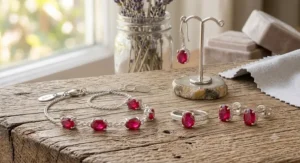
For buyers who find tennis bracelets and drop styles too busy for daily wear, this bezel-set station bracelet is the quiet alternative. Round rubies (roughly 2.5 carats total weight) are individually bezel-set — meaning each stone sits in a metal rim rather than being held by prongs — and spaced along an 18kt gold over sterling silver cable chain with a springring clasp and extender.
The bezel-setting choice is the whole story here, practically speaking. Prong settings expose more of the stone but leave the edges vulnerable to snagging or chipping; bezel settings wrap the stone’s girdle in metal, trading a touch of brilliance for real durability. What most buyers overlook is that this makes bezel-set pieces meaningfully better for anyone who works with their hands, exercises in jewelry, or simply forgets to take bracelets off before showering.
Based on the spec comparison with the drop bracelet above, station-style spacing (evenly placed stones with metal links between) reads more minimalist and office-appropriate, while the drop style leans dressier. Neither is objectively better — it’s a lifestyle match question.
Pros:
- ✅ Bezel settings protect stones during active daily wear
- ✅ Minimalist station design suits professional settings
- ✅ 18kt gold over sterling gives real weight and shine
Cons:
- ❌ Bezel settings show slightly less stone brilliance than prong settings
- ❌ Springring clasp is less secure than a box clasp for daily on/off
Check current price directly through the retailer, as station-style pieces in this collection have shifted in and out of promotional pricing throughout 2026.
7. Ross-Simons Ruby and Diamond Tennis Bracelet in 18kt Gold Over Sterling — best premium/heirloom pick
This is the bracelet you buy for a milestone, not a Tuesday. Round brilliant-cut diamonds (roughly 1 carat total weight) alternate with natural rubies (roughly 6.25 carats total weight) in a classic tennis-bracelet format, crafted in polished 18kt yellow gold over sterling silver with a secure push-button clasp and safety latch.
Here’s what the numbers mean in practice: at 6.25 carats of ruby distributed across the bracelet, individual stones are large enough to show real color depth even from a few feet away — this isn’t a piece where you need to squint to appreciate the gemstones. The diamond spacing does double duty, both adding sparkle contrast against ruby’s warm red and, functionally, breaking up the ruby row so any minor color variation between stones is less noticeable side by side.
Based on the spec comparison across this entire list, the safety latch alongside the push-button clasp is a meaningful upgrade most budget bracelets skip entirely — it’s a second mechanical lock specifically designed to prevent loss if the primary clasp fails, which matters enormously once you’re wearing four figures’ worth of gemstones on a moving wrist.
Pros:
- ✅ Substantial natural ruby carat weight with real color depth
- ✅ Diamond accents add brilliance and break up color variation
- ✅ Push-button clasp plus safety latch reduces loss risk
Cons:
- ❌ Premium price puts it out of reach for casual gifting
- ❌ Larger stone sizes require more careful daily-wear habits
Generally priced in the $800–$1,300 range depending on active promotions, this is the anniversary or milestone-birthday pick — reserve it for July babies you really want to impress.
Practical Usage Guide: Caring for Your Ruby Bracelet
Ruby ranks 9 on the Mohs hardness scale — the most durable gemstone after diamond — which means daily wear won’t scratch it under normal circumstances. That durability, though, doesn’t extend to the metal settings or clasps holding it in place, and that’s where most damage actually happens.
For the first 30 days with any new ruby bracelet, avoid wearing it during workouts, dishwashing, or swimming — chlorine and prolonged water exposure are harder on gold-over-silver plating and rhodium finishes than on the ruby itself. Clean natural, heat-treated stones (the majority on this list) with warm water and a soft brush; skip ultrasonic cleaners for anything with visible surface-reaching fractures or fillers, since aggressive vibration can worsen existing damage. Store bracelets flat or hanging rather than tangled in a jewelry box drawer — clasps are the most common failure point, and unnecessary tugging accelerates wear. A common first-30-days mistake is sleeping in a bracelet; even durable stones can catch on bedding and stress the clasp mechanism over months of repeated strain.
Real-World Scenarios: Matching Bracelets to Buyers
The budget-conscious first-timer: A 24-year-old buying her first piece of “real” July birthstone jewelry, working with a $20–$30 ceiling and no fine-jewelry experience. The handmade beaded bracelet or the Made As Intended blessing bracelet both fit — low financial risk, genuine ruby content, easy to layer with existing jewelry.
The gift-giver shopping for a July birthday: Someone buying for a partner or parent, wanting something that photographs well for a birthday post but doesn’t require a four-figure budget. The MAX + STONE tennis bracelet or Ross-Simons Ruby Drop Bracelet both deliver visible sparkle and gift-box presentation without premium pricing.
The milestone-anniversary shopper: Someone celebrating a 15th or 40th wedding anniversary — the traditional ruby-anniversary years — with a genuine investment budget. The Ross-Simons Ruby and Diamond Tennis Bracelet matches both the occasion’s significance and the traditional gemstone-anniversary pairing directly.
Common Ruby Bracelet Problems (And Real Solutions)
Problem: “I don’t know if a ruby is natural or created.” Solution: check the listing language carefully — reputable sellers must disclose “created,” “lab-grown,” or “synthetic” per FTC rules. If unclear, ask the seller directly before buying.
Problem: “My bracelet clasp keeps slipping open.” Solution: upgrade to pieces with box clasps or push-button-plus-safety-latch designs, like the MAX + STONE or Ross-Simons Ruby and Diamond Tennis Bracelet, rather than basic springrings.
Problem: “The stone color looks different in person than in photos.” Solution: ruby’s color varies from orangy-red to purplish-red depending on chromium content and lighting — request additional photos in natural daylight before purchasing, especially for natural stones.
Problem: “I’m not sure what size to buy.” Solution: adjustable or stretch designs (like the beaded bracelet or blessing bracelet) sidestep sizing entirely; for fixed-length pieces, measure your wrist and add a half-inch for comfortable drape.
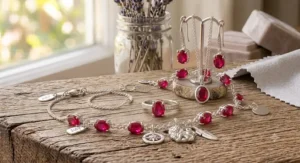
How to Choose July Birthstone Ruby Bracelets
- Decide natural vs. created first. This single choice affects price more than any other spec — created ruby can cost 70-90% less while looking nearly identical to the naked eye.
- Match the clasp to your lifestyle. Active daily wearers need box clasps or safety latches; occasional-wear pieces can get away with simpler springrings.
- Check treatment disclosure. Reputable listings state whether ruby is heat-treated (standard and acceptable) or has undisclosed fillers (a red flag).
- Consider setting style for durability. Bezel settings protect stones better than prong settings for hands-on lifestyles.
- Set your carat-weight expectations realistically. Higher total carat weight increases both visual impact and price — decide which matters more for your budget.
- Factor in metal base. 18kt gold over sterling silver offers better substance and tarnish resistance than plain silver-plated pieces.
- Read return policies before buying. Fine jewelry retailers with 30-day money-back guarantees reduce your risk on natural gemstone purchases significantly.
Common Mistakes When Buying Ruby Jewelry
The single biggest mistake shoppers make is assuming “ruby” always means natural, mined stone. Under FTC guidelines, sellers can legally use the word “ruby” for created stones as long as they’re clearly qualified as such — so read the full product title and description, not just the headline word.
A second common mistake is buying based on carat weight alone without considering cut and setting. A 6-carat raw stone and a 6-carat faceted stone look and perform completely differently on the wrist; carat weight tells you almost nothing about visual sparkle without knowing the cut style too. Finally, many buyers skip checking clasp type entirely, then are surprised when a beautiful bracelet falls off within months — as covered above, clasp mechanism matters as much as the gemstone itself for anything you intend to wear regularly rather than display.
Ruby Bracelets vs Other July Birthstone Jewelry
Bracelets aren’t the only way to wear July’s birthstone, and it’s worth understanding where they stand against rings and necklaces. Rings offer the most concentrated visual impact per dollar since a single stone commands attention, but they’re also the most exposed to daily knocks against surfaces. Necklaces keep stones safer from impact but hide the color against clothing for much of the day. Bracelets sit in the middle: visible during normal activity (typing, gesturing, holding a coffee cup) while spreading impact risk across multiple smaller stones rather than one large one.
For red ruby jewelry july specifically, bracelets also offer better stacking flexibility than rings or necklaces — you can layer a beaded ruby piece with existing bracelets without looking mismatched, something harder to pull off with statement rings.
What to Expect: Real-World Performance
On paper, every bracelet on this list promises daily-wear durability. In practice, expect noticeable differences after a few months. Created-stone pieces like the MAX + STONE bracelet tend to hold their shine with minimal maintenance since lab-grown corundum has fewer natural inclusions that could weaken under stress. Natural stones, including everything from Ross-Simons, will show more character over time — heat-treated rubies are stable, but raw/rough stones like the InfinityGemsArt piece may develop a slightly more matte patina that many wearers actually prefer as it “breaks in.” Stretch and beaded designs lose elasticity gradually over one to two years of regular wear, which is normal wear-and-tear rather than a defect, and simply signals it’s time for a restring or replacement.
Ruby Gemstone Gifts for Cancer and Leo Birthstone Lovers
July sits at the overlap of two zodiac signs — Cancer (through July 22) and Leo (from July 23) — which makes ruby gemstone gifts genuinely double-purpose for anyone shopping by star sign rather than just birth month. Interestingly, ruby’s fiery, bold red aligns almost too well with Leo’s reputation for confident, statement-making style, while Cancer’s more sentimental, protective personality pairs naturally with meaning-driven pieces like the Made As Intended Blessing Bracelet.
If you’re buying specifically for a cancer leo birthstone connection rather than a strict birthday, lean into the symbolism angle: ruby has historically represented passion, vitality, and protection across cultures, themes that resonate with either sign’s traits. A Leo recipient will likely gravitate toward bolder, brighter pieces like the tennis bracelets on this list, while a Cancer recipient may appreciate the quieter, sentimental framing of the beaded or blessing-style bracelets more.
Long-Term Cost & Maintenance
Total cost of ownership matters more for fine jewelry than the sticker price alone suggests. Budget pieces ($15-$60) typically need no professional maintenance but may need periodic restringing or replacement every 1-3 years as cords stretch or wear. Mid-range and premium natural-stone pieces ($150+) benefit from annual professional inspection — checking prong or bezel security, clasp integrity, and stone tightness — typically costing $20-$40 per visit at a local jeweler, a small price against losing a stone. Insurance is worth considering once you cross into premium territory; the Ross-Simons Ruby and Diamond Tennis Bracelet, for instance, likely qualifies for a jewelry rider on homeowner’s or renter’s insurance given its carat weight and diamond content, protecting against loss or theft for a modest annual premium.
Safety, Regulations & Compliance Guide
The jewelry industry operates under specific consumer-protection rules worth knowing before you buy. The FTC’s Jewelry Guides require sellers to disclose gemstone treatments — including the heat treatment standard across most commercial ruby — whenever that treatment isn’t permanent, requires special care, or meaningfully affects the stone’s value. In practice, this means a trustworthy seller will tell you upfront if a ruby is heat-treated, lab-created, or has fracture-filling, rather than leaving you to assume.
For hypoallergenic concerns, sterling silver and rhodium-plated pieces are generally safer for sensitive skin than base-metal alternatives, though anyone with a documented nickel allergy should confirm alloy content directly with the seller before buying, since “sterling silver” alone doesn’t guarantee nickel-free construction in every market.
Frequently Asked Questions
❓ Is ruby only for July birthdays?
❓ What's the difference between created and natural ruby?
❓ Are ruby bracelets a good gift for a Cancer or Leo?
❓ How do I know if my ruby has been treated?
❓ Can I wear a ruby bracelet every day?
Conclusion
Choosing among july birthstone ruby bracelets really comes down to answering one honest question: are you buying for sparkle, sentiment, or significance? The MAX + STONE and Ross-Simons Ruby Drop Bracelet deliver sparkle without draining a bank account. The handmade beaded piece and the Made As Intended Blessing Bracelet lean into sentiment and accessibility. And the Ross-Simons Ruby and Diamond Tennis Bracelet exists purely for significance — the anniversary, the milestone birthday, the gift that says you meant it.
Whichever direction you go, remember the practical fundamentals covered here: check treatment disclosure, match the clasp to how you’ll actually wear it, and don’t confuse carat weight with visual impact until you’ve factored in cut and setting style. Ruby has represented passion, protection, and power for centuries — pick the piece that lets you wear that meaning comfortably, not just admire it in a box.
✨ Ready to find your perfect July birthstone piece? Explore current pricing and availability on any of the bracelets above — your ruby is waiting. 💬
Recommended for You
- 7 Best June Birthstone Pearl Bracelets in 2026: Ultimate Gift Guide
- 7 Emerald Birthstone Bracelets May Buyers Will Love in 2026
- April Birthstone Diamond Bracelets: 7 Best Picks for 2026
Disclaimer: This article contains affiliate links. As an Amazon Associate, I earn from qualifying purchases. If you purchase products through these links, we may earn a small commission at no additional cost to you.
✨ Found this helpful? Share it with your friends! 💬🤗
