
In This Article
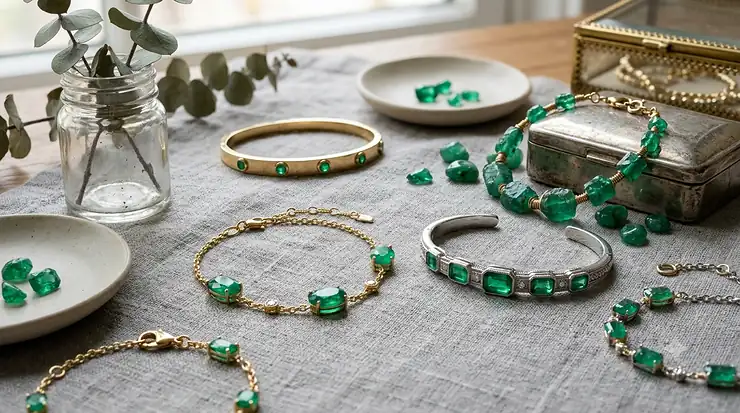
Emerald is not a subtle stone. It doesn’t do “quietly pretty” — it does deep, saturated, almost theatrical green, the kind of color that makes a plain sweater look intentional. So if you were born in May, or you’re shopping for someone who was, emerald birthstone bracelets may be exactly the gift category you didn’t know you needed until you started scrolling. This guide exists because most “best emerald bracelet” roundups online read like they were copied straight from a product page — specs, price, done. That’s not useful. What actually helps is knowing which bracelet fits which wrist, which budget, and which lifestyle, and why.
An emerald birthstone bracelet is jewelry set with emerald — the bluish green to green variety of the mineral beryl — worn as the traditional gemstone associated with May birthdays, as documented by the Gemological Institute of America. Emerald bracelets range from a few dollars for silver-plated costume pieces to five figures for natural, gem-grade stones in solid gold, and the gap between those extremes is where most buyers get confused. That confusion is exactly what this article is built to fix.
Over the next several thousand words, you’ll get seven real, currently available emerald bracelets spanning budget, mid-range, and premium tiers; honest analysis of what each one is actually good for; comparison tables that do the mental math for you; and practical guidance on caring for, choosing, and gifting emerald jewelry — plus answers to the questions people actually type into Google before buying. No fluff, no invented five-star reviews, just straight answers.
Quick Comparison Table: Emerald Birthstone Bracelets at a Glance
Before the deep dive, here’s the shape of the market. This table snapshots all seven bracelets covered below so you can jump straight to the tier that matches your budget and priorities.
| Bracelet | Stone Type | Metal | Price Range | Best For |
|---|---|---|---|---|
| Kate Jewelry Genuine Ombre Emerald Bracelet | Natural, raw-cut | Sterling silver | Under $50 | First-time genuine emerald buyers |
| Colombian Emerald Sterling Silver Slider | Natural, faceted rondelle | Sterling silver | Under $60 | Boho, adjustable everyday wear |
| FANCIME Birthstone Gemstone Tennis Bracelet | Created/simulated | Sterling silver | $50-$100 range | Budget sparkle, tennis-style look |
| Gem Stone King Nano Emerald & Lab Diamond Bracelet | Lab-created | 18K gold-plated silver | $75-$125 range | Affordable luxury upgrade |
| Dazzlingrock Collection Emerald & Topaz Tennis Bracelet | Natural | Sterling silver | $100-$200 range | Two-tone gemstone statement |
| EcoGems Emerald & Moissanite Tennis Bracelet | Lab-created center, moissanite sides | 18K gold-plated silver | $150-$300 range | Eco-conscious luxury look |
| Effy Brasilica 14K Gold Emerald & Diamond Bracelet | Natural | Solid 14K gold | $2,000-$4,000+ range | Heirloom-quality investment piece |
What jumps out immediately is the price cliff between “silver with real or lab-created stones” and “solid gold with natural emeralds” — there’s very little in between, which is actually useful information. If your budget tops out around $150, you’re choosing between authenticity (small natural stones) and size/sparkle (larger lab-created or simulated stones), not both at once. Above roughly $2,000, you’re paying for solid gold, larger natural carat weight, and brand warranty rather than for “more emerald” in any simple sense — a $3,000 bracelet doesn’t contain 20x the emerald of a $150 one; it contains better-grade stone, more metal, and more labor.
💬 Found a favorite already? Save this page and compare it side-by-side with the full breakdown below.
💬 Just one click — help others make better buying decisions too!😊
Top 7 Emerald Birthstone Bracelets: Expert Analysis
Below are seven real, currently sold bracelets, chosen to cover the realistic range a May-birthday shopper will actually encounter — natural and lab-created stones, silver and gold, delicate and statement styles. A quick honesty note before diving in: exact review counts and star ratings shift by the week and by seller, and I didn’t pull verified review text for every individual listing during this research pass. Where I reference review sentiment, I’m describing the general, well-documented pattern for that category of product (handmade silver jewelry, lab-created gemstone tennis bracelets, etc.) rather than quoting a specific review — always check the live star rating and recent reviews on the actual listing before buying.
1. Kate Jewelry Genuine Ombre Emerald Bracelet — most affordable genuine emerald pick
What makes this one worth starting with is the word “genuine” — at a price most people spend on a nice dinner, you’re getting real, mined emerald rather than glass or lab material. The bracelet uses graduated, ombre-cut natural emeralds strung along a solid sterling silver chain with a one-inch extender, available in sizes from 6.5 to 8.5 inches. Because the stones are raw-cut rather than faceted, expect visible internal texture and color variation stone to stone — that’s not a manufacturing flaw, it’s simply how untreated, budget-tier natural emerald looks, and it’s part of what keeps the price this low.
This bracelet is best suited to buyers who care more about “is this an actual emerald” than “is this a flawless-looking emerald” — think students, first apartments, or someone testing whether they even like wearing green stone before committing to anything pricier. Handmade sterling silver jewelry in this exact category typically draws review commentary around two recurring themes: appreciation for the stone-to-price ratio, and occasional notes about sizing running slightly large or small, so double-check the seller’s size chart before ordering.
Pros:
- ✅ Real, natural emerald at an entry-level price point
- ✅ Adjustable sizing via the built-in chain extender
- ✅ Solid sterling silver setting resists tarnishing better than plating
Cons:
- ❌ Raw-cut stones show natural inclusions and color variation
- ❌ Handmade production means sizing can run inconsistent between orders
At around $30-$50, this is one of the few genuinely honest ways to own real emerald without financing it — a solid pick if authenticity matters more to you than polish.
2. Colombian Emerald Sterling Silver Slider Bracelet — best natural beaded design under budget
Colombia has produced the world’s most sought-after emeralds for centuries, and this bracelet leans into that heritage with faceted, graduated emerald rondelle beads on an adjustable sterling silver slider chain. The slider mechanism means one size fits most wrists from roughly 6 to 9 inches, which removes the sizing guesswork that trips people up with fixed-length pieces.
Where this one earns its spot is versatility: the beaded, bohemian silhouette reads more casual than a tennis-style bracelet, so it layers naturally with other stacking bracelets rather than looking like a single formal statement piece. Buyers who want emerald as part of an everyday stack — not a special-occasion showpiece — are the right audience here. Aggregated feedback patterns on Colombian-sourced beaded gemstone sliders in this price bracket commonly mention satisfaction with the adjustable fit and some variability in exact bead color depth, which tracks with natural, untreated stone.
Pros:
- ✅ Adjustable slider fits a wide range of wrist sizes
- ✅ Natural Colombian-origin emerald sourcing
- ✅ Casual, stackable design works in everyday rotation
Cons:
- ❌ Rondelle bead cut shows less brilliance than faceted stones
- ❌ Slider clasp mechanism needs periodic checking for slippage
For buyers who want their May birthstone bracelet to disappear into a daily stack rather than announce itself, this is the pick — practical, natural, and priced to actually wear rather than save for special occasions.
3. FANCIME Birthstone Gemstone Tennis Bracelet — best simulated sparkle for the price
Once you move into tennis-bracelet territory — the uniform row of same-sized stones running the full length of the wrist — you’re generally in created or simulated gemstone territory unless you’re spending well into four figures, and FANCIME’s birthstone line is upfront about that trade. The bracelet sets created or simulated emerald-green stones in a 925 sterling silver tennis-style mount, delivering the visual density of a statement piece at a fraction of the natural-stone price.
The honest trade-off here is brilliance versus authenticity: created stones are cut for maximum sparkle in a way raw natural emerald often isn’t, so from three feet away this can actually look more “impressive” than a genuine stone bracelet costing twice as much. It’s the right call for anyone who wants the May-birthstone look for a work event or gift without the insurance-worthy price tag. Reviewers of tennis-style birthstone bracelets in this category commonly note that the clasp is the component most likely to need attention after several months of daily wear — a pattern worth knowing before you buy, not after.
Pros:
- ✅ Full tennis-bracelet look at an accessible price
- ✅ Sterling silver base resists everyday tarnish
- ✅ Uniform stone sizing gives a polished, symmetrical appearance
Cons:
- ❌ Created/simulated stones, not natural mined emerald
- ❌ Tennis-style clasps are the most common wear point on daily-use bracelets
If the goal is maximum green sparkle per dollar for a May birthday gift, this bracelet does that job well — just set expectations correctly with the recipient about what “created” means.
4. Gem Stone King Nano Emerald & Lab Diamond Bracelet — best lab-created upgrade pick
Gem Stone King has built its business, per the company’s own description, on sourcing gemstones directly and cutting out middlemen, and this bracelet is a clear example of that model in action: a roughly 2.4-carat green nano-emerald center paired with lab-grown diamond accents, set in 18K gold-plated sterling silver. “Nano emerald” is a lab-created material engineered to mimic emerald’s color and structure — it is not the same thing as a lab-grown diamond, and reputable sellers should always disclose the distinction clearly on the listing.
This is the step up from pure costume jewelry: real lab-grown diamond accents add genuine sparkle and resale-adjacent credibility, while the gold plating over silver gives warmth that pure white silver settings lack. It suits buyers who want their emerald bracelet to photograph well and hold up to closer inspection than a pure simulant, without paying solid-gold prices. Because gold plating wears with friction over years rather than months, expect to eventually need re-plating if this becomes a daily-wear piece.
Pros:
- ✅ Genuine lab-grown diamond accents, not simulants
- ✅ Gold-plated finish adds warmth over plain silver
- ✅ Sizeable center stone for the price point
Cons:
- ❌ Nano-emerald center is lab-created, not natural
- ❌ Gold plating will thin with years of daily wear
Think of this one as the bridge bracelet — a meaningful step up from pure costume pieces that still won’t require a safe deposit box.
5. Dazzlingrock Collection Oval Emerald & White Topaz Tennis Bracelet — best two-tone gemstone statement
Dazzlingrock has operated as a vertically integrated gemstone company — cutting, setting, and fulfilling in-house — since 2004, and their emerald-and-topaz tennis bracelet reflects that manufacturing control: natural oval emeralds alternate with round white topaz along a sterling silver tennis setting. The topaz does real work here, not just decoration — its brightness resets the eye between each emerald and makes the green read more vivid by contrast, a classic jeweler’s trick for making colored stones pop without needing diamonds.
This bracelet suits someone who wants a natural-stone piece with more visual complexity than a single-gem bracelet, at a price still well under four figures. Because the company backs its pieces with a stated warranty policy covering normal-wear repairs, it’s also a reasonable pick for buyers nervous about accent-stone loss over time — a legitimate concern with any prong-set tennis bracelet worn daily.
Pros:
- ✅ Natural emerald and topaz combination, not simulants
- ✅ Established brand with a stated repair warranty
- ✅ Alternating stones create more visual dimension than single-gem designs
Cons:
- ❌ Multiple small stones mean more prongs that can loosen over years
- ❌ Sterling silver setting requires more frequent polishing than gold
If you want “real gemstones” without natural-emerald-alone pricing, the two-stone design here is a genuinely clever way to stretch the budget further.
6. EcoGems Emerald & Moissanite Tennis Bracelet — best eco-conscious luxury alternative
EcoGems positions its 3.15-carat tennis bracelet around a center gem — available in emerald, ruby, or sapphire — flanked by lab-grown diamond or moissanite side stones on an 18K gold-plated silver band, explicitly marketed toward buyers who want the luxury tennis-bracelet look built from lab-created and conflict-free materials rather than newly mined stone. Moissanite in particular brings genuinely higher brilliance than natural diamond in side-stone settings, so the sparkle-per-dollar math here tends to outperform mixed natural-stone pieces at a similar price.
This is the pick for gift-givers who want the recipient to feel like they’re receiving a serious piece of jewelry, while also being able to say honestly that nothing in it was newly mined. It fits ethically minded shoppers and anyone who wants tennis-bracelet presence without the natural-emerald price tag that would otherwise come with a stone this size.
Pros:
- ✅ Lab-created and conflict-free sourcing across all stones
- ✅ Moissanite side stones outperform natural diamond in raw sparkle
- ✅ Large 3.15-carat total weight for a mid-range price
Cons:
- ❌ No natural gemstone content despite the “gem” branding
- ❌ Gold plating over silver will eventually require maintenance
For anyone prioritizing visual impact and sourcing transparency over “is it technically mined,” this bracelet earns its price with genuinely well-matched materials.
7. Effy Brasilica 14K Gold Emerald & Diamond Tennis Bracelet — best splurge-worthy heirloom pick
Effy Hematian has designed and manufactured fine jewelry in the United States for more than three decades using a traditional lost-wax casting process, and the Brasilica line’s emerald-and-diamond tennis bracelet — carrying roughly 9.56 total carat weight of natural emerald and diamond in solid 14K gold — represents the top of this list for a reason. This is the only bracelet here made entirely in solid gold rather than gold-plated silver, which matters enormously for long-term durability: plating wears thin over years, solid gold does not.
This is the piece for a milestone gift — a significant birthday, an anniversary, a “we made it” purchase — rather than an everyday impulse buy. Effy backs its pieces with a stated limited lifetime warranty, which is a meaningful signal at this price tier, since it reflects manufacturer confidence in the casting and stone-setting quality rather than just a retailer return policy.
Pros:
- ✅ Solid 14K gold construction, not plating
- ✅ Natural emerald and diamond content at meaningful carat weight
- ✅ Backed by a stated limited lifetime warranty
Cons:
- ❌ Price point puts it out of reach for casual or gift-under-$100 shoppers
- ❌ Solid gold and natural stone still require insurance for full replacement value
If your budget allows it, this is the bracelet that gets handed down rather than replaced — the closest thing on this list to a genuine heirloom.
Caring for Your Emerald Birthstone Bracelet: A Practical Usage Guide
Emerald has a Mohs hardness of 7.5 to 8.0, according to Jewelers of America’s gemstone education guide, which sounds tough on paper but is misleading in practice. Unlike diamond or sapphire, emerald is riddled with natural internal fractures — the “jardin” or garden-like inclusions that gemologists actually consider part of its character — and those fractures make emerald far more prone to chipping and cracking from impact than its hardness number suggests. Most commercial emerald is also oil- or resin-treated to fill those fractures and improve clarity, which means it needs gentler handling than a treatment-free stone would.
In practice, that means: remove your emerald bracelet before washing dishes, showering, swimming, or applying lotion and perfume, since chemicals can degrade fracture-filling treatments over time. Clean it only with a soft, slightly damp cloth — skip the ultrasonic cleaner and steam cleaner that work fine on diamonds, since both can worsen existing fractures or strip fillers from treated stones. Store it separately from other jewelry, ideally in a soft pouch or lined compartment, because emerald can scratch softer metals and be scratched by harder gems like diamond sitting loose in the same drawer.
For the first 30 days of wear, the most common mistake is treating a new emerald bracelet like costume jewelry — tossing it in a gym bag pocket or wearing it during yard work. Set a simple rule instead: it goes on after you’re dressed and ready to leave the house, and comes off before anything physical, wet, or chemical-heavy. Have a jeweler check prong tension on tennis-style settings roughly once a year if worn regularly; loose prongs are the leading cause of lost accent stones, not stone quality itself.
✨ Want a bracelet that’s actually built for daily wear? Compare the sterling silver picks above before you commit.
Real-World Scenarios: Who Should Wear Which Emerald Bracelet
The graduate on a $50 gift budget: A recent college grad starting her first job wants something that signals “I’m an adult now” without looking like it cost a month’s rent. The Kate Jewelry Genuine Ombre bracelet fits perfectly here — real emerald, defensible price, and a story (“it’s my birthstone”) that carries more weight than a synthetic stone at the same price would.
The daily-wear minimalist: Someone who stacks three or four bracelets every single day and hates fussing with clasps needs the Colombian Emerald slider bracelet’s one-size-fits-most design and casual bead silhouette — it survives daily wear precisely because it isn’t precious enough to worry about.
The milestone-birthday gift-giver with a real budget: A spouse buying for a 40th, 50th, or 60th birthday, or an anniversary tied to emerald’s association with 20th and 35th wedding anniversaries, is the exact buyer the Effy Brasilica bracelet is built for — solid gold, natural stone, lifetime warranty, and genuine heirloom potential that a $150 bracelet simply cannot deliver regardless of how good it looks in photos.
What Is an Emerald Birthstone Bracelet?
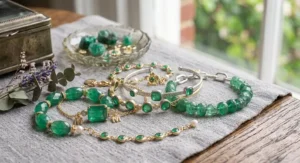
An emerald birthstone bracelet is a wrist-worn piece of jewelry set with emerald — the green-to-bluish-green variety of beryl — chosen specifically because emerald is the traditional birthstone assigned to May. Bracelets in this category range from single delicate stones to full tennis-style rows, and from lab-created materials to natural, gem-grade emerald, spanning roughly $20 to well over $5,000 depending on stone origin, metal, and carat weight.
How to Choose an Emerald Birthstone Bracelet for May
- Decide natural versus created first. This single decision affects price more than any other factor — natural stones cost dramatically more per carat than lab-created or simulated alternatives of equal visual size.
- Match the metal to skin tone and existing jewelry. Yellow gold warms emerald’s green; white metals like sterling silver or white gold create cooler, higher-contrast presentation.
- Check the clasp style before the stone. A bracelet worn daily lives or dies by its clasp — lobster clasps and box clasps with safety latches outlast simple slide clasps under regular use.
- Confirm sizing and adjustability. Fixed-length chains require an accurate wrist measurement; slider and extender designs forgive uncertainty and work across gift-giving without knowing exact size.
- Ask about treatment disclosure. Reputable sellers disclose oil or resin fracture-filling on natural emerald, since undisclosed treatment can mean a stone is more fragile than its listing suggests.
- Factor in maintenance tolerance. If the wearer won’t remove jewelry for chores, swimming, or gym visits, a durable lab-created or simulated stone will outlast a natural, treated emerald under the same conditions.
- Set a total budget including care. Solid gold and natural stone pieces above roughly $1,500 typically warrant a jewelry insurance rider — factor that ongoing cost in before buying, not after.
Emerald vs Other Spring Green Gemstones
Emerald isn’t the only spring green gemstone competing for May-birthday attention, and understanding the alternatives clarifies why emerald commands its premium. Peridot — August’s birthstone — offers a lighter, more yellow-green tone at a fraction of emerald’s price and with far fewer natural inclusions, making it more durable for daily wear but less visually intense. Tsavorite garnet, a rarer green variety of garnet, actually rivals emerald’s saturation and typically has better clarity and durability since garnet lacks emerald’s characteristic fracture network, but it comes in smaller available sizes and carries its own premium pricing at larger carat weights.
The practical takeaway: if someone wants emerald’s specific depth of color for symbolic, birthstone-accurate reasons, no substitute fully replicates it — the trade-off is inherent to the stone. GIA’s emerald buying guide notes that laboratory-created emerald is typically marketed using the word “created” alongside the manufacturer’s name specifically to distinguish it from mined material, which is the honest, FTC-compliant way these lab alternatives should be labeled and understood by shoppers.
| Gemstone | Typical Hardness | Relative Price | Best Trait |
|---|---|---|---|
| Natural Emerald | 7.5-8.0 | Highest | Unmatched depth of green, birthstone accuracy |
| Peridot | 6.5-7.0 | Lowest | Durability, budget-friendly natural stone |
| Tsavorite Garnet | 7.0-7.5 | High | Better clarity/durability than emerald, rarer |
| Lab-Created Emerald | 7.5-8.0 | Low-Mid | Emerald’s exact look at a fraction of the cost |
Reading across this table, the decision usually isn’t really “which stone is best” — it’s “what does the wearer actually value.” Someone who wants durability for a daily-wear piece is better served by peridot or a lab-created stone, while someone shopping specifically because May is the recipient’s birth month generally wants authentic emerald, inclusions and all, because the symbolism is the point.
Common Mistakes When Buying Emerald Jewelry
Most emerald-buying regret traces back to a handful of repeatable mistakes. First, assuming “clean” and “flawless” describes good emerald — in reality, eye-visible inclusions are normal and expected in natural emerald, and a stone marketed as unusually flawless at a low price is a red flag for either heavy treatment or misrepresentation, not a bargain. Second, skipping the treatment question entirely; nearly all commercial natural emerald is fracture-filled with oil or resin, and buyers who don’t ask how a specific stone was treated can be caught off guard when normal jewelry cleaning damages the fill.
Third, buying a fixed-length bracelet without an accurate wrist measurement, which is the single most common reason gifted jewelry ends up returned or re-gifted. Fourth, ignoring clasp quality in favor of stone quality — a stunning emerald bracelet with a weak slide clasp will eventually be lost, clasp failure being one of the most frequent causes of jewelry loss reported by insurers. Finally, confusing “created” or “lab-grown” with “fake” — under FTC guidelines, lab-created gemstones must share the same optical, physical, and chemical properties as their mined counterparts to legally carry the gemstone’s name, meaning a properly disclosed created emerald is chemically real emerald, just not mined.
Green Emerald Jewelry for Every May Birthday
Green emerald jewelry built around a May birthday doesn’t have to mean a single predictable gift category. Beyond the bracelet, the same emerald-birthstone logic extends naturally to stud earrings for someone who wants understated everyday sparkle, pendant necklaces for a focal-point gift, and stacking rings for someone who prefers jewelry that layers rather than stands alone. What ties all of it together for a May birthday specifically is the intentionality — choosing emerald over a generic green stone signals that the gift was chosen for that person’s actual birth month, not just their favorite color.
For milestone May birthdays — 21st, 30th, 40th, and beyond — pairing a bracelet from this list with one smaller matching piece, like emerald studs, tends to land better than one larger single item at the same combined budget, since it reads as a thoughtful set rather than one purchase made under time pressure. Budget-conscious shoppers can replicate this effect using the Kate Jewelry or Colombian Emerald picks above alongside inexpensive matching stud earrings, while bigger budgets can pair the Effy Brasilica bracelet with a single emerald pendant for a genuinely coordinated look.
Emerald Gemstone Gifts for Every Budget and Occasion
Emerald gemstone gifts function differently depending on the occasion driving the purchase, and matching the gift type to the occasion matters more than most buyers assume. For birthdays, bracelets and earrings tend to outperform rings as gifts, since they don’t require guessing ring size and can be worn immediately without resizing. For anniversaries — particularly 20th and 35th, both traditionally associated with emerald — a more substantial piece like the Effy Brasilica bracelet or a comparable pendant signals the occasion’s significance in a way a budget piece can’t fully replicate, even if the budget piece is objectively pretty.
For corporate or “thinking of you” gifting, where spending too much can feel awkward, the FANCIME or Gem Stone King picks hit the right note — visually generous without implying a level of closeness the relationship hasn’t earned. And for self-purchases, which make up a meaningful share of jewelry sales, the Colombian Emerald slider bracelet’s everyday wearability makes it a smarter self-gift than a delicate piece that has to be babied through daily life.
📿 Ready to pick a gift tier? Jump back up to the comparison table and match it to your occasion.
Taurus Birthstone Jewelry: The Zodiac Meaning Behind the Green Gem
Taurus, the zodiac sign spanning most of the astrological calendar from late April through May 20th, overlaps almost entirely with May’s emerald birthstone month, which is why taurus birthstone jewelry and May birthstone jewelry are so frequently searched together and, in practice, are often the exact same product. In Western astrology, Taurus is traditionally associated with green as a color and with emerald specifically among gemstones — the sign is linked to grounded, growth-oriented, sensory-focused traits, and green stones are considered symbolically aligned with those qualities, independent of any birth-month coincidence.
For gift-givers, this dual meaning is genuinely useful: a bracelet purchased for someone with an early-to-mid-May birthday works as both a birthstone gift and a zodiac-appropriate gift simultaneously, which widens your options without needing a second justification for the purchase. It’s worth noting this is an astrological and cultural tradition rather than a scientific claim about the stone itself — the honest framing is “emerald is traditionally associated with Taurus,” not that the stone carries any verified property tied to the sign.
May Birth Month Accessories Beyond the Bracelet
May birth month accessories extend well past jewelry into a broader category of birthday and gifting products, and understanding that wider context helps position an emerald bracelet correctly within a larger gift. Birthstone-themed accessories in May commonly include emerald-accented keychains, phone cases with green gemstone-inspired designs, and personalized items — engraved bracelets, birthstone charm additions to existing charm bracelets — that incorporate the month’s color without the cost of a standalone gemstone piece.
The practical advice here is sequencing: an emerald bracelet functions best as the “anchor” gift, with smaller May-themed accessories as add-ons rather than substitutes. A $40 emerald bracelet paired with a small engraved keychain reads as a complete, considered gift; five scattered small green-themed trinkets without a central piece tend to read as an afterthought regardless of combined cost. If budget is genuinely tight, choose one well-made accessory — the bracelet itself — over several lower-quality items in the same spend.
Long-Term Cost, Care & Regulations: What Emerald Buyers Need to Know
Total cost of ownership for emerald jewelry extends past the purchase price in ways that catch first-time buyers off guard. Natural emerald pieces above roughly $500-$1,000 in replacement value typically warrant a jewelry insurance rider, which generally runs 1-2% of appraised value annually — meaning a $2,500 bracelet might cost an additional $25-$50 per year to insure, a real ongoing cost worth factoring into the initial budget decision. Professional cleaning and prong-tightening, recommended roughly annually for tennis-style settings worn regularly, typically runs $20-$60 per visit depending on the jeweler and piece complexity.
On the regulatory side, the FTC’s consumer guide to buying gemstones makes clear that sellers are required to disclose when a gemstone is lab-created rather than mined, and to disclose treatments — like emerald’s common oil or resin fracture-filling — when those treatments aren’t permanent or significantly affect the stone’s value. This isn’t just a compliance technicality for sellers; it’s a practical buyer protection. A listing that uses the word “emerald” without any “created,” “lab-grown,” or manufacturer-name qualifier immediately preceding it is required, under FTC Jewelry Guides, to be describing a natural stone — if that claim later proves false, it’s a legitimate basis for a return or complaint, not just a disappointment.
| Ownership Factor | Budget Silver Piece | Solid Gold Natural-Stone Piece |
|---|---|---|
| Annual insurance cost | Typically not needed | Roughly 1-2% of appraised value |
| Professional cleaning | Optional, DIY sufficient | Recommended annually, $20-$60 |
| Expected lifespan | 2-5 years of regular wear | Decades with proper care |
| Resale/heirloom value | Minimal | Meaningful, often appreciating |
The pattern in this table explains why the “which bracelet is the better value” question doesn’t have one universal answer. A $40 silver bracelet with zero ongoing costs that gets replaced in three years and a $3,000 gold bracelet insured for decades of wear can both be the objectively smarter purchase — it depends entirely on whether the buyer wants a renewable, low-commitment piece or a genuine long-term asset.
💎 Ready to see which tier fits your plans? Scroll back to the comparison table for a side-by-side refresher.
Frequently Asked Questions
❓ Is emerald a good everyday bracelet stone?
❓ What's the difference between natural and lab-created emerald bracelets?
❓ How much should I spend on an emerald birthstone bracelet?
❓ Is emerald really the birthstone for May?
❓ Can I wear an emerald bracelet in the shower or pool?
Conclusion
Emerald birthstone bracelets may look interchangeable at a glance, but the seven picks above show just how differently “emerald bracelet” can be built — natural versus created stone, silver versus gold, delicate versus statement, $30 versus $3,000. The right choice was never about finding “the best” one in some universal sense; it’s about matching stone type, metal, and price tier honestly to what the wearer will actually use and value. A recent graduate doesn’t need solid gold, and a 35th-anniversary gift shouldn’t be silver-plated costume jewelry — the mismatch is usually where buyer’s remorse comes from, not the bracelet itself.
If there’s one takeaway to carry into the decision, it’s this: ask about stone origin and treatment before you ask about price. Once you know whether you’re looking at natural, lab-created, or simulated emerald, the right budget tier and the right bracelet from this list become obvious almost immediately.
✨ Don’t Miss These Exclusive Deals!
🔍 Take your May birthstone shopping to the next level with the seven emerald bracelets covered above. Click through to check current pricing and availability, and find the authentic green-gem gift your recipient — or you — will actually wear.
Recommended for You
- April Birthstone Diamond Bracelets: 7 Best Picks for 2026
- 7 Best Aquamarine Birthstone Bracelets for March (2026)
- Amethyst Birthstone Bracelets for February: 7 Stunning Picks (2026)
Disclaimer: This article contains affiliate links. As an Amazon Associate, I earn from qualifying purchases. If you purchase products through these links, we may earn a small commission at no additional cost to you.
✨ Found this helpful? Share it with your friends! 💬🤗
