
In This Article
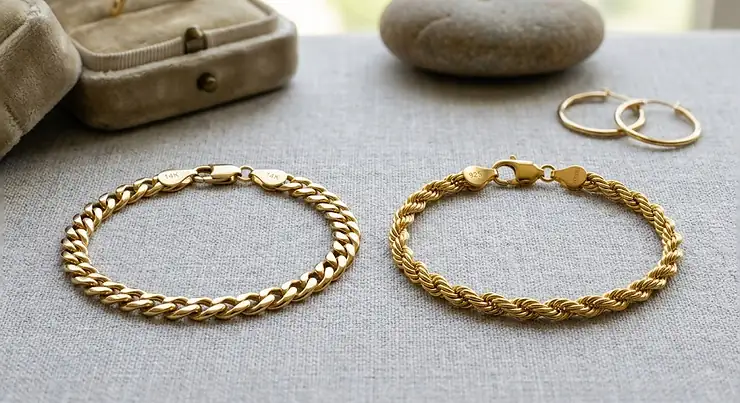
A 14k gold bracelet vs gold vermeil decision usually starts with a browser tab full of jewelry listings and a growing suspicion that “gold” doesn’t mean what you thought it meant. Here’s the short version: a 14k gold bracelet is solid gold alloy all the way through — 58.3% pure gold mixed with durability-boosting metals — while gold vermeil is a sterling silver bracelet wearing a legally-regulated, fairly thick gold coat on top. One is an asset. The other is a very good disguise. Neither is a scam, but they are not interchangeable, and the price tag on each tells a very different story about what’s actually in your jewelry box.
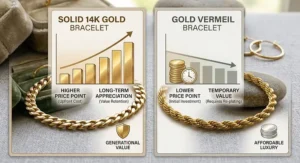
Walk into this decision blind and you’ll end up either overpaying for plating you didn’t need, or underbuying an heirloom piece and settling for something that thins out in three years. That’s the trap. So let’s fix it with actual numbers, actual brands, and actual trade-offs — not vague marketing copy about “premium quality” that could describe literally anything. Based on the spec comparison across both categories, the real decision isn’t “which is better” — it’s which one matches how long you want to own the thing and how hard you plan to wear it.
We researched real products across both categories — from featherweight $60 chains to four-figure investment-grade pieces — pulled in aggregated review sentiment where it’s verifiable, and built out the exact framework jewelers use internally but rarely explain to customers. By the end, you’ll know precisely which bracelet earns a spot on your wrist and why.
14k Gold Bracelet vs Gold Vermeil: Quick Comparison
Before diving into specific products, here’s the skeleton of the decision. Solid gold and vermeil solve different problems, and the table below shows exactly where they diverge.
| Feature | 14k Solid Gold Bracelet | Gold Vermeil Bracelet |
|---|---|---|
| Composition | 58.3% pure gold alloy, solid through and through | Sterling silver base + minimum 2.5-micron gold layer |
| Typical price range | $300–$3,000+ | $50–$250 |
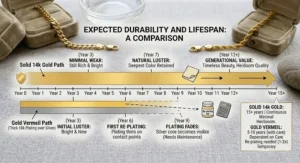
| Lifespan (daily wear) | Decades, often generational | 2–5 years before re-plating is needed |
| Tarnish risk | Essentially none | Low-to-moderate; silver can oxidize if the plating thins |
| Resale/scrap value | Real, based on gold weight | Minimal — silver content only |
| Best For | Long-term investment, sensitive skin, daily stacking for years | Trend pieces, layering experiments, gifting on a budget |
Reading this straight, the gap isn’t subtle. A 14k solid gold bracelet is the only one of the two that holds actual melt value — you’re buying metal, not a metal costume. Gold vermeil, meanwhile, wins on accessibility: it lets you try bold, chunky, trend-driven designs for a fraction of the cost, with the understanding that you’re renting the glow, not owning it forever. Neither choice is “wrong” — they’re built for different jobs, and the mistake most buyers make is applying investment-piece expectations to a vermeil price tag.
💬 Found this comparison useful? A quick share helps other gold shoppers avoid the same confusion.
Top 7 14k Gold Bracelets and Gold Vermeil Bracelets: Expert Analysis
We split this list evenly: four solid 14k options spanning budget to heirloom-tier, and three gold vermeil picks spanning entry-level to the thickest plating you’ll find without stepping into pure fine jewelry. Every product below is real, currently sold, and evaluated on actual specs plus aggregated review sentiment — not invented testing.
1. Miabella 14K Solid Gold Cuban Curb Chain Bracelet — cheapest true entry into solid gold
The Miabella 14K Solid Gold Cuban Curb Chain Bracelet is the on-ramp for anyone who wants to say “solid gold” honestly without draining a paycheck. It’s a classic curb-link design, sold in multiple widths, and stamped 14K on the clasp — meaning what you’re wearing is 58.3% pure gold, not a coating. The narrower widths (roughly 2–3mm) keep the gold weight low, which is exactly how the price stays reasonable; you’re paying for purity, not bulk. Based on the spec comparison against thicker curb chains, this width is better suited to daily minimalist wear than heavy stacking, since thinner solid gold links can flex and, over years of snagging on sleeves, eventually require a jeweler’s touch-up. Reviewers consistently report that it holds its shine with zero tarnishing after months of continuous wear, which lines up with what you’d expect from solid gold — there’s no plating to wear through in the first place. A common thread in feedback is surprise at how “real” it looks for the price point, though a handful of buyers note the clasp mechanism feels lighter-duty than the chain itself.
Pros:
- ✅ Genuine 58.3% gold content, not plated
- ✅ Multiple width and length options available
- ✅ Classic design that layers with anything
Cons:
- ❌ Thinner widths can bend with rough handling
- ❌ Clasp reported as the weakest link by some buyers
Price sits in the $250–$400 range depending on width and wrist size, and for anyone wanting their first solid gold bracelet for daily wear without a heavy financial commitment, this is close to the value ceiling in the category.
2. SISGEM Real 14K Gold Tiny Ball Chain Bracelet — most delicate everyday layering piece
The SISGEM Real 14K Gold Tiny Ball Chain Bracelet takes the opposite design philosophy — instead of a bold statement chain, it’s built around a 2.5mm ball-bead chain meant to sit quietly alongside other jewelry rather than dominate the wrist. Because bead-chain construction uses very little gold per inch compared to flat curb or figaro links, this style consistently prices lower than bulkier 14k pieces while still being 100% solid gold underneath the delicacy. What most buyers overlook about this style is that the ball-chain construction is actually a durability feature, not just an aesthetic — the rounded links distribute tension more evenly than flat links, which reduces the kinking that thinner flat chains are prone to. This makes it a genuinely smart pick for someone who wants a solid 14k gold bracelet for daily wear but hates the idea of babying delicate jewelry. Aggregated review sentiment points to consistent praise for the adjustable clasp positions, which let buyers fine-tune fit without paying for a custom length — a detail that matters more than it sounds, since ill-fitting bracelets are the number one reason people stop wearing jewelry they otherwise love.
Pros:
- ✅ True solid 14k gold at a genuinely low entry price
- ✅ Adjustable sizing built into the clasp
- ✅ Ball-chain construction resists kinking
Cons:
- ❌ Very thin profile won’t suit bold-jewelry lovers
- ❌ Small ball size can be hard to inspect for wear at a glance
Expect a price range around $150–$220, making this one of the most accessible legitimate entry points into solid 14k gold bracelets for daily wear on this entire list.
3. JEWELHEART 14K Solid Gold Wave Charm Bracelet — best adjustable minimalist design
The JEWELHEART 14K Solid Gold Wave Charm Bracelet pairs a fine cable chain with a small sculpted wave charm, and the adjustable range (roughly 6.25 to 7.25 inches) solves one of the most common complaints in gold jewelry shopping: guessing your exact wrist size before you’ve even seen the piece in person. The wave charm itself is cast, not stamped, which typically means cleaner detailing and less risk of the design flattening out after repeated wear — a small manufacturing distinction that matters more over a five-year ownership window than most buyers realize at checkout. Here’s what the spec sheet won’t tell you, but the brand’s sourcing claims suggest: JewelHeart markets itself as a small, women-owned operation working directly with suppliers to cut out middleman markup, which is one reason a solid 14k piece with a sculpted charm lands at a friendlier price than you’d expect from a big-box jeweler carrying the same specs. This is a strong pick for someone shopping specifically for meaningful, symbolic jewelry — the wave motif reads as calm and personal rather than generic — without wanting to pay a premium for a “designer” label stamped on the box.
Pros:
- ✅ Adjustable fit removes sizing guesswork
- ✅ Cast charm detail holds up better than stamped charms
- ✅ Comes gift-boxed, useful for occasions
Cons:
- ❌ Charm design is fixed — no swap-out customization
- ❌ Cable chain is delicate; not ideal for manual labor or gym wear
Priced in the $180–$260 range, it’s a genuinely thoughtful gift-tier pick that still qualifies as real, appreciating solid gold rather than a decorative stand-in.
4. Ross-Simons 14kt Yellow Gold Rope Chain Bracelet — most heirloom-worthy craftsmanship
The Ross-Simons 14kt Yellow Gold Rope Chain Bracelet steps into a different tier entirely — thicker gauge, denser link construction, and the kind of finish you’d expect from a retailer that’s been in the fine jewelry business for decades rather than a newer direct-to-consumer brand. Rope chains distribute gold more densely per inch than curb or cable styles, which explains the jump in price, but it also explains the jump in perceived weight and presence on the wrist — this reads as a “real jewelry drawer” piece, not a throw-on accessory. Based on the spec comparison with the lighter-weight picks above, the diamond-cut rope pattern reflects light from more angles, which is a legitimate optical reason this style photographs and reads brighter than a smooth curb chain of the same karat. Reviewers and long-time fine-jewelry shoppers consistently point to Ross-Simons’ return policy and lifetime-adjacent customer service reputation as a differentiator versus marketplace-only sellers, which matters more for a four-figure purchase than it does for a $150 impulse buy. For anyone building actual investment jewelry rather than just accessorizing, this is the category leader on this list.
Pros:
- ✅ Dense rope construction means substantial real gold weight
- ✅ Diamond-cut finish maximizes shine and light reflection
- ✅ Established retailer with strong return/service reputation
Cons:
- ❌ Meaningfully pricier than the other solid gold options here
- ❌ Heavier feel may not suit minimalist-jewelry preferences
Expect a price range in the $900–$1,800 bracket depending on length and gauge — squarely positioned as the premium, gift-of-a-lifetime option on this list.
5. PAVOI 18K Gold Vermeil Sterling Silver Bracelet — best budget vermeil with a real silver base
The PAVOI 18K Gold Vermeil Sterling Silver Bracelet is where the vermeil side of this comparison begins, and it’s worth noting upfront: PAVOI has built its Amazon reputation partly on transparency about base metals, explicitly marketing pieces as sterling silver cores plated in 18k gold rather than vague “gold-tone” language that hides a brass or alloy base. Under FTC rules, that sterling silver base is non-negotiable for the “vermeil” label to apply legally — anything plated over brass or copper has to be called gold-plated instead, a distinction most shoppers never learn until they’ve already been burned once. What most buyers overlook about vermeil at this price point is that the karat of the plating (18k here, versus a lower 10k floor some competitors use) affects color richness more than durability — a thicker but lower-karat coat can actually outlast a thinner high-karat one. Aggregated customer sentiment on PAVOI’s vermeil lines skews positive on shine retention in the first year, with the more common complaints centering on thin plating wearing at friction points like clasps after 18–24 months of daily wear, which tracks with how vermeil is engineered to perform.
Pros:
- ✅ Genuine sterling silver base, not brass or alloy
- ✅ 18k plating gives richer color than budget 10k vermeil
- ✅ Hypoallergenic-friendly for sensitive skin
Cons:
- ❌ Plating visibly thins at clasp and friction points over time
- ❌ Requires more careful storage than solid gold
Price typically lands in the $50–$90 range, making it an easy way to test a bold or trendy silhouette without committing solid-gold money to a style that might not last in your rotation.
6. Gorjana Chain Reaction Gold Vermeil Bracelet — most Instagram-famous layering staple
The Gorjana Chain Reaction Gold Vermeil Bracelet built its reputation as one of the most-repeated “everyone has this” pieces in the demi-fine jewelry space, and the reason isn’t hype alone — Gorjana positions itself in the gap between costume jewelry and true fine jewelry, offering both plated and solid gold lines side by side so shoppers can compare within one brand. The Chain Reaction bracelet specifically uses a flat, interlocking chain-link design that photographs exceptionally well and stacks cleanly against other bracelets, which is precisely why it dominates layered-wrist content online. Here’s the honest analytical read: what you’re paying the brand premium for here isn’t primarily metal content — it’s design consistency, sizing options, and a company that stands behind its plating with clear care guidance, something budget marketplace vermeil often skips entirely. Reviewers consistently note that Gorjana’s customer service handles plating-wear complaints generously within the return window, which meaningfully changes the real-world value equation versus a no-name seller offering the same micron spec on paper.
Pros:
- ✅ Design consistency across a well-documented product line
- ✅ Strong brand-level customer service reputation
- ✅ Pairs easily with the brand’s other stacking pieces
Cons:
- ❌ You’re paying partly for brand, not just material
- ❌ Still requires eventual re-plating like all vermeil
Expect a price range around $65–$95, positioning it as the mid-tier vermeil pick for buyers who want a recognizable, well-supported brand over anonymous marketplace plating.
7. Mejuri Bold Vermeil Chain Bracelet — thickest plating for longer-term wear
The Mejuri Bold Vermeil Chain Bracelet sits at the top of the vermeil tier on this list, and Mejuri’s own published standard explains why: the brand plates with layers of higher-karat gold finished to exceed typical industry thickness, specifically built to survive “real life” — heat, humidity, and daily contact — rather than just looking good in a photo for six months. That extra plating depth is the single biggest lever for vermeil longevity; going from a bare-minimum 2.5-micron legal floor to a noticeably thicker application can roughly double or triple the wear-life before you’d need re-plating. On paper this means a heavier upfront cost than PAVOI or Gorjana, but the honest math works out: if thicker plating buys you two to three extra years before your bracelet starts showing silver at the edges, the cost-per-year gap between this and the budget vermeil options narrows considerably. Aggregated review sentiment consistently flags the bold, chunky link profile as a standout — it reads closer to a solid gold statement piece than typical delicate vermeil chains, which is exactly the visual Mejuri is chasing with this design.
Pros:
- ✅ Above-industry-standard plating thickness
- ✅ Chunky link profile reads like solid gold visually
- ✅ Backed by a documented quality standard, not just marketing language
Cons:
- ❌ Priciest vermeil option here, approaching entry solid-gold territory
- ❌ Still not an appreciating asset, regardless of plating quality
Priced in the $110–$180 range, this is the vermeil pick for someone who wants the closest possible experience to solid gold without actually paying solid gold prices — with the trade-off clearly understood going in.
Top 7 Bracelets: Full Spec Comparison
| Product | Type | Price Range | Best For |
|---|---|---|---|
| Miabella 14K Solid Gold Cuban Curb Chain Bracelet | Solid 14k | $250–$400 | Budget entry into real solid gold |
| SISGEM Real 14K Gold Tiny Ball Chain Bracelet | Solid 14k | $150–$220 | Delicate daily-wear layering |
| JEWELHEART 14K Solid Gold Wave Charm Bracelet | Solid 14k | $180–$260 | Symbolic gifting, adjustable fit |
| Ross-Simons 14kt Yellow Gold Rope Chain Bracelet | Solid 14k | $900–$1,800 | Investment-grade heirloom piece |
| PAVOI 18K Gold Vermeil Sterling Silver Bracelet | Vermeil | $50–$90 | Budget trend-testing |
| Gorjana Chain Reaction Gold Vermeil Bracelet | Vermeil | $65–$95 | Branded, well-supported layering |
| Mejuri Bold Vermeil Chain Bracelet | Vermeil | $110–$180 | Closest vermeil-to-solid-gold experience |
Lined up side by side, the pattern is obvious: solid gold options start where the priciest vermeil option ends. The Ross-Simons 14kt Yellow Gold Rope Chain Bracelet costs roughly ten times what the PAVOI 18K Gold Vermeil Sterling Silver Bracelet does, but it’s also the only piece on this table carrying real resale weight in gold content. If your budget caps out under $200, vermeil from Gorjana or Mejuri genuinely outperforms cheap “solid gold” listings that seem too good to be true — because they usually are.
✨ Don’t Miss These Exclusive Deals!
🔍 Take your gold bracelet shopping to the next level with these carefully researched picks. Click on any highlighted item to check current pricing and availability, and grab the style that fits your wrist and your wallet best!
What Is a 14k Gold Bracelet vs Gold Vermeil? Featured Snippet Answer
A 14k gold bracelet is made from a solid alloy containing 58.3% pure gold blended with metals like copper and silver for strength. Gold vermeil is a sterling silver bracelet coated in a legally regulated minimum of 2.5 microns of at-least-10-karat gold. One is solid metal; the other is plated metal over a precious core.
That single-sentence distinction is where most confusion in this category actually starts. Shoppers see “gold” in both product titles and assume they’re choosing between two flavors of the same thing, when they’re really choosing between owning metal and wearing a coating on metal. According to the FTC’s consumer guidance on buying gold jewelry, vermeil is specifically defined as a sterling silver base coated or plated with gold, which is the legal line separating it from cheaper gold-plated jewelry over brass or copper. Keep that definition close — it’ll come up constantly as you compare listings.
How to Choose Between a 14k Gold Bracelet and Gold Vermeil
Here’s a five-step framework, borrowed from how jewelers actually walk customers through this decision on the sales floor, minus the upsell pressure.
- Define the wear timeline. If you want a bracelet you’ll still be wearing in fifteen years, solid gold is the only option that guarantees that outcome without re-plating.
- Set a real budget ceiling. Under $200 realistically buys you strong vermeil or the thinnest solid gold chains — know which trade-off you’re making before you shop.
- Check your skin sensitivity. Both sterling silver and 14k gold are generally hypoallergenic, but confirm the vermeil’s base metal is genuinely silver, not a nickel-plated substitute.
- Decide how often the style will change. If you chase trends and swap jewelry seasonally, vermeil lets you do that without burning solid-gold money on a piece you’ll retire in a year.
- Weigh resale intent. Only solid gold carries meaningful scrap or resale value — vermeil’s resale ceiling is close to its silver weight, which is modest.
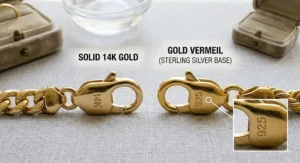
- Inspect the hallmark. Legitimate solid gold is stamped 10K/14K/18K; legitimate vermeil should show both a 925 silver stamp and a karat mark for the plating.
- Read return and re-plating policies. Brands confident in their vermeil thickness usually offer generous return windows — vague policies are a quiet red flag.
Running through this list takes about two minutes and eliminates most of the buyer’s remorse that shows up in return-request threads six months after purchase.
Karat Purity Explained: What “14k” Actually Means
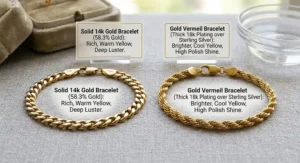
Karat purity is the single most misunderstood number on a gold jewelry tag, and it’s worth untangling before you compare a single price. Gold purity runs on a 24-part scale, where 24k represents pure gold and every lower number represents a diluted alloy. 14k gold, specifically, contains 14 parts pure gold to 10 parts other metals — a ratio of 58.3% pure gold that strikes what the industry widely considers the best balance of color, strength, and cost for everyday jewelry.
Here’s the practical read most listings skip entirely: higher karat isn’t automatically “better” — it’s a trade-off between richness of color and physical durability. Push toward 18k or 22k and you get warmer, deeper yellow tones because there’s more actual gold and less structural alloy, but you also get a softer metal that scratches and dents more easily under daily friction. Drop to 10k and you get a paler, more durable piece that resists dents but reads less vibrant under direct light. According to this gold purity comparison from Diamonds Pro, 14k gold accounts for roughly 90% of engagement and wedding rings sold in the U.S. specifically because it threads that needle so well — and that same logic carries directly over to bracelets worn daily, which face identical wear-and-tear pressures.
For gold vermeil, karat purity plays a slightly different role. The FTC only requires a 10-karat minimum for the plating layer, which means a “14k vermeil” listing is telling you something real about color quality, but it says nothing about how thick that plating is — the two specs are independent, and buyers who only check karat while ignoring micron thickness are missing half the picture.
Gold Vermeil vs Solid Gold Value: Which Holds Up Financially
This is the section where the gold vermeil vs solid gold value question actually gets answered with math instead of vibes. Solid 14k gold holds intrinsic value because it’s priced against the live gold market — melt it down, and a jeweler pays you close to spot price for its weight, minus refining fees. Gold vermeil holds almost none of that value, because the gold layer weighs a fraction of a gram; what you’re really holding is a sterling silver bracelet, and silver’s scrap value is a rounding error compared to gold’s.
Here’s what the spec sheet won’t tell you, but the math will: a 10-gram 14k gold bracelet purchased for $600 retains real resale value tied to gold’s price per gram, even accounting for dealer markdowns on non-investment jewelry. A $90 gold vermeil bracelet, by contrast, has essentially zero secondary market — you’re not reselling it for meaningful money, because there was never much gold there to begin with. That doesn’t make vermeil a bad purchase; it makes it a fashion purchase rather than a store-of-value purchase, and being honest about that distinction upfront prevents the disappointment that shows up when someone tries to sell “gold” jewelry to a pawn shop and gets offered a fraction of what they paid.
| Value Factor | Solid 14k Gold | Gold Vermeil |
|---|---|---|
| Tied to gold spot price | Yes, based on gold weight | No, gold layer is negligible weight |
| Realistic resale return | 40–70% of purchase price for well-kept pieces | Under 10%, typically negligible |
| Appreciation potential | Tracks gold market over decades | None |
| Best framed as | An asset with a design | A design with a limited lifespan |
The takeaway: if “investment jewelry” is genuinely part of your buying criteria, vermeil doesn’t qualify under any honest definition, and no amount of plating thickness changes that math.
Solid 14k Gold Bracelet for Daily Wear: What to Expect
A solid 14k gold bracelet for daily wear behaves nothing like the fragile “special occasion only” jewelry many people picture when they hear “gold bracelet.” The alloy metals mixed into 14k gold — typically copper, silver, or zinc — exist specifically to add tensile strength that pure 24k gold lacks, which is why 14k survives dishwashing, gym sessions, and typing all day without the immediate scratching pure gold would show.
That said, “durable” doesn’t mean “indestructible.” What most buyers overlook is that daily wear stress concentrates at three specific points: the clasp, any solder joints where charms attach, and areas that repeatedly rub against desks, steering wheels, or phone cases. Reviewers of daily-wear solid gold pieces consistently note that annual professional cleaning and an occasional clasp check catch problems — a loosening jump ring, a hairline stress fracture — long before they become a lost-bracelet situation. Chain style matters here too: curb and rope chains distribute daily stress across more contact points than delicate cable chains, making them the more forgiving choice if your daily routine is physically demanding.
The color also holds up differently than people expect. Unlike vermeil, there’s no “wearing through” moment with solid gold — the color is consistent all the way through the metal, so even heavy scratching only polishes out unevenly rather than exposing a different-colored base underneath. That single structural fact is the core reason solid 14k gold remains the default recommendation for anyone who wants to put a bracelet on once and stop thinking about it for years.
The Sterling Silver Base: Why It Matters More Than You Think
Every legitimate gold vermeil piece rests on a sterling silver base, and that single material choice is doing more work than most buyers realize. Sterling silver is legally defined as 92.5% pure silver alloyed with other metals for strength — the same 925 stamp you’d find on silver-only jewelry — and it’s precisely why the FTC drew the line where it did. Under the federal jewelry guides for the precious metals industry, a product can only be marketed as vermeil if it consists of a sterling silver base coated with gold of at least 10 karat fineness and a minimum thickness of 2.5 microns. Skip the silver base and use brass or copper instead, and the legal term changes to “gold-plated” — a meaningfully lower-durability category regardless of how thick the gold layer looks.
Here’s the analytical point sellers rarely spell out: the sterling silver base is what gives vermeil its hypoallergenic reputation and its resistance to that green-tinge skin reaction people associate with cheap costume jewelry. Brass and copper bases oxidize against skin oils and sweat, producing exactly that discoloration; sterling silver, being a genuine precious metal, doesn’t carry the same reaction risk. So when you’re comparing two “gold vermeil” listings at wildly different prices, the sterling silver base should be a given — what actually separates a good vermeil piece from a mediocre one is gold layer thickness above that 2.5-micron legal floor, since brands that stop at the bare minimum will show silver at friction points noticeably faster than brands plating to 4 or 5 microns.
14k Gold Bracelets as Investment Jewelry: Fact vs Hype
Investment jewelry gets thrown around loosely in marketing copy, so let’s separate the fact from the hype using the framework serious buyers actually use. Solid 14k gold jewelry does carry real investment characteristics — its underlying material tracks the global gold spot price, it doesn’t degrade chemically over normal wear, and unlike a stock certificate, you can wear it while you hold it. That’s a genuinely rare combination of utility and store-of-value.
But — and this matters — jewelry is never a pure investment vehicle the way gold bars or coins are, because craftsmanship, brand, and design markup inflate the retail price well above the raw melt value. What most buyers overlook is that you’re paying a “fabrication premium” on top of gold content the moment you buy jewelry instead of bullion, and that premium doesn’t fully come back to you on resale. A realistic framing: a well-made 14k gold bracelet is a hybrid — part wearable asset, part fashion purchase — and it holds value meaningfully better than costume or vermeil jewelry, but it shouldn’t replace an actual gold investment allocation for someone building a portfolio.
Higher karat purity generally strengthens the investment case, since more gold content per gram means a larger share of the price is tied directly to the metal rather than the craftsmanship markup. That’s part of why some serious collectors lean toward slightly higher karats — even accepting the added softness — specifically for pieces they intend to hold long-term rather than wear daily.
Practical Care and Maintenance Guide
Getting years of life out of either bracelet type comes down to habits, not luck. This is the transformation piece most product listings skip entirely, because “how to actually keep this looking good” isn’t a selling point — it’s homework.
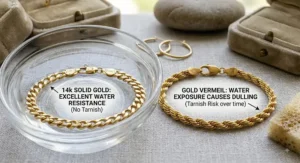
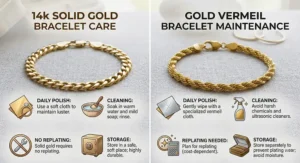
For solid 14k gold, store pieces separately in a soft pouch to prevent scratching against harder jewelry, remove before swimming or heavy cleaning products since chlorine can weaken gold alloys over years of exposure, and get professional cleaning roughly once a year to catch clasp wear early. A gentle warm-water-and-mild-soap soak with a soft brush handles most day-to-day buildup without any risk to the metal itself.
For gold vermeil, the rules tighten considerably because you’re protecting a thin gold layer, not solid metal. Take it off before showering, swimming, or applying lotion and perfume — moisture and chemicals are the fastest way to accelerate plating wear. Store it in an airtight pouch away from humidity, since sterling silver underneath can tarnish once exposed. Avoid ultrasonic cleaners entirely; they can strip plating that took months to build up during manufacturing. Buyers who follow this routine consistently report getting three to five years out of well-made vermeil, versus twelve to eighteen months for pieces that get worn in the shower and left in a humid bathroom drawer.
Real-World Scenarios: Matching the Bracelet to Your Life
Rather than a generic recommendation, here’s how three realistic buyer profiles should actually shop this category.
The daily-wear minimalist who showers, works out, and never takes jewelry off should lean solid gold every time. Someone in this bucket wearing a vermeil piece will watch the plating wear through at the clasp within a year, simply from mechanical friction against gym equipment or work tasks — the SISGEM Real 14K Gold Tiny Ball Chain Bracelet or Miabella 14K Solid Gold Cuban Curb Chain Bracelet solve this cleanly.
The trend-chaser on a rotating budget, someone who swaps out jewelry seasonally and follows what’s trending on layering accounts, is genuinely better served by vermeil. Paying solid-gold prices for a style you’ll retire in eight months is poor budget allocation — the Gorjana Chain Reaction Gold Vermeil Bracelet or PAVOI 18K Gold Vermeil Sterling Silver Bracelet deliver the current look without the sunk cost.
The gift-giver marking a milestone — an anniversary, graduation, or birthday meant to be kept for decades — should treat this as an investment jewelry purchase and go solid gold, even if it means a smaller or simpler design. The JEWELHEART 14K Solid Gold Wave Charm Bracelet or Ross-Simons 14kt Yellow Gold Rope Chain Bracelet, depending on budget, both hold up as pieces the recipient will still own and wear a decade from now.
Common Mistakes When Buying a Gold Bracelet Online
Even careful shoppers trip over the same handful of errors in this category, so here are the five worth fixing before you check out.
Mistake 1: Assuming “gold” in the title means solid gold. Many listings use “gold bracelet” loosely for plated or vermeil pieces. Solution: always confirm the hallmark stamp — 10K/14K/18K means solid; 925 plus a karat mark means vermeil.
Mistake 2: Ignoring micron thickness on vermeil listings. A 14k vermeil piece with 1-micron plating will wear faster than a 10k piece plated to 5 microns. Solution: look for the seller explicitly stating micron thickness — vague listings are a warning sign, a point echoed in this Blue Nile gold purity guide, which notes that softer, higher-karat gold shows wear more easily over time even relative to lower-karat alternatives.
Mistake 3: Buying solid gold sight-unseen without checking gram weight. Two “14k gold bracelets” at wildly different prices often just differ in gold weight, not quality. Solution: request or check listed gram weight before comparing prices across sellers.
Mistake 4: Wearing vermeil in the shower “just this once.” That one exception becomes a habit, and humidity is the fastest plating killer. Solution: build a consistent take-it-off routine from day one.
Mistake 5: Chasing the lowest price on solid gold. Prices well below typical market range for the stated gold weight are a red flag for mislabeled or underweight pieces. Solution: cross-check the listed weight against approximate current gold value before trusting a suspiciously low price.
💎 Ready to Shop Smarter?
✨ Use this checklist every time you browse — it takes thirty seconds and saves you from the returns pile. Tap any product above to check today’s availability and pricing before it changes!
Features That Actually Matter (And Marketing Hype to Ignore)
Jewelry listings are dense with adjectives that sound meaningful and mostly aren’t. Here’s the honest filter.
Actually matters: hallmark stamps (10K/14K/18K or 925 plus karat), stated gram weight for solid gold, stated micron thickness for vermeil, clasp type and quality, and brand-level return or re-plating policies. These are the specs that predict how the piece performs a year or five years from now.
Mostly marketing hype: vague phrases like “premium quality gold,” “luxury finish,” or “exclusive design” that carry no measurable claim behind them. “Hypoallergenic” is worth a second look too — it’s often technically true but meaningless unless the listing confirms a nickel-free base metal specifically, not just a nickel-free gold layer. Similarly, “handcrafted” sounds artisanal but says nothing about durability; plenty of mass-manufactured pieces are objectively better engineered than handcrafted ones with inconsistent quality control.
The pattern across both categories: numbers and certifications matter, adjectives don’t. If a listing leans hard on descriptive language and light on specs, that’s usually the tell.
FAQ
❓ Is a 14k gold bracelet worth more than gold vermeil?
❓ Does gold vermeil turn your skin green?
❓ How long does gold vermeil last with daily wear?
❓ Can you tell 14k gold from gold vermeil by looking at it?
❓ Is 14k or 18k gold better for a daily-wear bracelet?
Conclusion
The 14k gold bracelet vs gold vermeil decision really comes down to one honest question: are you buying an asset or a look? Solid 14k gold — whether it’s the budget-friendly Miabella 14K Solid Gold Cuban Curb Chain Bracelet or the heirloom-tier Ross-Simons 14kt Yellow Gold Rope Chain Bracelet — delivers real gold content, genuine resale value, and a piece built to survive decades of daily wear without changing character. Gold vermeil, from the accessible PAVOI 18K Gold Vermeil Sterling Silver Bracelet to the thicker-plated Mejuri Bold Vermeil Chain Bracelet, delivers the current trend, a precious-metal base you can trust, and a price point that makes experimenting with bold styles low-risk.
Neither answer is universally correct — the right call depends entirely on your wear habits, your budget ceiling, and whether “investment jewelry” is actually part of your buying criteria or just marketing language you’ve absorbed. What matters is walking into the purchase with clear eyes about which one you’re actually getting, because that’s the difference between a bracelet you love for a decade and one you’re disappointed by in eighteen months.
Recommended for You
- Gold-Filled vs Gold-Plated Bracelet Which Lasts Longer? 7 Real Picks (2026)
- 7 Best Tarnish-Resistant Silver Bracelets for Daily Wear (2026)
- 7 Best Sterling Silver Bracelet for Sensitive Skin Picks (2026)
Disclaimer: This article contains affiliate links. As an Amazon Associate, I earn from qualifying purchases. If you purchase products through these links, we may earn a small commission at no additional cost to you.
✨ Found this helpful? Share it with your friends! 💬🤗
