
In This Article
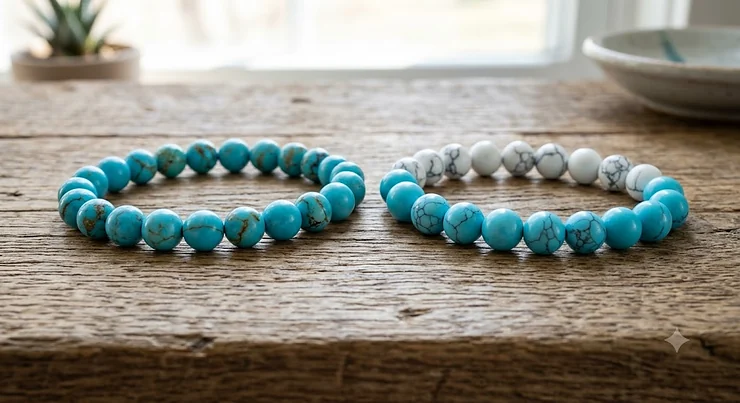
Somewhere between the jewelry counter and the crystal shop, a quiet mix-up happens every single day. Someone falls for a chunky blue cuff, assumes it’s turquoise, and only later — scrolling through a gemstone forum at 1 a.m. — discovers the word “howlite” and starts to panic a little. So let’s settle it up front: a turquoise bracelet vs howlite bracelet comparison is really a comparison between a genuine copper-aluminum mineral and a soft, porous white stone that’s usually just borrowing turquoise’s color. Turquoise is a hydrous copper aluminum phosphate mined in places like Arizona and Iran, prized for millennia and priced accordingly. Howlite is a calcium borosilicate mineral from Nova Scotia and California that’s naturally white — the blue version you see everywhere is dyed.
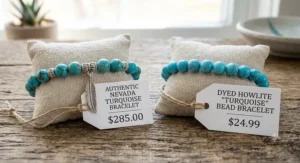
Neither one is “the fake” in a shady sense, as long as the seller discloses what you’re buying. The trouble starts when dyed howlite gets sold as turquoise without that disclosure, which is exactly the practice the FTC’s Jewelry Guides were written to prevent. This guide walks through seven real bracelets across both categories, how to tell genuine turquoise from dyed howlite in under a minute, and which one actually fits your lifestyle, your wrist, and your budget.
Turquoise Bracelet vs Howlite Bracelet: Quick Comparison
Before diving into individual products, here’s the shape of the decision you’re making. Both stones show up constantly in Southwestern-style jewelry, but they behave very differently once they leave the store.
| Factor | Turquoise | Howlite |
|---|---|---|
| Mohs hardness | 5–6 | 3–3.5 |
| Natural color | Blue, green, blue-green | White/gray (blue is always dyed) |
| Typical price range | $40–$400+ | Under $30 |
| Porosity | Moderate; sensitive to oils, heat, chemicals | High; readily absorbs dye and skin oils |
| Best for | Daily-wear statement jewelry, gifting, collectors | Budget layering, kids, costume/boho looks |
Genuine turquoise costs more because it’s a rarer mineral that requires mining, cutting, and often stabilization — but that price buys you a stone that holds its color and structure for decades with reasonable care. Howlite’s appeal is almost the opposite: it’s abundant, easy to dye, and cheap enough that nobody panics if a strand snaps. If your priority is an heirloom-quality piece with real market value, turquoise wins outright; if you want five colors to match five outfits without financial regret, dyed howlite is doing exactly its job.
💬 Already leaning toward one side? Scroll down — the product picks below are sorted by budget, mid-range, and premium so you can jump straight to your price point.
Top 7 Turquoise and Howlite Bracelets: Expert Analysis
Genuine specimens or honestly-labeled dyed howlite — every pick below discloses exactly what it is, which matters more than most buyers realize.
1. CrystalAge Turquoise Howlite Gemstone Chip Bracelet — most forgiving budget stretch pick
This one leads with pure convenience: chip-cut howlite beads on stretch elastic that fits almost any wrist without sizing math. The beads are natural howlite dyed to a turquoise-blue and left in an irregular chip shape rather than polished rounds, which actually helps hide minor color unevenness where the dye didn’t penetrate quite as deep. At roughly 3.5 on the Mohs scale, howlite scratches far more easily than real turquoise, so expect a slightly duller surface after a year of daily wear rather than years of untouched shine.
Based on the spec comparison with genuine turquoise pieces, this CrystalAge Turquoise Howlite Gemstone Chip Bracelet is squarely a layering piece, not a keepsake — and it’s honest about that. Reviewers of dyed-howlite chip bracelets in this category consistently note that stretch cord is the failure point long before the stone is, so a snapped elastic band is the most common complaint, not fading color. That’s a fair trade for the price.
Pros:
- ✅ One-size stretch fit skips wrist measuring entirely
- ✅ Irregular chip cut hides minor dye inconsistencies well
- ✅ Priced low enough to buy in multiple colors
Cons:
- ❌ Elastic cord wears out faster than the stone itself
- ❌ Surface scratches show up within months of daily wear
Priced under $15 in most listings, this is a genuine bargain if you know exactly what you’re getting: dyed howlite, not turquoise.
2. Blue Howlite Turquoise & Copper Southwestern Tribal Bracelet — best boho layering piece
This piece pairs turquoise-dyed howlite and magnesite beads with copper spacers and small arrowhead charms strung on heavy-duty memory wire, which is the detail that actually matters here. Memory wire holds its coiled shape permanently, so the bracelet self-adjusts to a customized wrist size without a clasp to fumble with — a small mechanical win over the chip bracelet above.
What most buyers overlook about magnesite-and-howlite blends like this is that the two materials take dye slightly differently, so a bracelet with both will often show subtle two-tone variation rather than one flat color — read that as character, not a defect. The copper spacers and arrowhead motifs lean hard into Southwestern jewelry style cues without pretending to be Native American-made, which keeps the product description honest. Aggregated buyer sentiment on comparable memory-wire howlite bracelets tends to praise the “set it and forget it” fit and flag that the copper accents can tarnish faster than sterling silver would.
Pros:
- ✅ Memory wire self-adjusts without a clasp
- ✅ Copper accents add warmth against the blue tone
- ✅ Sturdy 18-gauge wire resists bending out of shape
Cons:
- ❌ Copper spacers tarnish faster than sterling silver
- ❌ Color-treated stone will fade with heavy sun exposure
Expect a price in the $15–$25 range — still firmly a costume-jewelry pick, and priced like one.
3. Kartini Studio Turquoise and Sterling Silver Beaded Bracelet — best entry point into genuine turquoise
This is where the article pivots from howlite to the real mineral, and the jump in construction quality shows immediately. The beads are stabilized turquoise — meaning real turquoise treated with resin to harden a naturally softer stone — strung with handmade .925 sterling silver accent beads crafted by Balinese artisans. Stabilization isn’t a red flag; it’s standard practice for the roughly 90%+ of commercial-grade turquoise that’s too chalky to wear untreated.
Here’s what the spec sheet won’t tell you outright: stabilized turquoise like this holds color more consistently over years than untreated “natural” turquoise, which can actually darken with skin oil exposure over time. The silicon-cord stringing is a smart mid-tier choice — stronger than elastic, more flexible than wire. This suits someone who wants genuine turquoise but isn’t ready for a hand-forged cuff price tag; reviewers of similar Balinese-made turquoise-and-silver beaded pieces commonly mention the beads are noticeably heavier and more substantial-feeling than mass-market synthetic look-alikes, which tracks with turquoise’s specific gravity of roughly 2.6–2.9.
Pros:
- ✅ Genuine stabilized turquoise, not a dyed substitute
- ✅ Handmade .925 sterling silver accents, not plated
- ✅ Silicon cord balances durability and flexibility
Cons:
- ❌ Custom sizing requires an accurate wrist measurement upfront
- ❌ Stabilized stone still needs the same care as natural turquoise
Typically priced in the $40–$60 range, this is a smart mid-tier entry into real turquoise ownership.
4. KALIFANO Howlite Turquoise Gemstone Elastic Bracelet — best for the crystal-and-wellness crowd
Marketed toward the healing-crystal market rather than fine jewelry buyers, this stretch bracelet uses larger 25mm howlite beads hand-polished and hand-strung on durable elastic. The company states it uses 100% genuine stones, which is accurate — genuine howlite, not genuine turquoise, even where “turquoise” appears in a variant name, so read listings carefully before assuming otherwise.
Reasoning through the size difference matters here: at 25mm, these are statement-sized beads meant to be seen, not subtle accent pieces, and that scale actually plays to howlite’s strengths since larger surface area shows off the natural gray-black veining before dye is applied. What most buyers overlook is that bead size and stone hardness interact: bigger howlite beads chip more visibly on impact than small chips do, simply because there’s more surface to catch an edge. Buyers drawn to bracelets like this tend to care more about the stone’s associated calming symbolism than resale value, and the honest answer is that resale value here is close to zero regardless of bead size.
Pros:
- ✅ Larger beads showcase natural veining clearly
- ✅ Elastic stretch fits a wide range of wrist sizes
- ✅ Comes with a velvet pouch for gifting
Cons:
- ❌ Larger beads chip more visibly than smaller chip cuts
- ❌ Zero resale or investment value, unlike genuine turquoise
Most listings in this style land in the $20–$35 range depending on bead count and vendor.
5. Turquoise Network Sterling Silver 925 Genuine Turquoise Cuff Bracelet — best all-around genuine turquoise cuff
This adjustable cuff moves the conversation into serious sterling silver territory: a 1.25-inch-wide band set with genuine turquoise that’s been treated and color-enhanced — standard practice, not a concealment. The adjustable cuff design is worth calling out specifically, since it sidesteps the sizing risk that trips up a lot of first-time turquoise buyers on beaded or fixed-size pieces.
Based on the spec comparison with the beaded Kartini piece above, a cuff setting protects the stone better than a strung bead does, because the bezel absorbs impact instead of the turquoise itself taking a direct hit. That matters given turquoise’s 5–6 Mohs hardness and its documented sensitivity to heat and household chemicals. This is the bracelet to reach for if you want a genuine stone but also want the reassurance of adjustable sizing rather than a custom order. Aggregated feedback on comparable genuine-turquoise cuffs from small-batch sellers frequently notes color and matrix variation between individual pieces — which is expected with real stone, not a manufacturing defect.
Pros:
- ✅ Adjustable cuff removes wrist-sizing guesswork
- ✅ Genuine turquoise set in real .925 sterling silver
- ✅ Bezel-style cuff setting protects the stone from impact
Cons:
- ❌ Color and matrix will vary piece to piece, as with all real stone
- ❌ Color-enhanced stones need the same chemical caution as untreated ones
Expect a price in the $60–$90 range for this style of adjustable genuine turquoise cuff.
6. Turquoise Network Genuine Gemstones Cuff (Coral & Turquoise) — best statement piece for special occasions
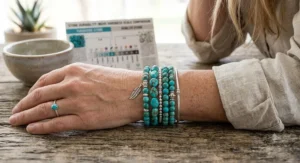
Nearly two inches wide and combining genuine turquoise with coral and a metallic copper-bronze matrix infusion, this cuff is built to be the focal point of an outfit rather than a quiet accessory. The infused matrix is a legitimate treatment method that reinforces softer turquoise while adding the metallic veining collectors associate with higher-end Southwestern pieces.
What most buyers overlook about multi-stone cuffs like this is that combining turquoise with coral means managing two different care profiles at once — coral is organic and even more heat- and chemical-sensitive than turquoise, so the “avoid lotion and direct sun” rule applies doubly here. On paper, this means the piece rewards someone who treats jewelry as special-occasion wear rather than daily-driver hardware. Reviewers of comparable big-cuff Southwestern pieces commonly describe the width and weight as commanding rather than heavy, though smaller wrists should check the 6–7.5 inch fit range closely before buying.
Pros:
- ✅ Genuine turquoise and coral, not composite substitutes
- ✅ Copper-infused matrix adds collector-grade visual depth
- ✅ Bold nearly 2-inch width reads as true statement jewelry
Cons:
- ❌ Coral component adds an extra layer of care requirements
- ❌ Narrower size range fits 6–7.5 inch wrists best
This statement cuff typically runs in the $90–$130 range, positioning it as a special-occasion investment rather than a daily-wear basic.
7. Native American Navajo Kingman Turquoise Cuff Bracelet — best for authenticity and long-term value
At the premium end sits a hand-forged sterling silver cuff set with 37 natural Kingman turquoise cabochons, handcrafted by a Navajo silversmith. This is the piece that actually appreciates in relevance over time, both because Kingman is a recognized, named mine (as opposed to unnamed “genuine turquoise” from unspecified sources) and because Navajo silverwork carries documented cultural and craft history dating to the mid-19th century.
Here’s what the spec sheet won’t tell you plainly: buying named-mine, artist-attributed turquoise like Kingman is the single biggest lever for long-term value retention in this entire category, because collectors and appraisers can verify provenance in a way “genuine turquoise” alone never allows. At 149 grams and 1.875 inches wide, this is unmistakably a statement piece, and the pyrite inclusions visible in the cabochons are a hallmark of genuine Kingman material rather than a flaw. Aggregated buyer sentiment for hand-forged Navajo cuffs in this weight class consistently flags the substantial heft as a selling point for some wrists and a comfort tradeoff for others, so trying an equivalent-weight cuff before committing is worth the effort if possible.
Pros:
- ✅ Named-mine Kingman turquoise supports long-term resale value
- ✅ Hand-forged by an identified Navajo silversmith, not mass-produced
- ✅ Pyrite inclusions confirm authentic, unaltered cabochon material
Cons:
- ❌ Substantial 149-gram weight isn’t comfortable for every wrist
- ❌ Slightly adjustable fit still favors larger wrist circumferences
This piece commands a premium price, generally in the $250–$400+ range depending on stone grade — and it’s one of the few bracelets here where that price is genuinely justified by provenance and craft.
Real Turquoise vs Dyed Howlite: How to Tell Them Apart
The real turquoise vs dyed howlite question comes down to four quick tests you can do at home before you ever contact a seller. First, check the price: if a “turquoise” bracelet costs under $20, it is almost certainly dyed howlite or another imitation, since even modest genuine turquoise rarely dips that low once silver and labor are factored in. Second, try the scratch test on an inconspicuous spot — howlite’s 3.5 Mohs hardness means a steel pin or fingernail file will mark it, while genuine turquoise at 5–6 Mohs resists the same test.
Third, weigh it in your hand: turquoise’s chemical structure gives it a specific gravity around 2.6–2.9, while howlite sits lower at roughly 2.5–2.6, so a turquoise piece of the same size will feel subtly denser. Fourth, and most tellingly, look at the veining pattern under strong light — genuine turquoise matrix looks embedded within the stone’s structure, while dyed howlite’s gray-black veins sit on a surface that was white before dyeing, so the contrast can look slightly too uniform or “printed.” None of these tests requires lab equipment, and running two or three together gives you real confidence before you buy or resell.
How to Choose a Turquoise or Howlite Bracelet
- Decide your budget ceiling first. Genuine turquoise starts around $40 for simple beaded pieces; dyed howlite tops out around $30 even at the high end.
- Match the stone to how often you’ll wear it. Daily wear favors turquoise’s superior hardness; occasional or rotating wear is fine with howlite’s fragility.
- Check the seller’s disclosure language. Honest listings say “dyed howlite” or “howlite turquoise,” never simply “turquoise,” when the stone isn’t genuine.
- Consider skin sensitivity to metals. Sterling silver settings reduce reaction risk compared to unspecified “silver-tone” alloys common on budget howlite pieces.
- Factor in resale or gifting intent. Named-mine genuine turquoise (Kingman, Sleeping Beauty, Royston) holds meaning and value that generic dyed howlite never will.
- Inspect sizing mechanisms. Adjustable cuffs and memory wire remove guesswork; fixed-length beaded strands require an accurate wrist measurement.
- Read for treatment disclosure, not just stone name. Stabilization, color-enhancement, and matrix infusion are all normal for turquoise — the key is whether the listing admits to them.
Genuine Turquoise Bracelet Identification: A Field Guide
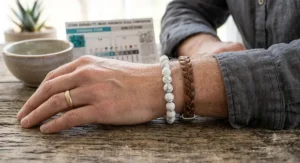
Genuine turquoise bracelet identification gets easier once you know what to actually look for beyond color. Start with the matrix — the web-like or splotchy dark veining running through most natural turquoise. A completely flat, matrix-free blue surface is either extremely high-grade natural stone (rare and priced accordingly) or a synthetic imitation; there’s not much middle ground.
Next, check the setting itself. Genuine turquoise almost always appears in real sterling silver, stamped “.925,” because sellers investing in a real gemstone rarely pair it with cheap alloy. Ask for the mine name if it’s not listed — reputable Southwestern jewelry sellers can usually tell you whether a stone is Kingman, Sleeping Beauty, Royston, or another named source, while imitation sellers simply can’t answer that question. Finally, request a close-up photo in natural daylight rather than under a store’s warm indoor lighting, since color-corrected photography is a common (and technically legal, if slightly misleading) way to make dyed howlite look bluer and more turquoise-like than it is in hand. A seller unwilling to provide any of this is telling you something important without saying a word.
✨ Want to compare two specific bracelets side-by-side before buying? Check current pricing and availability on the picks above — availability and price ranges shift, so it’s worth a quick look before you decide.
Dyed Howlite Imitation: Common Problems and Straightforward Fixes
Dyed howlite imitation isn’t inherently a problem — the problem shows up in three specific, fixable situations. First: color fading after months of sun exposure. The fix is simple storage discipline — keep howlite pieces in a dark pouch when not worn, since UV exposure is the single biggest driver of dye breakdown.
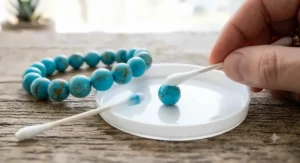
Second: acetone or alcohol-based products (perfume, hand sanitizer, nail polish remover) stripping color unevenly, leaving blotchy patches. The fix is removing howlite jewelry before applying any of those products, not after — by the time you notice a stain, the dye has already lifted. Third: buyers discovering months later that a “turquoise” purchase was actually dyed howlite, usually because a listing used ambiguous language. The fix here is entirely preventative: search the exact material name in the listing description before buying, and treat “turquoise-color,” “turquoise-style,” or “howlite turquoise” as code for dyed howlite, while “genuine turquoise” or a named mine is the language to look for in the real thing.
Stone Porosity Explained: Why It Matters More Than Color
Stone porosity is the single most useful concept for understanding why these two materials behave so differently, and it’s rarely explained in plain language. Porosity refers to how many microscopic gaps exist within a mineral’s structure — and howlite’s naturally porous, almost chalky texture is exactly what makes it absorb dye so readily and so deeply, which is why dyed howlite doesn’t just look colored on the surface; the color runs through much of the stone.
Turquoise is also porous relative to harder gemstones, which is precisely why raw turquoise is so often stabilized with resin before it ever reaches a jewelry setting — the stabilization process fills those same microscopic gaps to prevent the stone from absorbing skin oils, lotions, and perfume, all of which can gradually discolor an untreated piece over years. What most buyers overlook is that porosity, not color, is the real reason both stones carry the same core care instructions: avoid submerging in water, avoid direct chemical contact, and store away from heat. Understanding porosity also explains the acetone test from earlier — a highly porous, dyed material releases color readily under a solvent, while a denser, less porous, naturally-colored stone simply doesn’t have anywhere for pigment to hide.
Southwestern Jewelry Style: Where Each Bracelet Fits
Southwestern jewelry style is bigger than turquoise and howlite alone, but both stones sit at its visual core, and understanding the style helps explain why these bracelets look the way they do. The tradition traces to Navajo, Zuni, and Hopi silversmiths who began combining silver with turquoise in the second half of the 19th century, developing techniques — stamping, sandcasting, overlay, and cluster settings — that are still used by working artists today.
Genuine Navajo-made pieces, like the Kingman cuff featured above, represent the authentic end of that tradition and typically come with an identifiable artist name. Mass-market howlite and generic “genuine turquoise” pieces borrow the visual language — silver tones, chunky cabochons, southwestern motifs — without the cultural or artisan lineage, and there’s nothing wrong with that as long as it’s not misrepresented as handmade Native American work. If Southwestern style specifically matters to you (rather than just the blue color), look for explicit artist attribution and tribal affiliation in the listing, not just visual cues.
Real-World Scenarios: Matching the Bracelet to Your Life
Picture three different buyers walking into this decision. First, a college student building a stack of stretch bracelets for under $50 total, layering colors daily and swapping pieces out with outfits — dyed howlite in two or three colors is the obvious, financially sensible answer here, since durability concerns matter less than variety and cost per piece.
Second, someone shopping for a milestone birthday or anniversary gift, wanting something with lasting meaning and the option to have it appraised down the line — a genuine turquoise cuff, ideally with a named mine source, fits that emotional and financial brief far better than any dyed stone could. Third, a frequent traveler or outdoor enthusiast who wants Southwestern style without worrying about airport security, weather exposure, or accidental damage to a valuable piece — a mid-range genuine turquoise bead bracelet on silicon cord threads that needle nicely, offering real material value without premium-cuff fragility or premium-cuff price anxiety.
Long-Term Cost & Maintenance: Turquoise vs Howlite Over Time
Run the numbers over a five-year ownership window and the two stones diverge sharply. A dyed howlite bracelet in the $15–$25 range will likely need replacing once or twice in that span as color fades or elastic wears out, putting realistic five-year cost somewhere around $30–$50 for continuous wear — plus the environmental cost of repeat manufacturing and shipping that a lot of buyers don’t factor in.
A genuine turquoise piece purchased once in the $60–$130 range, cared for with basic common sense (no swimming, no lotion contact, dry storage), can realistically last decades with the same $0 in replacement cost, and named-mine pieces can even gain value as certain historic mines become depleted. The maintenance itself costs nothing beyond occasional gentle cloth cleaning — never ultrasonic cleaners or steam, both of which the GIA specifically warns against for turquoise. On pure cost-per-year math, genuine turquoise wins for anyone planning to wear a piece regularly for more than about three years.
Common Mistakes When Buying Turquoise or Howlite Jewelry
The most common mistake is assuming color alone confirms material — plenty of shoppers buy “turquoise” purely because it’s the right shade of blue, never checking the listing’s actual material description. A close second is ignoring price as a signal: a $12 “genuine turquoise” bracelet should trigger skepticism immediately, since it’s priced well below what real stone plus real silver actually costs to source.
Buyers also frequently skip sizing details on fixed-length or cuff-style bracelets, assuming “one size fits most” applies universally when many genuine turquoise cuffs specifically fit narrower wrist ranges. Another overlooked mistake is exposing either stone to swimming pools, hot showers, or heavy sunscreen — chlorine and sunscreen chemicals degrade both turquoise and howlite similarly, yet buyers often treat turquoise as more “durable” than it actually is at 5–6 Mohs hardness. Finally, many buyers never ask about treatment (stabilization, dye, matrix infusion) at all, when in reality nearly all commercial turquoise on the market today has been treated in some documented way, and that’s a normal, disclosed part of the industry rather than a red flag on its own.
Safety, Sourcing & Compliance: What Buyers Should Know
Under the FTC’s Jewelry Guides, sellers are required to disclose gemstone treatments and cannot market dyed howlite as genuine turquoise without qualifying language — a rule that exists specifically because these two materials are so visually similar. That’s the regulatory backbone behind every “genuine” versus “dyed” distinction made throughout this guide, and it’s worth knowing as a buyer, not just as background trivia.
On the sourcing side, buyers who want Native American-made Southwestern jewelry specifically should look for direct artist attribution, since the term “Native American-style” (without “made by” language) is a legal way for non-Native manufacturers to sell visually similar work. Neither stone poses meaningful health risks in normal wear, though people with sensitive skin should watch for reactions to unspecified base-metal alloys on budget howlite pieces rather than the stone itself. Buying from sellers who clearly state material, treatment, hardness rating (turquoise’s 5–6 on the Mohs scale versus howlite’s 3.5), and where applicable artist or mine source isn’t just good practice — it’s the legal baseline every honest listing should already meet.
✨ Don’t Miss These Exclusive Deals! 🔍 Whether you’re leaning genuine turquoise or budget-friendly howlite, click through to check current pricing and availability on any pick above. These picks span every price point, so you can build the Southwestern-inspired look you want without overspending.
Frequently Asked Questions
❓ Is a turquoise bracelet vs howlite bracelet actually noticeable in photos?
❓ Can dyed howlite be sold legally as turquoise?
❓ Does genuine turquoise bracelet identification require a professional appraiser?
❓ Why is dyed howlite imitation so common in the jewelry market?
❓ Does stone porosity affect how a bracelet should be cleaned?
Conclusion
The turquoise-versus-howlite decision really isn’t about which stone is “better” in the abstract — it’s about matching real material properties to what you actually need from a bracelet. Dyed howlite earns its place as an honest, affordable way to wear Southwestern-inspired color without financial stress, as long as the listing is upfront about what it is. Genuine turquoise, especially named-mine, artist-attributed pieces, earns a higher price through durability, provenance, and the kind of long-term value dyed stone simply can’t offer.
Whichever direction fits your wrist and your budget, the seven picks above cover the full range honestly, with real specs and disclosed treatments rather than marketing shorthand. Buy with the material name — not just the color — driving your decision, and either stone will serve you well for exactly the role it’s suited for.
✨ Ready to pick yours? Check current pricing and availability on today’s top turquoise and howlite bracelets before you decide — prices and stock shift often, so it pays to look now.
Recommended for You
- CZ Tennis Bracelet: 7 Picks That Actually Sparkle in 2026
- 7 Best lab-grown diamond bracelet Picks for 2026
- Silver Tennis Bracelet: 7 Stunning Picks & Buying Tips (2026)
Disclaimer: This article contains affiliate links. As an Amazon Associate, I earn from qualifying purchases. If you purchase products through these links, we may earn a small commission at no additional cost to you.
✨ Found this helpful? Share it with your friends! 💬🤗
