
In This Article
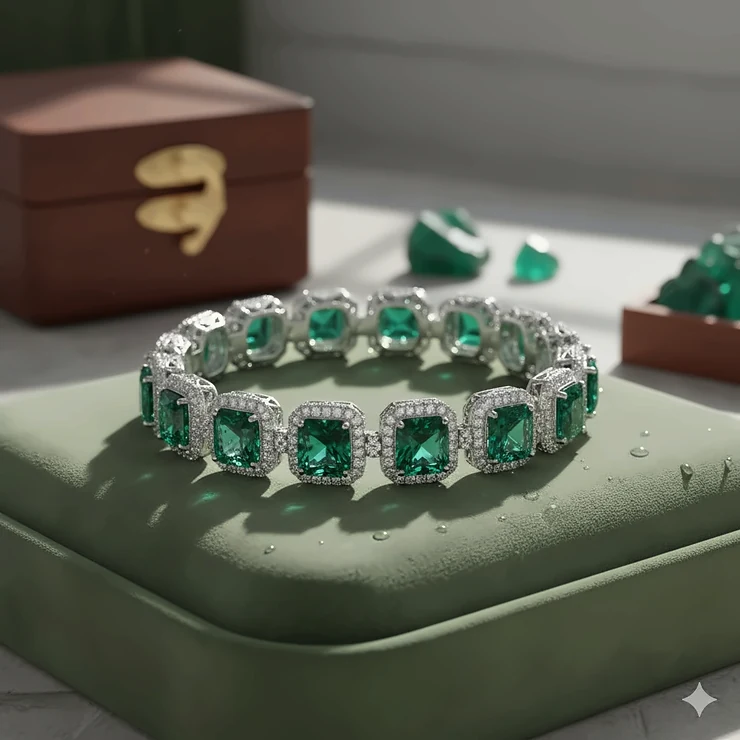
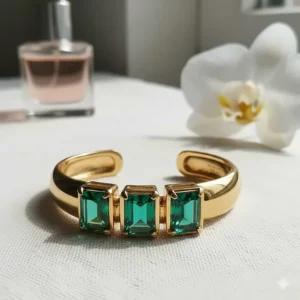
An emerald bracelet is wrist jewelry set with emeralds, the green variety of beryl, usually styled as a tennis line, bangle, bolo, or station design. The stones can be natural, lab-created, or simulated, and that one detail shapes price, durability, and care more than any other emerald bracelet feature.
Emerald is the May birthstone, and according to Jewelers of America it is also the traditional gem for 20th and 35th wedding anniversaries. That explains why gift shoppers keep circling back to it. But green is a tricky color to buy blind. Two bracelets can look identical in a thumbnail and behave completely differently on your wrist.
So this guide does the sorting for you. You’ll find seven real bracelets, from a budget-friendly simulated option to a 14k gold bangle. Each comes with the specs translated into plain English, honest notes on who it suits, and the trade-offs a product page tends to skip. Along the way you’ll see how an emerald and diamond bracelet differs from a pure-emerald design, and why the phrase “emerald bracelets” covers everything from a $90 fashion piece to a four-figure heirloom.
Affiliate note: this article contains affiliate links, explained in the disclaimer at the end. Product details come from published retailer listings and gemological sources. Listings, sizes, and availability change, so confirm specs on the current product page before you buy.
Emerald Bracelet Quick Comparison: 7 Picks at a Glance
| Bracelet | Stone Type | Metal | Clasp / Fit | Price Tier | Best For |
|---|---|---|---|---|---|
| Ross-Simons 4.10 ct. Emerald and Diamond Tennis Bracelet | Emerald with diamond accents | Sterling silver | Push-button clasp, 7″ | Mid-range | Classic tennis look |
| Ross-Simons 8.00 ct. Emerald Bracelet with Diamonds | Emerald with diamonds | Sterling silver | Box clasp, 8″ | Mid-range | Bigger green impact, larger wrists |
| Ross-Simons 4.90 ct. Emerald and 1.20 ct. Diamond Tennis Bracelet | Emerald with diamond accents | Sterling silver | Push-button clasp, 8″ | Mid-range | More sparkle, longer fit |
| Ross-Simons 4.50 ct. Emerald Bolo Bracelet with Diamonds | Emerald with diamonds | Sterling silver | Bolo (slide-style) | Mid-range | Easy sizing, gifting |
| Ross-Simons 3.70 ct. Simulated Emerald Tennis Bracelet | Simulated emerald and CZ | Sterling silver | Box clasp | Budget | Costume and occasion wear |
| Emerald-Cut Lab-Created Halo Tennis Bracelet | Lab-created green stones, lab-created white sapphire halo | Rhodium-plated sterling silver | Fixed length, not adjustable | Budget to mid (roughly $180-$270 range) | Statement look for less |
| 14k Gold Emerald & Diamond Bangle | Emerald with diamonds | 14k yellow gold | Rigid bangle | Premium (roughly $2,000-$3,400 range) | Long-term wear, stacking |
Read the table by tier and the story gets simple. Five of the seven picks use sterling silver, which keeps costs sane. The Ross-Simons 4.50 ct. Emerald Bolo Bracelet with Diamonds solves the “what size is she?” gift problem, while the 14k Gold Emerald & Diamond Bangle is the only one built with precious metal that won’t tarnish. If your priority is lowest risk and lowest cost, the Ross-Simons 3.70 ct. Simulated Emerald Tennis Bracelet wins, but it isn’t actual emerald.
💬 Just one click — help others make better buying decisions too!😊
Top 7 Emerald Bracelets: Expert Analysis
1. Ross-Simons 4.10 ct. Emerald and Diamond Tennis Bracelet — classic line with a secure push-button clasp
The appeal here is rhythm. Twenty-two round emeralds alternate with twenty-two round brilliant diamonds in polished sterling silver, so the green never gets crowded.
The listing totals 4.10 carats of emerald and 1.00 carat of diamond. Emerald is a lighter material than diamond, so a carat of it takes up more physical space, which means these stones read as clear green points of color rather than tiny flecks. The diamonds are graded I-J in color and I3 in clarity. In plain English, they are included and slightly warm, which is typical for accent stones, but you’re buying sparkle, not investment-grade diamonds. The push-button clasp is designed to latch flat against the bracelet, so nothing snags on a sleeve.
Based on the spec comparison, this is the sensible entry point for an emerald and diamond bracelet look without stepping up to gold. The I3 diamonds are the trade-off you accept for the sterling-silver price tier.
Public buyer-review data I could find for this exact style was thin, so rather than guess at themes, check the review page for comments on clasp security and color consistency.
Pros:
- ✅ Alternating emerald and diamond rhythm looks balanced
- ✅ Flat-latching push-button clasp resists snagging
- ✅ Sterling silver keeps the entry cost reasonable
Cons:
- ❌ Accent diamonds are low clarity (I3)
- ❌ Silver will need occasional polishing
Price: check the current listing. It sits in the mid-range for sterling-silver gemstone jewelry, and the value verdict is good if you want the look more than the carat bragging rights.
2. Ross-Simons 8.00 ct. Emerald Bracelet with Diamonds — the biggest green impact in this lineup
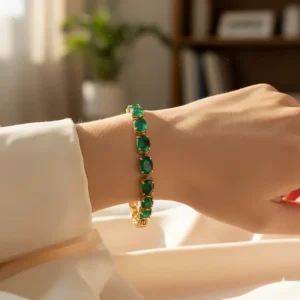
Eight total carats of gemstone is a lot of wrist. This is the pick for someone who wants the color to be the headline.
The 8-inch length is the detail most shoppers skim past. Most standard bracelets sit nearer 7 inches, so an 8-inch piece suits larger wrists, or anyone who likes a looser drape. On a smaller wrist it can slide around and flip, which exposes the clasp and makes the stones rub against surfaces. The box clasp, which tucks into a slot and typically adds a safety latch, is generally a sturdier choice than a simple hook for a bracelet this size.
My read: this is the emerald bracelet for people who find 4-carat tennis styles a bit polite. With more emerald weight, color saturation matters more, so study photos in natural light before committing, and confirm how the seller describes the stones’ treatment.
I couldn’t verify enough buyer reviews for this exact listing to summarize them honestly. Look specifically for comments on color (too pale, too dark) and whether the 8-inch length ran large.
Pros:
- ✅ High total gemstone weight for visual impact
- ✅ Box clasp suits a heavier bracelet
- ✅ Longer length fits larger wrists comfortably
Cons:
- ❌ Too loose for petite wrists
- ❌ Heavier feel than slimmer tennis lines
Price: check the current listing. It’s mid-range for the category, and the value is strongest if you actually need the 8-inch fit.
3. Ross-Simons 4.90 ct. Emerald and 1.20 ct. Diamond Tennis Bracelet — extra diamond sparkle on a longer fit
Think of this as the sibling of pick one, scaled up. You get 4.90 carats of round emeralds and 1.20 carats of diamonds in sterling silver, in an 8-inch length with a push-button clasp.
The extra diamond weight is the main difference. With more diamond between the emeralds, the bracelet throws more light and the green reads a touch softer. That’s a style choice, not a quality upgrade. If you love a bright, glittery tennis bracelet, this is the better match. If you want green to dominate, pick one or two will feel richer.
Here’s what the spec sheet won’t tell you: tennis bracelets live and die by flexibility. An 8-inch line with 44-plus stones needs links that articulate smoothly, so run your eye over buyer comments for any mention of stiffness or stones loosening. I found too little review data for this exact style to summarize, so treat that as your homework.
Pros:
- ✅ More diamond weight adds noticeable sparkle
- ✅ Push-button clasp lies flat on the wrist
- ✅ 8-inch length suits larger wrists
Cons:
- ❌ Green looks softer next to more diamond
- ❌ Long length may need sizing for small wrists
Price: check the current listing. It’s priced as a mid-range piece, and it’s worth it if sparkle matters as much as color.
4. Ross-Simons 4.50 ct. Emerald Bolo Bracelet with Diamonds — adjustable fit that makes gifting easy
A bolo bracelet slides to adjust, rather than fastening on a clasp. For gift buyers, that’s the headline: no wrist measurement required.
At 4.50 carats total in sterling silver, it balances emerald and diamond in a style that feels a bit more modern than a straight tennis line. Bolo-style closures also remove the most common failure point of any bracelet, the clasp. There’s nothing to pop open at a wedding or tangle in a coat sleeve.
The honest caution is wear. Any sliding mechanism has moving parts that can loosen over years, and an emerald bracelet that’s constantly adjusted gets more contact with desks and doorframes. Since emerald has only fair-to-good toughness according to the Gemological Institute of America, the safest habit is to set the fit once and leave it.
Reviewer data on this specific bolo wasn’t extensive enough for me to summarize responsibly, so scan buyer comments for the slide’s tension and how well the stones sit.
Pros:
- ✅ Adjustable slide fits many wrist sizes
- ✅ No clasp to fail or snag
- ✅ Modern alternative to a classic tennis line
Cons:
- ❌ Moving parts may loosen with long use
- ❌ Constant adjusting exposes stones to knocks
Price: check the current listing. It lands in the mid-range, and the value shines for gifts where fit is a gamble.
5. Ross-Simons 3.70 ct. Simulated Emerald Tennis Bracelet — the lowest-risk way to wear the color
Let’s be plain: this is not an emerald bracelet in the gemological sense. The listing is titled as simulated emerald with CZ stones in sterling silver, with a box clasp.
The U.S. Federal Trade Commission’s Jewelry Guides expect simulants to be identified as such, and this listing does it right in its own title. That honesty is worth noting because it shapes the value. You are paying for the look, not the gem, and the price tier reflects that.
The upside is practical. A simulated stone avoids the oil-filled-fracture issues that make natural emerald fussy, so you worry less about cleaning missteps. Think of it as a dress-up bracelet: weddings, holiday parties, or a “try the color first” experiment before investing in the real thing.
I didn’t find enough buyer reviews for this exact bracelet to summarize, so check recent comments for color accuracy, since simulated green can skew toward a more electric hue.
Pros:
- ✅ Most budget-friendly entry in this lineup
- ✅ No treatment or oil-care worries
- ✅ Clearly labeled as simulated
Cons:
- ❌ Not natural or lab-created emerald
- ❌ Color may look more uniform and electric
Price: check the current listing. It’s the budget pick, and it’s a fair deal as long as you buy it for fashion, not value retention.
6. Emerald-Cut Lab-Created Halo Tennis Bracelet — a 400-stone halo that looks pricier than it is
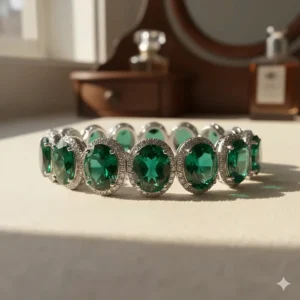
Nineteen emerald-cut green stones, each about 6 x 4 mm, sit in prongs and are ringed by a halo of roughly 400 lab-created white sapphires. The metal is rhodium-plated sterling silver.
The rhodium plating gives a bright white-metal finish and some resistance to tarnish, though plating can eventually wear on high-contact areas. The emerald-cut shape also quietly helps durability. Rectangular step cuts with protected corners tend to handle knocks better than pointed shapes, which matters for a stone that is already toughness-challenged.
This is the one pick where I could find real review sentiment, and it’s a small pool of about a dozen ratings. Reviewers consistently praise the expensive look and light weight, and several call the clasp sturdy. The recurring complaints: the length isn’t adjustable, so some buyers needed resizing, and a few found it fiddly to get on and off. Given the small sample, treat that as directional, not definitive.
Pros:
- ✅ Dense halo gives a high-end look
- ✅ Light on the wrist for its stone count
- ✅ Reviewers describe the clasp as sturdy
Cons:
- ❌ Fixed length may need resizing
- ❌ Can be fiddly to fasten
Price: roughly in the $180-$270 range for emerald-cut halo variants at the time of research, so check the current price. Value is strong for an occasion piece.
7. 14k Gold Emerald & Diamond Bangle — premium metal that’s built to stay
This is the grown-up of the group. Five pear-cut emeralds (about 5 x 3 mm each) share a 14k yellow gold bangle with 41 round diamonds in a tennis pattern, graded G-H color and I1 clarity.
Look closely at the numbers and the story changes. With forty-one diamonds and five small emeralds, the diamonds do most of the work and the emeralds act as color punctuation. That’s a legitimate design, particularly for stacking, but if you want a green-dominant emerald and diamond bracelet, picks one through four deliver more emerald per wrist-inch.
Solid gold is the real upgrade. It won’t tarnish like sterling, it can be resized or repaired by a jeweler, and it holds up to daily wear better than plating. The listing I found displayed a customer rating near the top of the scale, though I couldn’t gather enough individual reviews to extract themes.
Pros:
- ✅ 14k gold doesn’t tarnish like silver
- ✅ Stackable bangle design pairs with other pieces
- ✅ Better diamond grade than the silver options
Cons:
- ❌ Emeralds are small accent stones
- ❌ Rigid bangle is less forgiving on fit
Price: roughly in the $2,000-$3,400 range at the time of research, so check the current price. It’s good value if you’ll wear it for decades rather than seasons.
✨ Don’t Miss These Exclusive Deals!
🔍 Take your jewelry collection to the next level with these carefully selected pieces. Click on any highlighted bracelet to check current pricing and availability. A little green on the wrist goes a long way!
How to Care for Your Emerald Bracelet: The First 30 Days and Beyond
Amazon listings don’t teach you this part, and it’s where most disappointment starts. Emerald scores 7.5 to 8 on the Mohs scale, but GIA’s care guidance rates its toughness as fair to good, which means it chips more easily than ruby or sapphire. Hardness resists scratches. Toughness resists breaks. Emerald is strong at the first and merely decent at the second.
Week one: learn the fit. Wear it for a couple of hours at home. Check whether the clasp stays closed and whether stones catch on knits. If the bracelet spins or flips, it’s too loose.
Weeks two to four: build the habits.
- Put it on last, after perfume, hairspray, and lotion. Chemicals can affect the oils or resins used to fill fractures.
- Take it off for workouts, dishes, gardening, and anything that involves hot water or heavy hand use.
- Store it in a soft pouch, away from harder gems that can scratch the metal.
Cleaning routine. GIA notes that some estimates put fracture-filled emeralds at 90 percent or more, which is why ultrasonic and steam cleaners are risky: vibrations can weaken fractured stones and heat can push filler out. Warm, soapy water with a soft brush and a lint-free cloth is the safest method. Skip the jewelry-store tank unless you’ve confirmed your bracelet is safe for it.
The most common first-month mistake. Wearing it in the shower. Heat and detergents are the enemy, and silver tarnishes faster in humid bathrooms too. Treat your emerald bracelet like a silk blouse, not a gym watch.
Real-World Scenarios: Matching an Emerald Bracelet to Your Life
Specs mean nothing until they meet a life. Here are three profiles, with the reasoning shown.
Scenario 1: The May birthday gift on a modest budget. You’re buying for a sister whose wrist size you can’t confirm, with roughly $100-$300 to spend. The Ross-Simons 4.50 ct. Emerald Bolo Bracelet with Diamonds solves sizing, while the Emerald-Cut Lab-Created Halo Tennis Bracelet gives you a more dramatic look if you can find out her size. If budget is tighter, the Ross-Simons 3.70 ct. Simulated Emerald Tennis Bracelet keeps the color and lowers the stakes.
Scenario 2: The 20th-anniversary milestone. Since emerald is the traditional 20th-anniversary gem, this buyer wants something meaningful, worn weekly rather than yearly. Here the 14k Gold Emerald & Diamond Bangle earns its price: gold survives repeated wear and can be serviced. The compromise is that the emeralds are small accents, so confirm that’s the look she wants.
Scenario 3: The dressy-occasions collector. She wears jewelry to weddings and dinners maybe a dozen times a year and wants volume. The Ross-Simons 8.00 ct. Emerald Bracelet with Diamonds gives presence, and low-frequency wear is kind to sterling silver and emerald alike. Add a soft pouch and an annual polish and it will look sharp for years.
The pattern: frequency of wear matters more than carat weight. Daily wear favors metal quality and a secure clasp. Occasional wear favors drama.
Problem and Solution Guide: Fixing Common Emerald Bracelet Headaches
Problem: “The bracelet keeps flipping on my wrist.” The fix is length. A bracelet that’s too long slides and rotates. Measure your wrist, add roughly half an inch for comfort, and consider a jeweler’s resizing for fixed designs such as the halo tennis style, since several reviewers mention needing it.
Problem: “My sterling silver bracelet looks dull.” That’s tarnish, a normal reaction between silver and air or moisture. A soft polishing cloth handles light tarnish. Avoid soaking the whole bracelet in harsh dips if emeralds are in it, because chemicals and long immersion can disturb filled fractures.
Problem: “I’m afraid I’ll chip the stones.” Choose protective cuts and settings (emerald cuts and bezels fare well), avoid stacking it with hard metal cuffs, and take it off for chores.
Problem: “The green looks different in photos than in person.” Lighting and screens distort green more than most colors. Compare daylight photos, read buyer comments about color, and check the return window.
Problem: “I can’t tell if it’s real emerald.” Read the product title and description closely for the words lab-created, simulated, or natural. Sellers are expected to disclose these, and a missing disclosure on a bargain is a reason to move on.
How to Choose an Emerald Bracelet: 7 Steps
- Decide the stone type first. Natural, lab-created, or simulated. This sets your price floor, your care needs, and how you describe the gift. Lab-created emerald shares natural emerald’s chemistry and hardness, while simulated stones are imitations.
- Set your wear frequency. Daily wear needs gold or sturdy plating and a secure clasp. Occasional wear gives you room to choose sterling silver.
- Check the length and closure. Measure your wrist and add about half an inch. Box clasps with safety latches suit heavier bracelets, and bolo styles forgive sizing guesses.
- Judge the color in daylight. A deep, even green is prized, but a stone that’s too dark looks black indoors and one that’s too pale looks washed out.
- Ask about treatment. Most natural emeralds are oil- or resin-filled. A reputable seller discloses it, and the more enhancement present, the less you should pay.
- Look for a lab report on expensive natural stones. The GIA Emerald Buying Guide explains that GIA doesn’t grade emeralds but issues identification reports describing their characteristics, and it can give an opinion on origin.
- Read the return policy. Fine jewelry is personal, and a fair return window is your safety net.
Emerald and Diamond Bracelet: What the Pairing Really Does
An emerald and diamond bracelet isn’t just a prettier combination. It’s a functional one. Diamonds are tougher than emerald, so in a tennis-style layout they frame and separate the green stones, which spreads visual weight and reduces direct stone-to-stone contact. White stones also make green look more saturated by contrast, which is why the pairing feels richer than emeralds alone.
But the diamond quality matters, and listings rarely lead with it. In the Ross-Simons 4.10 ct. Emerald and Diamond Tennis Bracelet, the accent diamonds are listed at I-J color and I3 clarity, a spec that tells you they’re there for sparkle and framing. In the 14k Gold Emerald & Diamond Bangle, the diamonds are G-H color and I1 clarity, a clear step up.
Here’s the buying rule I’d use: decide whether you want green-forward or sparkle-forward. If an emerald and diamond bracelet is meant to show off the gem, choose a lower diamond-to-emerald ratio, like the Ross-Simons 8.00 ct. Emerald Bracelet with Diamonds. If you want something brighter and more versatile, higher diamond weight, as in the Ross-Simons 4.90 ct. Emerald and 1.20 ct. Diamond Tennis Bracelet, delivers it.
Features That Actually Matter (And Those That Don’t)
What matters:
- Setting protection. Bezels and well-formed prongs matter more than carat weight for a stone that chips.
- Clasp quality. A bracelet is only as safe as its clasp. Box clasps with safety latches and flat push-button clasps are both reasonable choices.
- Disclosure. Clear naming of natural, lab-created, or simulated stones is worth more than any sparkly marketing phrase.
- Metal. Gold doesn’t tarnish, and rhodium plating offers a bright white finish, but plating can wear.
What matters less than you think:
- Total carat weight. It’s easy to compare, but it says little about color or clarity. Emerald is lighter than diamond, so the same carat weight looks bigger.
- Stone count. Hundreds of tiny stones, like the halo design’s roughly 400 lab-created sapphires, create glitter but add tiny prongs to snag and maintain.
- “Genuine” language. Without a stone type, it’s decoration.
If you remember one filter, make it this: buy the clasp and setting you trust first, and the color second. A beautiful bracelet that falls off your wrist is a very expensive lesson.
Emerald Bracelet vs. Alternatives: Natural, Lab-Created, and Other Green Gems
| Option | Look | Durability | Care Level | Best For |
|---|---|---|---|---|
| Natural emerald | Deep, vivid green with natural inclusions | Hardness 7.5-8, fair-to-good toughness | High: avoid ultrasonic and steam | Heirloom buyers, as in the 14k Gold Emerald & Diamond Bangle |
| Lab-created emerald | Brighter, cleaner green | Same hardness as natural, 7.5-8 | Moderate | Budget statement pieces like the Emerald-Cut Lab-Created Halo Tennis Bracelet |
| Simulated emerald | Uniform green | Varies by material | Low | Costume wear, like the Ross-Simons 3.70 ct. Simulated Emerald Tennis Bracelet |
| Tsavorite or green tourmaline | Vivid green, different undertone | Hardness around 7-7.5, more durable in practice | Low to moderate | Daily wear |
| Green sapphire | Muted to teal green | Hardness 9 | Low | Active wearers |
The honest takeaway: emerald trades durability for beauty. If you’re hard on jewelry, tsavorite garnet or green sapphire can give you green with less worry, though neither replicates emerald’s classic hue. For everyone else, a protective setting and gentle habits make an emerald bracelet entirely livable. Lab-created stones are the sweet spot for value, as long as the seller names them as lab-created.
Common Mistakes When Buying Emerald Bracelets
Mistake 1: Chasing carat weight. Total carat numbers are easy to market, but color and clarity drive beauty. A smaller, evenly colored emerald often outclasses a bigger, pale one.
Mistake 2: Ignoring treatment. Most natural emeralds are enhanced with oil or resin to hide fractures. That’s industry-standard, but labs describe the degree as none, minor, moderate, or significant, and heavier treatment should mean a lower price.
Mistake 3: Skipping the length. Many emerald bracelets are listed at 7 inches, while some, like the Ross-Simons 8.00 ct. Emerald Bracelet with Diamonds and the Ross-Simons 4.90 ct. Emerald and 1.20 ct. Diamond Tennis Bracelet, run 8 inches. Measure before you click.
Mistake 4: Treating “emerald” as a guarantee of natural. Check for words like lab-created, simulated, or CZ in the title. If the word “emerald” appears with no qualifier at a suspiciously low price, ask questions.
Mistake 5: Buying for daily wear without daily-wear metal. Sterling silver is lovely, but it tarnishes, and plating wears. If you’ll wear it every day for years, gold is the more honest investment.
Mistake 6: Using the wrong cleaner. Ultrasonic cleaners and steam can damage filled emeralds, according to GIA. When in doubt, use warm soapy water.
Emerald Bracelet Treatments, Disclosure, and U.S. Rules
Here’s the quiet reason emerald shopping can feel murky: the gem is usually treated, and the market is built around disclosure rather than purity. Treatments such as oiling are widely accepted in the trade, and sellers are expected to tell you about them, especially when they affect durability or value.
For lab-created and simulated stones, the Federal Trade Commission’s Jewelry Guides are the key reference. As JCK’s coverage of the revised Guides explains, the Guides were updated to clarify how the trade can describe lab-grown stones and treatments, and they still call for clear, prominent disclosure of a stone’s origin. Accepted qualifiers include laboratory-grown, laboratory-created, and manufacturer-created, and unqualified words like “real,” “natural,” or “genuine” are discouraged for lab-grown diamonds.
What this means for you in practice: read the product title, not just the bullets. A trustworthy listing for a lab-created emerald bracelet names that clearly, and a simulated stone should be called simulated. If a listing leans on vague wording, treat it as a signal to look elsewhere. The Ross-Simons 3.70 ct. Simulated Emerald Tennis Bracelet is a good example of clean naming, since the word “simulated” appears right in the title.
Long-Term Cost and Maintenance of an Emerald Bracelet
The sticker price is only the first line of the ledger. Over five to ten years, an emerald bracelet carries a few ongoing costs.
Sterling silver pieces need polishing and occasional professional checks of the clasp and prongs. These are small, cheap chores, but skipping them can lead to a lost stone, which is not cheap.
Natural emeralds with filled fractures may need re-treatment over the years. Lab and trade sources note that filler can dry or migrate, so a jeweler may refresh it, which adds a modest service cost. Heat, harsh chemicals, and ultrasonic cleaning can all accelerate the need.
Gold pieces cost more upfront but spare you the plating-wear problem and can be resized or repaired. That’s why the 14k Gold Emerald & Diamond Bangle is the longest-horizon purchase on this list.
Cost-per-wear math. Say a mid-range sterling bracelet is worn twice a month for five years. That’s about 120 wears, and the cost per wear drops quickly. A bracelet bought on impulse and worn once is the expensive one, no matter how low the price.
My rule: spend more on pieces you’ll wear weekly, and less on pieces for special occasions.
Emerald Bracelet Price Range and Value Analysis
| Tier | Typical Build | Example From This List | What You’re Paying For | Best For |
|---|---|---|---|---|
| Budget (under about $100-$150) | Simulated stones, sterling silver | Ross-Simons 3.70 ct. Simulated Emerald Tennis Bracelet | The look | Costume wear |
| Value (roughly $180-$270) | Lab-created stones, plated sterling | Emerald-Cut Lab-Created Halo Tennis Bracelet | Visual volume | Occasions and gifts |
| Mid-range (check current price) | Emerald with diamond accents, sterling silver | Ross-Simons 4.10 ct. Emerald and Diamond Tennis Bracelet | Real gemstones in a classic layout | Classic style |
| Premium (roughly $2,000-$3,400) | Emerald and graded diamonds, 14k gold | 14k Gold Emerald & Diamond Bangle | Durable metal, better diamonds | Long-term wear |
The value logic is straightforward. You pay for the look at the budget end, for stone volume at the value tier, for real gems in the mid-range, and for durability at the premium end. The best deal isn’t always the cheapest. For daily wear, the premium option can cost less per wear over time, while for a once-a-year party, the lab-created halo is hard to beat.
Emerald Bracelet FAQs
❓ How much does an emerald bracelet cost?
❓ Can you wear an emerald bracelet every day?
❓ Are lab-created emerald bracelets real emeralds?
❓ What length should an emerald bracelet be?
❓ Is an emerald bracelet a good gift for a May birthday?
Conclusion: Which Emerald Bracelet Should You Choose?
Green is a generous color, but it asks for a little homework. The right emerald bracelet depends on three things: how often you’ll wear it, what stone type you’re comfortable with, and how much risk you want in fit and care.
If you want the classic emerald and diamond bracelet look in sterling silver, start with the Ross-Simons 4.10 ct. Emerald and Diamond Tennis Bracelet or its sparkly cousin, the Ross-Simons 4.90 ct. Emerald and 1.20 ct. Diamond Tennis Bracelet. If you want bigger green impact, the Ross-Simons 8.00 ct. Emerald Bracelet with Diamonds delivers it. Gift buyers who can’t confirm a wrist size should look at the Ross-Simons 4.50 ct. Emerald Bolo Bracelet with Diamonds. For a low-risk, high-drama occasion piece, the Emerald-Cut Lab-Created Halo Tennis Bracelet and Ross-Simons 3.70 ct. Simulated Emerald Tennis Bracelet keep the cost down. And for the buyer who’ll wear it for decades, the 14k Gold Emerald & Diamond Bangle is the quiet winner.
Whatever you pick, read the stone type in the title, confirm the length, and treat the care rules as part of the purchase. Emerald rewards gentle handling with a glow few gems can match.
🌿 Ready to add some green to your wrist? Tap any highlighted bracelet above to check current pricing and availability, then choose the one that fits your life, not just your screenshot. ✨
Recommended for You
Disclaimer: This article contains affiliate links. As an Amazon Associate, I earn from qualifying purchases. If you purchase products through these links, we may earn a small commission at no additional cost to you.
✨ Found this helpful? Share it with your friends! 💬🤗
