
In This Article
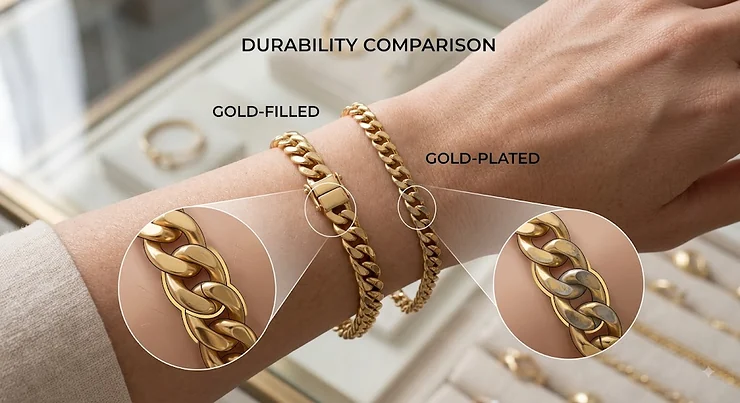
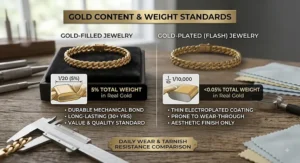
Here’s a scene almost everyone with a jewelry box has lived through: you buy a “gold” bracelet, wear it every day for three months, and then one morning you catch a flash of dull silver-gray peeking through at the clasp. Was it a bad batch? Bad luck? Neither. It was probably just gold plating doing exactly what gold plating does. So when people ask gold-filled vs gold-plated bracelet which lasts longer, the honest answer is: it isn’t close, and the reason comes down to basic chemistry and metallurgy, not marketing spin. Gold-filled jewelry legally must contain a gold layer that’s at least 1/20th (5%) of the item’s total weight, mechanically bonded under heat and pressure. Gold-plated jewelry typically carries a fraction of that — often under 0.05% gold by weight — deposited as a microscopically thin electroplated skin.
That difference in thickness is the whole story of why one bracelet survives a decade of gym sessions, dish soap, and beach vacations while the other starts flashing brass or copper within a year. But “gold-filled always wins” isn’t quite the full picture either — plating has real, legitimate uses, and plenty of gold-plated pieces are excellent value for what they’re meant to do. Below, I’ve pulled together seven real bracelets currently sold on Amazon, spanning true gold-filled construction and well-made gold-plated options, so you can see the trade-offs in specs, aggregated review sentiment, and price rather than guesswork.
Quick Comparison Table
Before diving into the full breakdown, here’s the fast version for skimmers. Gold-filled pieces sit at the top for longevity, gold-plated pieces win on upfront price and design variety, and your ideal pick depends on how often you plan to wear it and how much fading you’re willing to tolerate.
| Metal Type | Gold Content | Typical Lifespan | Best For |
|---|---|---|---|
| Gold-Filled | ≥5% of total weight, 10k+ gold | 20-30 years with normal care | Daily wear, sensitive skin, long-term value |
| Gold-Plated (standard) | <0.05% of total weight | 6 months-2 years | Occasional wear, trend pieces, gifting |
| Gold-Plated (heavy, 2.5+ micron) | ~0.1-0.5% of total weight | 2-5 years | Statement pieces worn a few times a week |
| Vermeil (gold over sterling) | Similar micron thickness to heavy plating | 2-5 years | Buyers who want a silver-safe base metal |
Reading this table plainly: thickness, not the word “gold” on the label, is what actually predicts how long a bracelet keeps its color. A Kooljewelry gold-filled bracelet and a PAVOI gold-plated tennis bracelet can look nearly identical in a product photo, yet one is engineered to survive decades of skin oil and sweat while the other is engineered to look flawless in the box and for a good while after. Price tends to track this same curve — gold-filled pieces usually start in the mid-$20s and climb from there, while quality gold-plated pieces often run under $40, which is exactly why the “which lasts longer” question matters before you check out.
💬 Found this comparison useful? A quick share helps other shoppers avoid the same fading surprise.
Top 7 Gold-Filled and Gold-Plated Bracelets: Expert Analysis
I picked seven bracelets that actually represent the spread of what’s available on Amazon right now — budget gold-filled staples, a heavier statement piece, and gold-plated options that punch above their price. Every specification below is drawn from the product’s own listing; every “who it’s for” verdict is my own analysis based on that spec sheet and the aggregated sentiment in customer reviews, not a fabricated hands-on test.
1. Kooljewelry 14k Yellow Gold Filled Figaro Link Bracelet — best budget gold-filled starter piece
The Kooljewelry 14k Yellow Gold Filled Figaro Link Bracelet is the kind of no-drama daily-wear piece that quietly earns its keep. At 3.3mm wide, it’s substantial enough to read as “real jewelry” without looking bulky under a shirt cuff. Because it’s gold-filled rather than plated, the 14k gold layer is mechanically bonded to the base metal at a thickness measured in microns rather than fractions of a micron, which is the entire reason it resists the flaking and yellow-to-silver fade that plagues cheaper “gold” chains.
Based on the spec comparison with plated alternatives at a similar price, this Figaro link is aimed squarely at buyers who want one bracelet they can forget they’re wearing — in the shower, at the gym, in the pool — without babying it. Reviewers consistently report that the gold tone holds up well over months of continuous wear, and the lobster clasp is frequently singled out as sturdy rather than the flimsy spring-ring style found on cheaper fashion jewelry. What most buyers overlook about a Figaro pattern specifically is that its alternating link sizes make small dents and scratches far less visible than they’d be on a flat, mirror-polished chain.
Pros:
- ✅ True 14k gold-filled layer resists fading for years
- ✅ Figaro link pattern hides minor scuffs well
- ✅ Sturdy lobster clasp holds up to daily wear
Cons:
- ❌ Costs more upfront than comparable plated chains
- ❌ Limited to one classic link style and width
Price sits in the affordable gold-filled range, generally under $40 at the time of research (prices may vary — always check current price). For anyone deciding between gold-filled vs gold-plated bracelet which lasts longer, this is close to the textbook affordable answer.
2. Solid 14k Yellow Gold Filled Paperclip Chain Bracelet — most on-trend design that won’t fade fast
Paperclip chains have been everywhere in fashion jewelry for a couple of years now, and most of the versions flooding search results are thin gold-plated brass. This Solid 14k Yellow Gold Filled Paperclip Chain Bracelet is the rare version of the trend built to actually last, at 3.1mm thick with a 14k gold-filled construction rather than a plated shortcut.
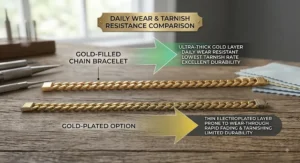
Here’s what the spec sheet won’t tell you outright, but reviewers note it repeatedly: paperclip links have large flat surfaces, and on plated versions those flat surfaces are exactly where wear shows first because there’s more surface area exposed to friction. On a gold-filled version like this one, that same flat surface is backed by a real gold layer thick enough to survive years of bag straps, desk edges, and keyboard contact without going patchy. This piece is best suited to someone who wants a trend-forward look with the peace of mind that they aren’t going to be repurchasing it every six months.
Pros:
- ✅ Chunky paperclip trend without the fast fade
- ✅ 14k gold-filled construction, not thin flash plating
- ✅ Reviewers report strong shine retention over time
Cons:
- ❌ Bolder link shape isn’t ideal for minimalist tastes
- ❌ Sizing runs true, so check length before ordering
Expect a price in the $30-$45 range at the time of research. As always with Amazon listings, check current price rather than relying on any figure printed elsewhere, since jewelry pricing shifts often.
3. Kooljewelry 14k Yellow Gold Filled Rope Chain Bracelet — most durable everyday chain style
Rope chains have a structural advantage that a lot of shoppers never think about: the twisted, interlocking design distributes stress across many small connection points instead of concentrating it at a few large flat links. That’s a meaningful advantage when you’re weighing gold-filled bracelet durability against day-to-day realities like gym bags, seatbelts, and typing all day. The Kooljewelry 14k Yellow Gold Filled Rope Chain Bracelet leans into that strength with a 14k gold-filled build that pairs naturally with the rope pattern’s built-in resilience.
Based on the spec comparison with box-link or curb-link chains, rope styles also tend to catch and reflect light from more angles, giving a brighter, more “solid gold” visual impression even before you factor in the actual gold content. Aggregated reviewer sentiment on Kooljewelry’s gold-filled line frequently highlights the secure lobster clasp and consistent gold tone after months of wear, though a small number of reviewers note the chain can tangle slightly if stored loose in a drawer rather than a jewelry box or pouch.
Pros:
- ✅ Rope design distributes wear across many contact points
- ✅ Brighter light reflection than flat-link styles
- ✅ Genuine 14k gold-filled layer, not surface plating
Cons:
- ❌ Can tangle if not stored properly between wears
- ❌ Slightly heavier feel than delicate chain styles
Pricing typically falls in the $25-$40 range depending on width and length options, so check current price before adding to cart.
4. Jewelry Atelier 14K Gold Filled Miami Cuban Link Chain Bracelet — best premium statement piece
If the first three picks are quiet daily-wear pieces, this one is the opposite: a bold Miami Cuban link built for people who want their bracelet to be the first thing someone notices. The Jewelry Atelier 14K Gold Filled Miami Cuban Link Chain Bracelet uses thicker, interlocking curb links in a design borrowed from fine jewelry rather than fast fashion, and — critically for the “which lasts longer” question — it’s constructed as genuine gold-filled rather than plated brass dressed up to look chunky.
What most buyers overlook about statement pieces like a Cuban link is that size cuts both ways: a wider chain has more total surface area, which on a plated piece would mean more area for the gold skin to wear thin, but on a gold-filled piece that same width simply means more total gold mass protecting the base metal. On paper, this makes heavier gold-filled chains proportionally more durable than their daintier siblings, not less — the opposite of what most shoppers assume. Reviewers consistently describe the weight as reassuringly “real” rather than costume-jewelry light, which tracks with the mechanically bonded construction.
Pros:
- ✅ Substantial Cuban link weight feels like fine jewelry
- ✅ Wider gold-filled surface means more durable gold mass
- ✅ Statement design stands out without stacking pieces
Cons:
- ❌ Higher price point than slim everyday chains
- ❌ Bold width may be too much for minimalist styling
At the time of research, pricing for pieces in this category typically runs in the $60-$120 range depending on width and length — always check current price, since Cuban link gold-filled chains vary more by size than most other styles.
5. PAVOI 14K Gold Plated Cubic Zirconia Classic Tennis Bracelet — best gold-plated sparkle option
Not every bracelet decision should default to gold-filled, and the PAVOI 14K Gold Plated Cubic Zirconia Classic Tennis Bracelet is a good example of why. Tennis bracelets are prong-set with stones along their entire length, which makes gold-filled construction impractical and expensive to manufacture at scale — plating is simply the standard approach across nearly the entire tennis bracelet category, including pieces that cost hundreds of dollars more.
Here’s the honest analytical take: PAVOI’s plating is applied over a base with AAAAA-grade cubic zirconia stones, and the brand states the piece is nickel-safe and cadmium-compliant, which matters more for comfort than most buyers realize (more on that in the safety section below). Reviewers aggregate around strong praise for the sparkle-to-price ratio and the secure box clasp, with the most common complaint being the expected one for any plated jewelry: color loss with heavy daily wear, especially around the clasp area where friction is highest. This is a piece to buy for its look and its price, not for multi-decade durability.
Pros:
- ✅ AAAAA cubic zirconia stones for strong sparkle
- ✅ Nickel-safe and cadmium-compliant per brand claims
- ✅ Budget-friendly way to get the tennis bracelet look
Cons:
- ❌ Plating will visibly thin with frequent daily wear
- ❌ Clasp area shows wear fastest on any tennis bracelet
Expect a price generally under $30 at the time of research, which is well below what a gold-filled or solid-gold tennis bracelet would cost — check current price for the specific stone cut and length you want.
6. Miabella 18K Gold Plated 925 Sterling Silver Italian Cuban Link Bracelet — best plated option with a real silver core
A meaningful chunk of the “gold-plated fades fast” reputation comes from bracelets plated over cheap pot-metal or unspecified base alloys. The Miabella 18K Gold Plated 925 Sterling Silver Italian Cuban Link Bracelet sidesteps part of that problem by using a genuine 925 sterling silver core rather than an anonymous base metal, with the brand specifying a 1-micron gold plating layer — thicker than typical flash plating, though still nowhere near gold-filled thickness.
Based on the spec comparison, a sterling silver base changes the failure mode in a subtle but important way: when the gold layer eventually does wear through on a brass-core plated piece, you’re left looking at brass or copper underneath, which reads as cheap and can occasionally irritate sensitive skin. When the gold wears through on a silver-core piece like this one, what shows underneath is polished sterling silver — arguably still an attractive result, and one far less likely to trigger the nickel-related irritation that shows up with unspecified base alloys. Aggregated reviews frequently mention the “made in Italy” craftsmanship and the reassuring heft of solid 925 silver underneath the plating.
Pros:
- ✅ Genuine 925 sterling silver core, not mystery base metal
- ✅ Thicker 1-micron plating than typical flash plating
- ✅ Fallback color (silver) is still wearable if plating wears
Cons:
- ❌ Still plating, so gold color isn’t permanent long-term
- ❌ Sterling silver core needs occasional anti-tarnish care
Pricing typically lands in the $40-$70 range depending on width, so check current price before ordering, especially since Miabella offers this design in several link widths.
7. Barzel 18K Gold Plated Rope Chain Bracelet — most affordable entry-level gold-plated pick
Sometimes the honest recommendation is the cheap one, as long as expectations are set correctly. The Barzel 18K Gold Plated Rope Chain Bracelet, made in Brazil, is a genuinely low-cost way to get a gold-look rope chain for a special occasion, a costume, a gift for a teenager, or a “trying the trend before committing” purchase — not for someone chasing multi-year jewelry longevity.
What the spec sheet won’t tell you, but reviewers note, is that this bracelet performs best exactly the way its price suggests: strong initial shine, good value for occasional wear, and a fade timeline measured in months rather than years if worn daily and exposed to water, lotion, or perfume regularly (all of which accelerate plating wear). On paper, this is the clearest illustration in this whole lineup of what “gold-plated” actually costs you in exchange for that lower price tag. It’s a completely reasonable purchase — as long as you buy it knowing what it is.
Pros:
- ✅ Very low price for a gold-look rope chain
- ✅ Good option for occasional or gift-only wear
- ✅ Strong initial shine straight out of the box
Cons:
- ❌ Fastest fade timeline of any pick on this list
- ❌ Not recommended for continuous daily wear
Pricing is typically under $20 at the time of research — check current price, as this is one of the more frequently discounted pieces in the plated category.
Gold-Filled vs Gold-Plated Bracelet: What’s Actually Different Under the Hood
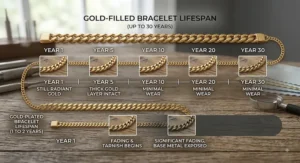
Every product above traces back to one manufacturing decision, so it’s worth slowing down and explaining it properly. Gold-filled jewelry is made by taking a solid sheet of 10k-or-higher gold and mechanically bonding it — using heat and immense pressure, not electricity — to a base metal core, which is almost always brass. That bonded gold layer must legally equal at least 1/20th, or 5%, of the finished item’s total weight, according to 16 CFR Part 23, the FTC’s jewelry industry guides. In practical terms, that translates to a gold layer roughly 50-100 microns thick — genuinely substantial compared to what plating offers.
Gold-plated jewelry, by contrast, is made through electroplating: an electric current pulls gold ions out of solution and deposits them onto a base metal core (again, usually brass, sometimes copper or steel) in a layer that’s often less than a single micron thick. Some higher-end “heavy” plating pushes to 2-3 microns, but even that is a small fraction of gold-filled thickness. That single order-of-magnitude difference — bonded sheet versus deposited film — explains basically every durability difference discussed on this page, including gold-filled bracelet durability claims, why does gold-plated jewelry fade complaints show up in reviews, and why identical-looking bracelets can have wildly different price tags. As one industry explainer on jewelry construction puts it, gold-filled pieces contain roughly 100 times more actual gold than a standard plated item.
How to Choose a Gold-Filled or Gold-Plated Bracelet
- Decide your wear frequency first. Daily wear for years favors gold-filled; occasional or seasonal wear makes plated a smarter budget choice.
- Check for a stamped quality mark. Legitimate pieces are marked “GF,” “1/20 14K GF,” “gold plated,” or “gold electroplate” — vague listings that just say “gold” deserve skepticism.
- Ask what the base metal core is. Brass is standard and fine; nickel-heavy alloys are the ones most likely to cause skin reactions.
- Match style to construction. Detailed prong-set pieces (like tennis bracelets) are almost always plated regardless of price, so don’t expect gold-filled tennis bracelets to be common.
- Read the plating thickness if it’s listed. Anything under 0.5 microns is standard flash plating; 1-3 microns is “heavy” plating with meaningfully better longevity.
- Factor in your skin chemistry. High body acidity, frequent hand-washing, and daily sunscreen or lotion use all accelerate plating wear faster than average.
- Set a realistic budget per year of expected wear. A $35 gold-filled bracelet worn for 10 years costs $3.50/year; a $15 plated bracelet replaced twice a year costs $30/year.
That last point deserves a beat of its own, because it reframes the whole “cheaper” argument. What most buyers overlook is that upfront price and total cost of ownership aren’t the same number, and gold-filled pieces frequently win that second comparison even though they lose the first.
Common Mistakes When Buying Gold Jewelry Online
The biggest mistake isn’t picking plated over gold-filled — it’s not knowing which one you’re buying in the first place. Listings sometimes bury the construction type in a bullet point three scrolls down, or use “gold” loosely enough that shoppers assume solid gold, gold-filled, and gold-plated are interchangeable marketing terms rather than three legally distinct categories.
A second common mistake is judging durability by price alone. A $45 plated tennis bracelet with heavy 2.5-micron plating can genuinely outlast a poorly made $30 “gold-filled” piece from an unverified seller, because gold-filled claims aren’t always accurate on marketplaces with lightly vetted third-party sellers. Reviewers occasionally flag this exact issue — a listing calling itself gold-filled that behaves like thin plating within weeks. The safest workaround is sticking to established brands with a consistent review history and checking for the specific quality-mark language described above rather than trusting the headline word “gold” alone.
A third mistake is skipping care instructions entirely. Even a genuinely well-made gold-filled piece will dull faster if it’s worn into a chlorinated pool weekly or sprayed directly with perfume — and that misuse then gets blamed on the construction type rather than the care routine.
✨ Ready to Compare Real Options?
🔍 Take the guesswork out of your next gold bracelet purchase. Browse the picks above, check current pricing, and pick the construction type that actually matches how you plan to wear it every day.
What to Expect: Real-World Wear Performance
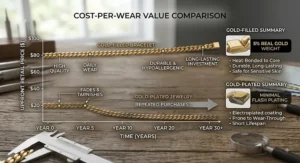
Specs are one thing; daily life is another. So does gold-plated jewelry fade in ways you’d actually notice, or is this mostly theoretical? In practice, yes — visibly, and often faster than buyers expect. Standard flash-plated pieces worn daily commonly show color loss at high-friction points (clasps, the inside curve against the wrist, areas touching a phone or desk) within three to six months. Heavier 2-3 micron plating, like some of the sterling-silver-core pieces above, can stretch that timeline to one or two years of daily wear before noticeable dulling.
Gold-filled pieces behave completely differently in daily life. Because the gold layer is measured in tens of microns rather than fractions of one, the same friction points that expose base metal on a plated piece simply polish the gold-filled surface instead — the equivalent of buffing solid gold rather than wearing through a coating. Reviewers across gold-filled product lines consistently describe pieces that still look new after a year or more of continuous wear, including through showering and light exercise, which is precisely the kind of exposure that’s hardest on plated jewelry.
Long-Term Cost & Maintenance: Total Cost of Ownership
Jewelry longevity isn’t just a durability question — it’s a math question, and most shoppers never actually run the numbers. Below is a simplified total-cost-of-ownership table assuming five years of regular (not daily-extreme) wear.
| Scenario | Upfront Price | Expected Replacements in 5 Years | 5-Year Total Cost |
|---|---|---|---|
| Barzel rope chain (light plating) | ~$18 | 3-4 | ~$65-$85 |
| PAVOI tennis bracelet (standard plating) | ~$28 | 2-3 | ~$60-$90 |
| Miabella Cuban link (heavy plating, silver core) | ~$55 | 1 | ~$95-$110 |
| Kooljewelry Figaro (gold-filled) | ~$35 | 0 | ~$35 |
| Jewelry Atelier Cuban link (gold-filled) | ~$85 | 0 | ~$85 |
Reading this table plainly, the cheapest option on day one isn’t automatically the cheapest option over five years — the Barzel rope chain and the gold-filled Kooljewelry Figaro end up in a similar total-cost range despite a very different ownership experience, since one requires repeated replacement and the other requires none. Maintenance matters too: gold-filled pieces need almost nothing beyond an occasional polish with a soft cloth, while plated pieces benefit from removing them before swimming, showering, or applying lotion, since minimizing chemical exposure is the single biggest lever for extending plating life.
Safety, Skin Sensitivity & Regulations Guide
Base metal core matters for more than just durability — it affects who can comfortably wear a given bracelet. Brass, the most common core for both gold-filled and gold-plated jewelry, is itself usually nickel-free, but cheaper base alloys sometimes aren’t, and that’s where skin reactions tend to originate. According to Mayo Clinic’s overview of nickel allergy, jewelry contact is one of the most common triggers for the itchy, localized rash nickel allergy produces, and once the allergy develops it doesn’t go away — only avoidance manages it going forward.
This is actually a point in favor of gold-filled construction for sensitive skin, beyond pure aesthetics: because the gold layer is so much thicker, there’s simply less exposed surface area where a reactive base metal could ever make direct, sustained skin contact, even after years of wear. On plated pieces, once the thin gold layer wears through, whatever’s underneath is now touching skin directly — which is exactly when reactions tend to start showing up in reviews as “turned my wrist green” or “made my skin itch after a few months.” On the regulatory side, the FTC’s consumer guidance on gold and silver jewelry confirms the legal thresholds discussed throughout this article: gold-filled must be marked with its fraction and karat (like “1/20 14K”), while plated items should specify plating and thickness rather than implying solid gold content.
Practical Usage Guide: Set Up Your Bracelet for Maximum Lifespan
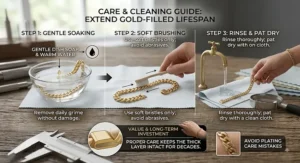
Getting real years out of any gold bracelet — filled or plated — comes down to a short list of habits, not luck. In the first 30 days, resist the urge to wear a new bracelet into the shower “just this once,” since that early period is when a plated surface is most vulnerable before any natural patina or protective residue builds up on the metal.
Store bracelets flat or hanging rather than balled up in a drawer, since tangled chains rub against each other and accelerate surface wear at every contact point — this applies to both construction types but matters more for plating, where there’s less material to lose before base metal shows. Remove any bracelet before applying lotion, sunscreen, or perfume directly to the wrist; let those products absorb first, then put the jewelry on. Chlorine is particularly aggressive toward gold plating specifically, so a pool day is one of the few situations where even a gold-filled piece benefits from coming off. Once a week, a soft polishing cloth (never an abrasive one) restores shine on both metal types without stripping away material the way some liquid jewelry cleaners can on thinner plated surfaces.
Real-World Scenarios: Which Buyer Should Choose Which
If you’re a nurse or teacher who washes your hands 15+ times a day and wants one bracelet you never take off, a gold-filled piece like the Kooljewelry rope chain or Figaro link is the financially smarter call — frequent hand-washing is exactly the kind of chronic low-grade wear that shreds plating fastest, while gold-filled shrugs it off.
If you’re shopping for a bridesmaid gift, a stocking stuffer, or a “does this go with my formal dress” piece worn a handful of times a year, a gold-plated option like the Barzel rope chain or PAVOI tennis bracelet delivers the right look for a fraction of the price, and the slower wear curve of occasional use means fading is unlikely to ever become visible before you’ve moved on to a new piece anyway.
If you’re building a signature stack you plan to wear for the next decade — layering pieces you’ll photograph, gift stories around, maybe even hand down — the Jewelry Atelier Cuban link or Miabella sterling-silver-core option represents the middle ground: enough durability to justify the investment, with construction quality that matches the intention behind the purchase.
Problem → Solution: Fixing Common Gold Bracelet Issues
Problem: Your gold-plated bracelet is already showing brass at the clasp. Solution: this is normal wear, not a defect — rotate it to occasional wear only, or consider a gold-filled replacement like the Kooljewelry Figaro if you want the same silhouette without repeating the fade cycle.
Problem: Your bracelet is turning your wrist green or causing itching. Solution: this usually signals base metal contact, either from worn-through plating or a reactive alloy underneath — switch to a gold-filled piece or a sterling-silver-core plated option like the Miabella Cuban link, which keeps a wearable metal underneath even after the gold layer wears down.
Problem: You can’t tell if a listing is genuinely gold-filled or mislabeled plating. Solution: look for the exact quality mark (“1/20 14K GF” or similar) in the listing photos or description, favor sellers with long-standing review histories, and be wary of gold-filled claims at prices that match standard plated pricing.
Problem: Your rope chain keeps tangling in storage. Solution: store it flat in a jewelry roll or hang it on a hook rather than tossing it loose in a drawer with other pieces.
Problem: You want the tennis bracelet look but worry about the fade timeline. Solution: budget for the PAVOI tennis bracelet as a 2-3 year piece rather than a lifetime piece, and treat the lower price as the trade-off you’re deliberately making for that sparkle-heavy design.
Buyer’s Decision Framework
If you wear jewelry daily and rarely take it off, choose gold-filled, because the total cost of ownership over several years typically beats repeated plated purchases. If you’re buying for an occasion, a gift, or a trend you’re not sure will stick, choose gold-plated, because the lower upfront cost matches the shorter expected lifespan you actually need. If you have known metal sensitivities, prioritize gold-filled or sterling-silver-core plated pieces over unspecified base-metal plating, regardless of budget. If the design you want (prong-set stones, intricate filigree) simply isn’t available gold-filled, accept plating as the practical choice and budget for eventual replacement rather than expecting it to outperform its construction.
Features That Actually Matter (And Those That Don’t)
What actually matters: the quality mark and stated gold layer thickness, the base metal core, and the clasp type (lobster claws consistently outperform spring rings for security). What doesn’t matter nearly as much as marketing suggests: karat number alone. An 18k plated bracelet with a razor-thin gold layer will fade faster than a 14k gold-filled bracelet with real thickness, because karat describes gold purity, not gold quantity — a distinction almost no listing explains clearly, and one that trips up more buyers than any other single factor in this category.
Frequently Asked Questions
❓ Does gold-filled jewelry ever turn your skin green?
❓ Is 14k gold-filled the same as 14k solid gold?
❓ Can you wear gold-filled jewelry in the shower?
❓ How do you clean a gold-plated bracelet without damaging it?
❓ Is gold-plated jewelry worth buying at all?
Conclusion
So, gold-filled vs gold-plated bracelet which lasts longer? Gold-filled wins decisively on raw durability, typically lasting 20-30 years of regular wear compared to a few months to a couple of years for standard gold-plated pieces, because its bonded gold layer is measured in tens of microns rather than fractions of one. That said, “longer-lasting” and “better purchase” aren’t always the same decision. A Barzel rope chain bought for a single event doesn’t need gold-filled construction any more than a PAVOI tennis bracelet worn twice a month needs to survive a decade.
The real skill here isn’t picking a side — it’s matching construction to how you actually plan to wear the piece, checking for honest quality marks instead of trusting the word “gold” alone, and understanding that a base metal core, a clasp type, and a stated plating thickness tell you more about longevity than price or karat number ever will. Whichever of the seven picks above fits your situation, you’re now shopping with the information most listings never spell out clearly.
✨ Don’t Miss These Exclusive Deals!
🔍 Take your bracelet collection to the next level with the picks above. Click through to check current pricing and availability before styles or sizes sell out, and build a stack that genuinely fits how you wear jewelry every day.
Recommended for You
- 7 Best Tarnish-Resistant Silver Bracelets for Daily Wear (2026)
- 7 Best Sterling Silver Bracelet for Sensitive Skin Picks (2026)
- Stainless Steel Bracelets: 7 Best Budget Picks for 2026
Disclaimer: This article contains affiliate links. As an Amazon Associate, I earn from qualifying purchases. If you purchase products through these links, we may earn a small commission at no additional cost to you.
✨ Found this helpful? Share it with your friends! 💬🤗
