
In This Article
Here’s the argument that’s probably playing out in your cart right now: do you toss in the earthy, tumbled tiger eye bracelet, or the one that throws rainbows across the ceiling every time it catches the light? A natural stone bracelet vs crystal bracelet debate sounds like a style question, but it’s really a physics question wearing a fashion costume. A natural stone bracelet is strung from mineral beads pulled from the earth — quartz, obsidian, hematite — while a crystal bracelet usually means precision-cut lead glass (think Swarovski) or a synthetic crystal grown in a lab, prized for sparkle rather than geology.
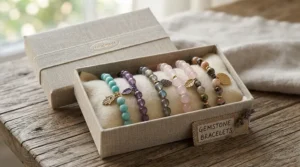
That distinction matters more than most shoppers realize, because it quietly decides how your bracelet ages. Natural stones are heavier, matte-to-glossy, and inherited their durability from whatever rock they used to be. Crystal pieces are engineered for brilliance first, and durability is a side effect of the cut and coating. Neither is “better” in a vacuum — they’re built for different jobs, and picking the wrong one for your daily grind is how a $20 gift ends up in a junk drawer by March.
We dug through real listings, spec sheets, and aggregated buyer feedback to pull seven actual products — three natural stone, two hybrid-durability picks, and two crystal pieces — so you can see exactly where each one shines and where it chips. Along the way we’ll lean on the Mohs hardness scale, the same one geologists have used since 1812, because hardness, alongside specific gravity, is one of the two properties gemologists lean on most when judging a stone, per the U.S. Geological Survey’s mineral gemstone reference. By the end, you’ll know which bracelet survives your gym bag and which one belongs in a jewelry box on “special occasion” duty only.
Quick Comparison: Natural Stone vs Crystal Bracelets
Before we get into individual products, here’s the fast answer to “what is a natural stone bracelet vs crystal bracelet” in table form — useful if you’re deciding between categories before you even start browsing models.
| Factor | Natural Stone Bracelet | Crystal Bracelet |
|---|---|---|
| Typical Mohs hardness | 5-7 (quartz family, jasper, obsidian) | Glass crystal ~5.5-6.5; lab-grown gems can hit 8-9 |
| Chip/crack risk | Low-moderate; scratches more than shatters | Moderate-high at facet edges and settings |
| Everyday wear durability | Good for gym, work, daily stacking | Better for occasion wear, gentler daily use |
| Typical price range | Under $10 to around $30 for beaded sets | Around $30 to $200+ for branded crystal pieces |
| Best for | Grounded, low-maintenance daily jewelry | Sparkle-forward, dressier occasions |
The takeaway here isn’t that one column “wins” — it’s that a tumbled stone bead absorbs bumps by being round and thick, while a faceted crystal concentrates stress at its sharp edges, which is exactly where chips start. If your bracelet lives on your wrist through workouts, dish duty, and backpack straps, the stone column is doing you a favor. If it’s coming out for dinner and going back in a box, the crystal column’s sparkle-per-dollar math finally gets to win.
Found a stone or crystal style you’re already leaning toward? Bookmark this page and keep scrolling — your exact match for daily wear is probably in the next section.
Top 7 Natural Stone and Crystal Bracelets: Expert Analysis
We picked across budget, mid-range, and premium tiers, and across both bracelet types, so you can compare apples to apples instead of guessing.
1. BOMAIL 9PCS Natural Crystal Bracelets Set — most stone varieties per dollar
The BOMAIL 9PCS Natural Crystal Bracelets Set packs nine separate bracelets — obsidian, amethyst, tiger eye, amazonite, lava rock, and more — into a single order, which is a clever way to sample stone types before committing to one you’ll wear daily. Each bead measures 8mm, cut and polished from genuine mineral material rather than dyed glass, and the stretch cord constructions mean no clasp to fumble with one-handed. Based on the spec comparison, this set works best as a “starter pack” for someone who hasn’t decided which stone actually suits their wrist and lifestyle yet, rather than as a single heirloom-grade piece.
Reviewers consistently report that the elastic cord is the weak link long before any individual bead is — expect the stretch cord to loosen or snap with heavy daily wear well before the stones themselves show damage. Aggregated buyer feedback also notes some color variation between batches, which is normal for genuine stone (dyed glass looks identical every time; real mineral doesn’t).
Pros:
- ✅ Nine different stone types in one purchase
- ✅ Genuine mineral beads, not dyed glass imitations
- ✅ Adjustable stretch fit works across most wrist sizes
Cons:
- ❌ Elastic cord wears out faster than the beads
- ❌ Batch-to-batch color consistency varies naturally
At around $10-$15 for nine bracelets, the BOMAIL 9PCS Natural Crystal Bracelets Set is priced like a sampler platter, and that’s exactly the value it delivers — cheap enough to stack all nine, low-stakes enough to retire the ones you don’t love.
2. Enjoy Risingsun Tiger Eye Triple Protection Bracelet — best beginner grounding stone
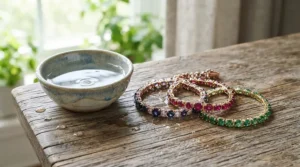
The Enjoy Risingsun Tiger Eye Triple Protection Bracelet pairs tiger eye with hematite and black beads in a single strand, and it’s a genuinely solid entry point into single-stone bracelets rather than mixed sets. Tiger eye sits at roughly 7 on the Mohs scale thanks to its quartz base, which is exactly why it’s a recurring pick in “everyday wear durability” guides — it can survive contact with sand, keys, and countertops that would leave marks on softer stones. What most buyers overlook about tiger eye specifically is its chatoyancy (that shifting golden band), which is a structural feature of the fibrous mineral, not a coating that can wear off.
The listing itself is upfront that natural beads may show small ice-crack inclusions, which honest sellers flag rather than hide — a good sign for a genuine stone product. Aggregated reviews describe the beads as comfortable for both 10mm (typically marketed to women) and 12mm (typically marketed to men) sizing, with the stretch cord holding up reasonably well under normal use.
Pros:
- ✅ Quartz-based hardness handles daily bumps well
- ✅ Seller discloses natural inclusions instead of hiding them
- ✅ Two bead sizes available for different wrist fits
Cons:
- ❌ Stretch cord is the first thing to fail over time
- ❌ Color depth varies bead to bead, being genuine stone
In the $10-$18 range, the Enjoy Risingsun Tiger Eye Triple Protection Bracelet earns its keep as a low-risk way to test whether single-stone, single-color pieces suit your style better than mixed sets.
3. Jovivi Hematite Black Obsidian Tiger Eye Bracelet — toughest budget stone trio
The Jovivi Hematite Black Obsidian Tiger Eye Bracelet leans into a three-stone combination that reads as much darker and more minimal than the previous two entries, and the hardness profile backs up that toughness reputation. Hematite is a dense iron oxide that resists scratching well in daily contact, obsidian is volcanic glass that’s surprisingly scratch-resistant despite its glossy look, and tiger eye rounds out the trio at 7 on Mohs. Here’s what to weigh: obsidian, despite being technically “glass,” is natural glass formed by rapid cooling lava — it’s not the same manufactured crystal glass used in Swarovski-style pieces, so don’t let the word “glass” scare you off this one.
Reviewers frequently mention the beads holding their polish well after months of regular wear, which tracks with the hardness numbers above. The main complaint in aggregated feedback centers on sizing — the stretch design runs snug for larger wrists, so checking the bead count or requesting a size note before ordering saves a return.
Pros:
- ✅ Three genuinely hard, scratch-resistant stones in one piece
- ✅ Dark, minimal palette pairs with most outfits
- ✅ Holds polish well over months of daily wear
Cons:
- ❌ Runs snug for larger wrist sizes
- ❌ Limited color options compared to mixed sets
Priced around $12-$20, the Jovivi Hematite Black Obsidian Tiger Eye Bracelet is arguably the strongest “everyday durability” pick on this list if you want one bracelet that just quietly survives your routine.
4. Jewdreamer 12Pcs Natural Stone Beaded Bracelet Set — best for stacking multiple colors
The Jewdreamer 12Pcs Natural Stone Beaded Bracelet Set takes the sampler concept from our first pick and scales it up to a dozen bracelets, including lava stone specifically called out for its lightweight, porous texture — a feature that lets wearers add a drop of essential oil for scent, something no crystal bracelet can replicate. On paper this means you’re getting genuine semi-precious material across twelve distinct colorways rather than a single stone repeated, which is a meaningfully different value proposition than a single premium piece.
Based on the spec comparison against our earlier picks, the individual stones here are similar in hardness to standard 7-Mohs quartz-family beads, so durability per bracelet is comparable to the Enjoy Risingsun Tiger Eye Triple Protection Bracelet — the real advantage is variety, not superior toughness. Aggregated reviews describe the set as a strong gifting option and note the stretch elastic performs adequately, though (as with every stretch-cord product on this list) it’s the component most likely to need replacing first.
Pros:
- ✅ Twelve distinct stone colors for daily stacking
- ✅ Lava stone bead doubles as an essential-oil diffuser
- ✅ Comfortable 8mm size fits most wrists without adjustment
Cons:
- ❌ Elastic cords are the predictable failure point
- ❌ Individual stone quality is good, not premium-grade
At roughly $15-$25 for twelve pieces, the Jewdreamer 12Pcs Natural Stone Beaded Bracelet Set delivers serious variety-per-dollar, especially for anyone who likes rotating bracelets by mood or outfit.
5. KELITCH Tiger Eye Hematite Leather Wrap Bracelet — most durable everyday build
The KELITCH Tiger Eye Hematite Leather Wrap Bracelet swaps the elastic-cord weakness we’ve flagged four times already for a genuine leather wrap strap with adjustable closures — and that single design choice is why it’s our top pick for daily-wear longevity among the natural stone entries. Tiger eye and hematite beads sit at a comfortably scratch-resistant hardness range, but the real durability story here is structural: leather doesn’t snap the way stretch cord eventually does, and the adjustable closure means the fit doesn’t loosen the way elastic does over months.
What most buyers overlook about wrap-style bracelets is that the leather itself needs occasional conditioning to prevent drying and cracking — a maintenance step elastic-cord bracelets don’t require, but one that pays off in a bracelet that lasts years instead of months. Aggregated review sentiment describes the handmade construction as noticeably sturdier than mass-produced stretch sets, with the tradeoff being a slightly bulkier wrap silhouette on the wrist.
Pros:
- ✅ Leather strap avoids the elastic-cord failure point
- ✅ Adjustable closure keeps a snug fit over time
- ✅ Handmade construction feels sturdier than stretch sets
Cons:
- ❌ Leather needs occasional conditioning to avoid cracking
- ❌ Bulkier wrap style than slim stretch bracelets
In the $18-$28 range, the KELITCH Tiger Eye Hematite Leather Wrap Bracelet is the value pick if “everyday wear durability” is your only priority and you’re willing to trade slim profile for structural toughness.
6. Swarovski Gema Soft Bracelet — best color-cut crystal sparkle
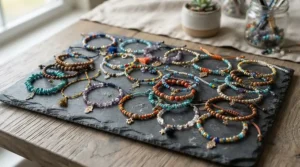
Here’s where the article pivots to genuine crystal territory. The Swarovski Gema Soft Bracelet uses mixed-cut crystals set in a gold-tone finished band, and the “mixed cuts” detail is doing real work — different facet angles catch light differently, which is why this piece reads as more dimensional than a uniform round-bead bracelet. Swarovski’s crystal is precision-cut lead glass, engineered specifically for optical brilliance rather than mineral rarity, and that’s a completely legitimate design goal — it’s just a different one than a tiger eye bead is solving for.
Reviewers consistently note the sparkle-to-price ratio as the standout feature, alongside praise for the gold-tone setting holding its finish well under normal conditions. The brand’s own care guidance is worth taking seriously here: Swarovski advises keeping the piece away from water, lotion, and perfume to preserve its brilliance long-term — which tells you plainly that this is occasion jewelry, not gym-bag jewelry.
Pros:
- ✅ Mixed-cut crystals create dimensional sparkle
- ✅ Gold-tone setting holds finish well with proper care
- ✅ Recognizable brand backing and consistent quality control
Cons:
- ❌ Requires removal before water, lotion, or perfume contact
- ❌ Facet edges are more chip-prone than rounded stone beads
Typically listed in the $80-$120 range, the Swarovski Gema Soft Bracelet is a strong pick for someone who wants branded crystal sparkle and understands it’s an “occasion piece,” not a daily-wear workhorse.
7. Swarovski Una Angelic White Crystal Tennis Bracelet — best premium crystal shine
The Swarovski Una Angelic White Crystal Tennis Bracelet is the premium anchor of this list, and it’s the clearest possible illustration of the natural stone bracelet vs crystal bracelet tradeoff: dozens of small, uniformly clear crystals set in a rhodium-plated band deliver a diamond-adjacent look that no natural stone — however polished — can replicate. One shopper’s aggregated review summed up the appeal directly, calling it “gorgeous” and noting it “sparkles beautifully” without tipping into flashy territory — which lines up with the tennis-bracelet silhouette’s reputation for timeless, low-key elegance.
Here’s what the spec sheet won’t tell you outright: a tennis bracelet’s continuous line of small stones means many individual settings, and each setting is a potential weak point if the piece is knocked against a hard surface — this is why tennis bracelets, crystal or diamond, are famous for occasionally scattering a stone if worn too casually. Based on the spec comparison with our stone picks, this is the least “everyday durability” friendly product on the list, and that’s fine; it was never built for that job.
Pros:
- ✅ Uniform, diamond-adjacent sparkle from dozens of crystals
- ✅ Rhodium-plated band resists tarnish with proper care
- ✅ Classic tennis-bracelet silhouette ages well stylistically
Cons:
- ❌ Many small settings mean many potential weak points
- ❌ Least suited to rough daily wear on this entire list
Usually priced in the $150-$200 range before seasonal promotions, the Swarovski Una Angelic White Crystal Tennis Bracelet is the pick for someone who wants maximum sparkle and is willing to treat their jewelry gently in exchange for it.
Top 7 at a Glance
| Product | Category | Price Range | Best For |
|---|---|---|---|
| BOMAIL 9PCS Natural Crystal Bracelets Set | Natural stone (9-pack) | $10-$15 | Sampling multiple stone types |
| Enjoy Risingsun Tiger Eye Triple Protection Bracelet | Natural stone | $10-$18 | First single-stone bracelet |
| Jovivi Hematite Black Obsidian Tiger Eye Bracelet | Natural stone | $12-$20 | Toughest daily-wear budget pick |
| Jewdreamer 12Pcs Natural Stone Beaded Bracelet Set | Natural stone (12-pack) | $15-$25 | Color-stacking variety |
| KELITCH Tiger Eye Hematite Leather Wrap Bracelet | Natural stone, leather build | $18-$28 | Most durable daily structure |
| Swarovski Gema Soft Bracelet | Crystal | $80-$120 | Branded occasion sparkle |
| Swarovski Una Angelic White Crystal Tennis Bracelet | Crystal | $150-$200 | Premium dress-up sparkle |
Look at that table sideways and a pattern jumps out: price climbs steadily as you move from stretch-cord stone sets to leather-built stone pieces to branded crystal, but “everyday durability” doesn’t climb with it — it actually peaks in the middle, with the KELITCH Tiger Eye Hematite Leather Wrap Bracelet. That’s the honest, slightly annoying truth of jewelry shopping: the most expensive option here isn’t the toughest one, it’s the sparkliest one, and those are two different shopping missions wearing the same product category.
Practical Usage Guide: Getting the Most From Either Type
Whichever category you land on, the first thirty days set the tone for how long it lasts. For natural stone bracelets, resist the urge to shower or swim with it daily — porous stones like lava rock and turquoise absorb soap residue and lotion, dulling their surface faster than harder stones like tiger eye or obsidian. Wipe beads with a soft, dry cloth after sweaty workouts rather than rinsing under a faucet, and store stretch-cord pieces flat rather than hanging, since gravity is quietly stretching that elastic every single day you don’t.
For crystal bracelets, the maintenance schedule is almost the opposite problem: less about the stone surface and more about the setting. Remove crystal pieces before applying perfume or lotion (both contain chemicals that dull facet coatings over time), and store them separately from other jewelry so facet edges don’t scratch each other in a drawer. A common first-30-days mistake is wearing a tennis-style crystal bracelet while typing at a keyboard for hours — the repetitive wrist-flat motion against a hard edge is exactly the kind of low-grade impact that eventually pops a setting.
Real-World Scenarios: Which Bracelet Fits Your Life
Picture three people shopping the exact same keyword. First, a nursing student who’s on her feet for twelve-hour hospital shifts, washing her hands forty times a day — she needs the Jovivi Hematite Black Obsidian Tiger Eye Bracelet or the KELITCH Tiger Eye Hematite Leather Wrap Bracelet, because both shrug off water and friction without needing removal between patients. Second, a college student building a stacked-bracelet aesthetic on a tight budget — the Jewdreamer 12Pcs Natural Stone Beaded Bracelet Set solves that instantly, since twelve colors for the price of one premium piece is unbeatable stacking math.
Third, someone shopping for a milestone anniversary gift with a real budget to spend — this is where the Swarovski Una Angelic White Crystal Tennis Bracelet actually makes financial and emotional sense, because the buyer isn’t optimizing for gym durability, they’re optimizing for the moment someone opens the box. Matching the bracelet to the actual environment it’ll live in, rather than to the prettiest photo, is the single biggest predictor of whether you’ll still love it in a year.
Problem → Solution Guide
Problem: My stretch bracelet keeps sliding off or feels loose after a few months. Elastic cord degrades with UV exposure and repeated stretching — this is physics, not a manufacturing defect. Solution: rotate between two or three stretch bracelets instead of wearing one daily, which roughly doubles the lifespan of each cord.
Problem: My crystal bracelet lost its sparkle. This is almost always residue buildup from lotion, soap, or perfume dulling the facet surface. Solution: wipe gently with a dry microfiber cloth after each wear; avoid ultrasonic cleaners unless the manufacturer specifically approves them for that piece.
Problem: A bead on my stone bracelet looks duller than the others. Natural color variation is normal, but uneven fading specifically suggests dye rather than natural mineral color. Solution: check the listing for treatment disclosure, and keep dyed pieces away from direct sun and alcohol-based hand sanitizer.
Problem: I can’t tell if my “crystal” bracelet is real crystal or plastic. Genuine cut crystal feels cool to the touch initially and warms slowly; cheap acrylic warms almost instantly and often shows visible mold seams. Solution: inspect facet edges under bright light — machine-cut crystal has crisp, symmetrical edges that acrylic rarely replicates.
Problem: My leather-wrap stone bracelet is stiffening and cracking. This is dehydration of the leather, usually from water exposure without follow-up conditioning. Solution: apply a small amount of leather conditioner every few months, the same way you’d treat a leather wallet or watch strap.
How to Choose Between Natural Stone and Crystal Bracelets
- Define the primary environment first. If it’s coming off before bed every night in a jewelry box, crystal is fair game; if it’s living on your wrist through workouts and dish duty, stone wins by default.
- Check the Mohs hardness if the listing provides it. Anything at 6 or above handles daily incidental contact reasonably well; below that, treat it as occasion jewelry regardless of type.
- Decide if sparkle or grounding aesthetic matters more to you. These aren’t durability questions — they’re personal-style questions, and there’s no wrong answer.
- Budget for the whole category, not one product. Stone sets let you buy variety for the price of one crystal piece; crystal pieces let you buy status and sparkle for the price of a dozen stone bracelets.
- Read the treatment disclosure, if any exists. Dyed or heat-treated stones aren’t inferior, but they do need gentler care than untreated material.
- Consider the closure mechanism, not just the beads. A stretch cord, a leather wrap, and a clasp-and-chain each fail differently — pick based on how rough you are on jewelry generally.
- Match metal tone and setting to what you already own. A gold-tone crystal piece next to silver-tone everything else will nag at you every time you glance down.
Common Mistakes When Buying a Stone or Crystal Bracelet
The most frequent mistake is assuming “natural” automatically means “indestructible” — it doesn’t, and a soft stone like turquoise (around 5-6 on Mohs) will scratch far more easily than a hard one like tiger eye. The second is buying crystal jewelry expecting stone-level daily toughness, then being disappointed when a facet chips after six months of rough handling; that’s a mismatch between product and expectation, not a defect. A third common misstep is skipping the return policy entirely — stretch-cord sizing varies enough between sellers that a “one size fits most” claim genuinely doesn’t fit everyone. Finally, plenty of buyers overlook clasp quality on crystal pieces specifically, focusing entirely on the stones and forgetting that a cheap clasp is usually the actual point of failure, not the crystals themselves.
Natural Stone Bracelet vs Crystal Bracelet: The Detailed Comparison
Zoom out from individual products and the category-level tradeoff becomes clear. Natural stone bracelets derive their durability from mineral structure that formed over millions of years — a tiger eye bead has already survived geological pressure that makes a gym bag look gentle by comparison. Crystal bracelets derive their appeal from human engineering — precise cuts and coatings designed to bend light in ways raw minerals rarely do on their own. That’s the honest tradeoff: stone durability is inherited, crystal brilliance is manufactured, and each approach optimizes for a different outcome.
Cost-per-wear tells an interesting story too. A $15 stone set worn daily for two years works out to roughly two cents per wear, even accounting for an eventual cord replacement. A $180 crystal tennis bracelet worn twice a month for special occasions works out to a similar cents-per-wear figure over the same period — so the “expensive” option isn’t actually a worse value, it’s just a value calculated on a completely different usage pattern. The mistake is comparing sticker price directly instead of comparing it against realistic wear frequency for how you actually live.
Mohs Hardness Scale: What It Actually Tells You
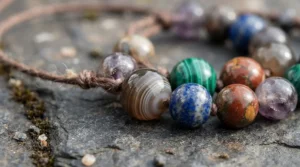
Since one of our core secondary topics is the Mohs hardness scale, it deserves its own explanation rather than a passing mention. The scale runs from talc at 1 to diamond at 10, with quartz landing at 7, topaz at 8, and sapphire at 9 on the standard reference chart. Most beaded stone bracelets — tiger eye, amethyst, jasper, agate — belong to the quartz family and land right around that 7 mark, which is why they’re such a common recommendation for daily wear.
The catch, and it’s an important one, is that hardness measures scratch resistance, not overall toughness. As one gemology resource puts it, hardness is about scratch resistance, not toughness — even diamond, the hardest natural material, is brittle enough to shatter on a sharp impact, a distinction covered in more depth in this gemstone hardness and wearability guide. Translate that to your bracelet drawer: a 7-Mohs tiger eye bead resists scratches from your keys and countertops just fine, but drop it hard enough on tile and it can still crack, because scratch resistance and impact resistance are simply different properties measured differently.
Most Durable Gemstone Bracelet: What Survives Daily Wear
If “most durable” is genuinely your only criterion, the quartz-family stones win decisively for daily wear: tiger eye, amethyst, citrine, and agate all sit around 7 on Mohs, comfortably above the roughly 7-hardness quartz dust that floats in ordinary household air and slowly scuffs softer materials. Hematite and obsidian, despite very different origins, both perform well too — hematite through sheer density, obsidian through its glassy, defect-resistant structure when free of internal fractures.
Softer stones deserve a mention precisely because they’re everywhere in budget sets: turquoise, howlite, and unstabilized lapis lazuli sit in the 3-6 range and require noticeably gentler handling. None of that makes them bad purchases — it just means the “most durable gemstone bracelet” crown, structurally speaking, goes to the harder quartz-family and iron-oxide stones featured in picks like the Jovivi Hematite Black Obsidian Tiger Eye Bracelet, not to the softer, prettier alternatives sitting one shelf over.
Crystal Bracelet Chipping and Cracking: Why It Happens
Crystal bracelet chipping and cracking almost always traces back to one of three causes: facet-edge impact, setting fatigue, or thermal shock. Facet edges are geometrically the thinnest, most exposed part of a cut crystal, so a knock against a doorframe concentrates force exactly where the piece is weakest — a rounded stone bead absorbs that same knock across a much larger surface area. Setting fatigue happens gradually, as prongs or bezels holding each crystal loosen slightly with repeated flexing, until one day a stone that was fine for years suddenly isn’t.
Thermal shock is the sneakiest cause, and it’s avoidable: going from a hot shower straight into cold air, or leaving a bracelet in a hot car and then handling it with cold hands, stresses the crystal-to-setting bond in ways that add up invisibly over time. The fix across all three causes is the same unglamorous habit — take crystal pieces off before physical activity, temperature swings, or anything involving hard surfaces, and they’ll comfortably outlast their warranty.
Everyday Wear Durability: What to Expect Realistically
Set your expectations by category rather than by price tag. A natural stone bracelet in the 6-8 Mohs range worn daily should show, realistically, a slight dulling of polish after six to twelve months of regular contact with skin oils and environmental grit, correctable with an occasional light polish, while the elastic cord itself is the more likely point of failure around the one-year mark. A crystal bracelet worn only for occasions should maintain its brilliance for years if it’s stored properly and kept away from lotion and perfume, but the same piece worn daily like a stone bracelet will likely show setting wear or a lost stone within a year, simply because it wasn’t engineered for that duty cycle.
Neither timeline is a flaw — they’re accurate previews of what “everyday wear durability” looks like for each category, and knowing them upfront prevents the disappointment of expecting stone-level daily toughness from a piece built for date nights.
Stone Treatment: Dyed, Heated, and Enhanced Beads Explained
Stone treatment is one of the least understood parts of buying beaded jewelry, and it deserves a straight answer rather than marketing-speak. Treatments aren’t automatically a red flag — heat treatments across many gemstone types are considered durable and permanent under normal handling conditions, according to gemological guidance detailed in this overview of gem treatments. Heat treatment has been used on stones like carnelian for literally thousands of years, and it’s disclosed industry practice, not deception, when sellers are upfront about it.
Dyeing is the treatment that most affects everyday care, since many dyes can fade over time with prolonged sun exposure, while others may be affected by chemicals such as alcohol or acetone — which is exactly why a dyed howlite “turquoise” bracelet needs more careful handling than genuine mineral-colored turquoise. The practical takeaway: treatment isn’t the enemy, undisclosed treatment is. A seller who lists “dyed” or “heat-treated” plainly in the description is giving you exactly the information you need to care for the piece correctly.
Long-Term Cost & Maintenance
Total cost of ownership looks different depending on which category you’re in, and it’s worth running the numbers before you assume the cheaper sticker price is the cheaper long-term choice. A stretch-cord stone bracelet at $15 might need a $3-5 replacement cord (or a full re-buy) every 12-18 months with daily wear, putting realistic five-year ownership cost somewhere in the $25-40 range for the same bracelet. A leather-wrap stone piece like the KELITCH Tiger Eye Hematite Leather Wrap Bracelet costs more upfront but, with occasional $5-10 leather conditioner touch-ups, can realistically last the full five years without replacement — which quietly makes it the cheaper long-term option despite the higher sticker price.
Crystal pieces flip the math again: a $100+ Swarovski-tier bracelet needs essentially no consumable replacement if worn occasionally and stored properly, making its five-year cost close to its purchase price, while heavy daily wear could mean a repair or restringing fee that erases that advantage. For a deeper technical breakdown of why hardness numbers alone don’t predict longevity, this explainer on gemstone hardness versus toughness is worth a read before your next purchase.
💎 Ready to build a wrist stack that actually survives your routine? Compare a few of today’s picks side by side and see which fits your daily grind before you check out.
FAQ
❓ Is a natural stone bracelet stronger than a crystal bracelet?
❓ What is the most durable gemstone bracelet you can buy?
❓ Why do crystal bracelets crack or chip so easily?
❓ Can you shower or swim in a stone bracelet?
❓ How do you tell if a stone bracelet has been treated or dyed?
Conclusion
The natural stone bracelet vs crystal bracelet decision really comes down to matching the product to the job you actually need it to do. If you want one piece that survives gym bags, dish soap, and daily stacking without a second thought, a quartz-family stone bracelet like the Jovivi Hematite Black Obsidian Tiger Eye Bracelet or the leather-built KELITCH Tiger Eye Hematite Leather Wrap Bracelet is the honest choice. If you’re shopping for sparkle that photographs beautifully at dinner and comes off before bed, a piece like the Swarovski Gema Soft Bracelet or the Swarovski Una Angelic White Crystal Tennis Bracelet delivers exactly that, on exactly those terms.
Neither category is objectively superior — they’re solving different problems, and the Mohs scale, treatment disclosures, and real aggregated reviews we’ve walked through are the tools for matching the right one to your actual life instead of just the prettiest photo online. Whichever direction you land on, buy with realistic expectations for that category, and it’ll reward you with years of wear instead of a single disappointing season.
Recommended for You
- Labradorite Bracelet for Meditation: 7 Picks That Actually Flash (2026)
- Tiger’s Eye Bracelet for Men: 7 Bold Picks for 2026
- Amethyst Bracelet for a February Birthstone Gift: 7 Stunning Picks
Disclaimer: This article contains affiliate links. As an Amazon Associate, I earn from qualifying purchases. If you purchase products through these links, we may earn a small commission at no additional cost to you.
✨ Found this helpful? Share it with your friends! 💬🤗
