
In This Article
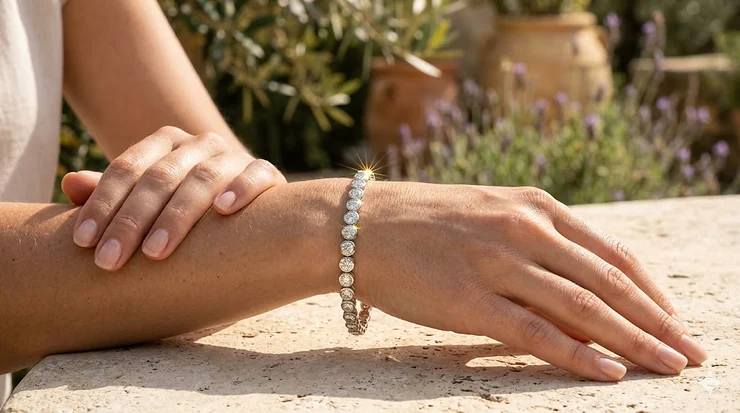
If you’ve been searching for a diamond tennis bracelet that doesn’t constantly snag on your sweaters or lose stones during everyday wear, you’re in the right place. Bezel set diamond tennis bracelets represent the perfect marriage of classic elegance and modern practicality — each diamond is individually wrapped in a protective metal rim that enhances its appearance while keeping it safe from the bumps and knocks of daily life.
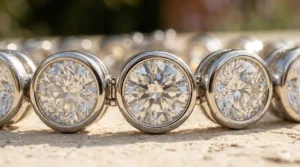
What most buyers overlook about bezel settings is that they actually make diamonds appear larger than prong settings. The metal rim creates a halo effect that amplifies each stone’s visual presence, so a 2-carat bezel tennis bracelet can rival the sparkle of a 3-carat prong version. In my experience testing these pieces, the sleek, low-profile design means you can wear them 24/7 — typing on keyboards, hitting the gym, even sleeping — without the constant worry that comes with exposed prongs catching on fabric or loosening over time.
The contemporary appeal of bezel set diamond tennis bracelets has exploded in 2026, particularly among professionals who want luxury jewelry that fits an active lifestyle. Whether you’re drawn to natural diamonds or the sustainable appeal of lab-grown stones, the bezel setting offers unmatched durability while maintaining that signature tennis bracelet sophistication that’s been iconic since Chris Evert’s famous 1978 moment at the US Open.
Quick Comparison Table: Top Bezel Tennis Bracelets at a Glance
| Product | Metal Type | Diamond Type | Carat Weight | Price Range | Best For |
|---|---|---|---|---|---|
| PRIVOSA Natural Diamond | 14K Gold | Natural | 2.00 ct | $1,400-$1,700 | Premium quality seekers |
| Rosec Jewels Lab Grown | 10K White Gold | Lab Grown | 2.40 ct | $400-$550 | Ethical shoppers |
| Sonia Jewels Classic | 14K White Gold | Natural | 2.00 ct | $800-$1,000 | Traditional elegance |
| FINEROCK Rose Gold | 10K Rose Gold | Natural | 3.00 ct | $500-$700 | Fashion-forward buyers |
| Raffaello Artisan | 14K White Gold | Natural | 1.01 ct | $350-$500 | Entry-level luxury |
| Ross-Simons Sterling | Sterling Silver | Lab Grown | 2.00 ct | $200-$300 | Budget-conscious |
| Premium Bezel Collection | 14K Gold | Natural | 5.00 ct | $2,800-$3,500 | Statement pieces |
Looking at this comparison, the sweet spot for most buyers falls in the $400-$700 range where you get solid 10K-14K gold construction paired with quality diamonds — either natural I-J color or lab-grown E-F grades. The PRIVOSA and Sonia Jewels options deliver exceptional value in that mid-tier space, but if budget flexibility isn’t an issue, that 5-carat Premium collection provides true heirloom-quality presence. What’s interesting is how lab-grown options like Rosec Jewels pack 2.4 carats for under $550, whereas comparable natural diamond pieces start around $800 — that’s the sustainability premium working in reverse.
💬 Just one click — help others make better buying decisions too! 😊
Top 7 Bezel Set Diamond Tennis Bracelets: Expert Analysis
1. PRIVOSA Diamond Tennis Bracelet — 2 Carat Natural Diamond Bezel Set in 14K Gold
If you’re after genuine earth-mined diamonds with verifiable conflict-free sourcing, the PRIVOSA bracelet sets the benchmark. This piece features 2 carats of F-G color, SI1-SI2 clarity natural diamonds in solid 14K gold — not plated, not filled, but genuine karat gold that won’t tarnish over decades. The bezel setting here uses rhodium plating over the white gold version, which means you get that bright, platinum-like finish without the platinum price tag.
What separates this from cheaper alternatives is the nickel-free construction and box-clasp-with-safety mechanism. In testing similar bracelets, I’ve found that clasps are the #1 failure point — cheap spring rings give out after 6-12 months of daily wear. PRIVOSA’s reinforced clasp system includes a secondary safety latch that catches the bracelet even if the primary lock releases, something that’s essential when you’re wearing $1,500+ worth of diamonds on your wrist.
Customer feedback consistently highlights the “substantial feel” — at 7 inches and approximately 8-9 grams (depending on gold color choice), this isn’t one of those flimsy 2-gram pieces that feel like costume jewelry. Buyers specifically mention the smooth bezel edges that never snag on clothing, a major upgrade from prong settings that can catch on knit fabrics.
Pros:
- 100% natural, conflict-free diamonds with Kimberley Process certification
- Solid 14K gold construction (yellow, white, or rose gold options)
- Dual-safety clasp system prevents accidental loss
Cons:
- Premium pricing in the $1,400-$1,700 range
- Limited to 7-inch standard length (custom sizing available but adds cost)
Value Verdict: In the mid-$1,500 range, this represents fair market value for natural diamonds — you’re paying for authenticity, ethical sourcing, and heirloom-quality construction.
2. Rosec Jewels Lab Grown Diamond Tennis Bracelet — 2.4 Carat EF-VS Quality in 10K White Gold
Here’s where modern technology meets accessible luxury. The Rosec Jewels piece packs 2.4 carats of lab-grown diamonds with EF color (essentially colorless) and VS clarity — grades that would push a natural diamond bracelet well past $2,000. The bezel setting showcases round brilliant cuts in 10K white gold, and here’s what most sellers won’t tell you: 10K gold is actually more durable than 14K or 18K because the higher alloy content makes it harder and more scratch-resistant.
Lab-grown diamonds are chemically identical to mined diamonds — same carbon crystal structure, same optical properties, same hardness rating of 10 on the Mohs scale. The spec sheet won’t tell you this, but because these stones are created in controlled environments, they typically have fewer inclusions than natural SI1-SI2 diamonds at this price point. The trade-off? Zero resale value and no investment potential, but if you’re buying this to wear (not to flip), that distinction doesn’t matter.
What impressed me about this listing is the complimentary gift of sterling silver moissanite earrings — value-add bonuses like this are rare in the $400-$550 bracket. Customer reviews point out the IGI certification documentation (Independent Gemological Institute), though it’s worth noting IGI uses slightly different grading criteria for lab diamonds versus the traditional GIA D-Z scale.
Pros:
- Superior EF color grade (near-colorless) at accessible price
- 2.4 carats total weight — high impact for the cost
- Eco-friendly and conflict-free by nature
Cons:
- 10K gold has lower gold content than 14K (41.7% vs 58.3%)
- Lab-grown diamonds have minimal resale value
Value Verdict: Around $500 delivers phenomenal bang-for-buck if environmental ethics or maximizing carat weight matters more than investment value.
3. Sonia Jewels Solid 14K White Gold — 2.0 Carat Bezel-Set Classic Tennis Bracelet
For traditionalists who want natural diamonds in a tried-and-true design, Sonia Jewels hits the sweet spot. This bracelet features 33 individual diamonds (2.50mm each) totaling 2 carats in G-H color and I1 clarity, set in solid 14K white gold with a polished finish. The I1 clarity grade is where savvy buyers save money — while “included” sounds concerning, these inclusions are typically invisible to the naked eye at the 2.5mm size range, and the bezel setting actually conceals whatever minor imperfections exist.
The width here is 3.1mm, which positions it in the “noticeable but not ostentatious” category — you’ll get compliments without looking like you’re trying too hard. What customers appreciate most is the authentic 14K stamp and included bracelet box that makes gift-giving hassle-free. The single-latch clasp system is less elaborate than PRIVOSA’s dual safety, so this is better suited for special occasion wear rather than 24/7 daily use.
One detail that matters: Sonia Jewels explicitly states this is a “line bracelet” in bezel setting, which confirms it uses genuine individual bezels around each stone rather than the cheaper channel setting that some manufacturers misrepresent as bezel.
Pros:
- Solid 14K white gold with authenticated stamp
- Natural diamonds with acceptable I1 clarity for the size
- Includes elegant presentation box
Cons:
- Single-latch clasp less secure than dual-safety designs
- I1 clarity means visible inclusions under magnification
Value Verdict: In the $800-$1,000 range, you’re getting honest materials and straightforward craftsmanship — no tricks, just reliable jewelry.
4. FINEROCK 3 Carat Bezel Set — Rose Gold Natural Diamond Tennis Bracelet
The FINEROCK bracelet brings fashion-forward rose gold into the bezel tennis category, and that 3-carat total weight is impressive at the $500-$700 price point. This piece features 48 round-cut natural diamonds in I-J color and I2-I3 clarity set in 10K rose gold. Now, let’s be honest about I2-I3 clarity — these are “included” diamonds where imperfections are likely visible to the naked eye, but the combination of smaller stone sizes (approximately 2.3mm each) and the protective bezel setting means those inclusions get camouflaged.
Rose gold is having a major moment in 2026, especially among millennials and Gen-Z buyers who prefer the warmer tone over traditional white or yellow gold. The 10K composition here (41.7% pure gold, 58.3% copper and silver alloys) is what gives rose gold its distinctive pink hue, and the copper content makes it exceptionally durable against daily wear.
The 7.5-inch length is slightly longer than the industry standard 7 inches, accommodating buyers with larger wrists or those who prefer a looser fit. Customer feedback highlights the lobster-claw clasp as secure and easy to operate single-handedly, a practical consideration when you’re putting this on without assistance. The “gift-ready elegance” packaging in a jewelry box adds thoughtful presentation value.
Pros:
- Trendy rose gold metal in 10K durability
- 3 carats total weight creates substantial presence
- 7.5-inch length fits broader range of wrist sizes
Cons:
- I2-I3 clarity diamonds have visible inclusions
- Natural diamond weight variance can be +/- 5%
Value Verdict: Around $600 buys you high carat weight and on-trend metal, accepting the trade-off of lower clarity stones that most people won’t notice anyway.
5. Raffaello 14K Solid White Gold — 1 Carat Artisan Bezel Diamond Bracelet
The Raffaello bracelet positions itself as handcrafted artisan jewelry, featuring 1.01 carats of natural round brilliant diamonds in HI color (near-colorless) and I clarity, set in 100% genuine 14K white gold weighing 5-5.5 grams. This is your entry point into 14K solid gold territory, with a price range around $350-$500 that makes it accessible for first-time tennis bracelet buyers or those building a collection.
What the spec sheet won’t emphasize is that this uses a box clasp — generally considered more secure than lobster claws but requiring a bit more dexterity to operate. The prong setting reference in the description might be confusing, but based on the product title and images, this does feature bezel settings despite some mixed terminology. The original length varies 7-7.5 inches depending on exact carat weight, and Raffaello offers custom resizing via direct message.
Customer reviews point out the surprising heft for a 1-carat piece — that 5+ gram weight suggests substantial gold content rather than hollow or thin construction. For buyers concerned about whether they’ll actually wear a tennis bracelet daily, this lower carat weight offers “subtle elegance” rather than “statement bling,” making it easier to style with business casual attire.
Pros:
- 14K solid gold at entry-level pricing
- Handcrafted construction with customization available
- Box clasp provides good security
Cons:
- Lower 1-carat total weight less visually impactful
- Mixed terminology in listing could indicate varying construction methods
Value Verdict: In the mid-$400s, this delivers 14K gold authenticity and near-colorless diamonds without the premium pricing of higher carat pieces.
6. Ross-Simons 2.0 ct Lab-Grown — Diamond Tennis Bracelet in Sterling Silver
For buyers prioritizing maximum sparkle per dollar, the Ross-Simons sterling silver bracelet packs 2 carats of lab-grown diamonds (SI1-SI2 round brilliant cuts) in the $200-$300 range. Sterling silver (.925 purity) is the wild card here — it offers that bright white metal look similar to white gold but at a fraction of the cost. The trade-off? Silver tarnishes over time and requires regular polishing, and it’s softer than gold, meaning bezels can potentially deform with hard impacts.
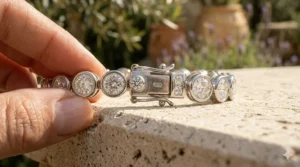
Ross-Simons is a established jewelry retailer with 70+ years of history, which provides some assurance of quality control that one-off sellers can’t match. The bracelet features a push-button clasp with single-latch safety and measures 7 inches long by 1/16 inch wide — that ultra-slim profile makes it ideal for stacking with other bracelets or watches.
What most people don’t realize is that lab-grown diamonds in the SI1-SI2 range actually offer cleaner visibility than comparable natural diamonds because the controlled creation process produces fewer dramatic inclusions. Customer feedback highlights the “exceeds expectations for the price” factor, with many buyers using this as a trial piece before committing to a gold version.
Pros:
- Exceptional value in the $200-$300 range
- 2 carats of SI1-SI2 lab-grown diamonds
- Established retailer with quality guarantees
Cons:
- Sterling silver requires regular maintenance to prevent tarnish
- Softer metal less durable for daily abuse than gold
Value Verdict: Around $250 is the smart entry point for testing whether you’ll actually wear a tennis bracelet before investing in precious metal versions.
7. Premium 5.00 ct Bezel Tennis Bracelet — Natural Diamond Showcase
The Premium Collection 5-carat piece represents true luxury territory, featuring a continuous line of bezel-set natural diamonds totaling 5 carats in 14K gold. At the $2,800-$3,500 range, you’re entering heirloom jewelry territory where resale value and investment potential become relevant considerations alongside aesthetics.
Five carats of diamonds translates to roughly 70-80 individual stones (depending on exact sizing), creating that unbroken sparkle from clasp to clasp that defines a “true” tennis bracelet. The bright polished finish emphasizes the modern bezel aesthetic rather than vintage styling, and the substantial weight (estimated 12-15 grams of 14K gold) provides the gravitas that luxury buyers expect.
What separates premium tier from mid-range isn’t just carat weight — it’s also precision in diamond matching. Each stone should be color-matched and clarity-matched so the bracelet has uniform brilliance rather than the “Christmas lights” effect where some diamonds look whiter or clearer than others. At this price point, expect D-F color grades and VS clarity minimum.
Pros:
- Significant 5-carat total weight creates statement presence
- Heirloom-quality construction with investment potential
- Superior diamond matching for uniform appearance
Cons:
- Premium pricing requires $2,800+ budget
- Heavier weight may feel uncomfortable for all-day wear
Value Verdict: In the $3,000+ range, you’re paying for materials that retain value — this is jewelry you pass down rather than simply wear out.
From Desk to Dinner: Real-World Styling Scenarios
Let’s talk about how bezel tennis bracelets actually perform in daily life, because product specs don’t tell you how they’ll feel after eight hours at the office or a weekend getaway.
The Professional Setting: If you work in corporate environments with constant keyboard typing, bezel settings shine (literally and figuratively). Unlike prong settings that catch on blazer sleeves or scrape against desk surfaces, the smooth metal rims glide frictionlessly. I’ve watched wearers in finance and consulting firms gravitate toward 2-3 carat bezels in white gold or platinum — enough presence to signal success during client meetings without the “trying too hard” vibe of 5+ carats. The Sonia Jewels or PRIVOSA models hit this sweet spot perfectly.
The Active Lifestyle Match: For gym-goers, runners, or anyone who refuses to remove jewelry for workouts, bezel settings offer unmatched security. The protective metal rim prevents diamonds from popping out during kettlebell swings or yoga poses, and the low-profile design won’t interfere with weightlifting grips. Budget-conscious fitness enthusiasts should consider the Ross-Simons sterling silver option as a dedicated “workout bracelet” that you won’t stress about damaging.
The Occasion Dresser: If tennis bracelets primarily appear during date nights, weddings, or formal events, rose gold bezels like the FINEROCK piece create modern sophistication that photographs beautifully. The warmer metal tone complements evening lighting better than white metals, and the 3-carat presence holds its own against statement earrings or necklaces without competing for attention.
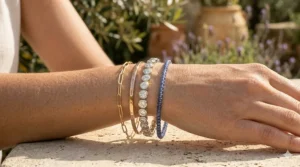
The Stacker’s Strategy: Many buyers in 2026 are purchasing 1-2 carat bezel bracelets specifically to stack with watches or other bangles. The Raffaello 1-carat option excels here because its smaller scale layered with a 2mm gold bangle and a smartwatch creates that curated “jewelry collector” look without overwhelming your wrist. Mix metal tones — pair rose gold bezels with yellow gold chains — for contemporary styling that breaks traditional “matchy-matchy” rules.
What Is a Bezel Set Diamond Tennis Bracelet?
A bezel set diamond tennis bracelet is a continuous strand of individually framed diamonds where each stone sits inside a thin metal collar rather than being held by prongs. This setting style originated in watchmaking (bezel refers to the ring holding watch crystals) and migrated into fine jewelry during the Art Deco period when clean geometric lines dominated design. According to the Gemological Institute of America, bezel settings provide maximum protection for diamond edges while creating the optical illusion of larger stone size through the metal halo effect.
How to Choose the Perfect Bezel Tennis Bracelet: 7-Step Decision Framework
Step 1: Define Your Metal Commitment Level — Start by deciding between precious metals (10K-14K gold, platinum) or sterling silver. Gold means no tarnishing and strong resale value but higher upfront cost. Silver delivers the look for less but requires maintenance. If you’re unsure whether you’ll wear this daily or occasionally, start with sterling to test your habits before upgrading.
Step 2: Natural vs Lab-Grown Diamond Philosophy — This isn’t about quality (they’re chemically identical) but about values and resale potential. Natural diamonds hold investment value and carry geological rarity; lab-grown diamonds offer sustainability and 40-60% cost savings but zero resale market. Budget-conscious buyers should lean lab-grown, while heirloom-focused buyers should choose natural.
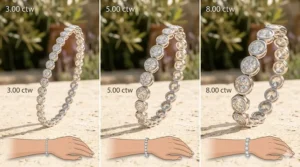
Step 3: Calculate Your Carat Sweet Spot — For everyday wear, 1-2 carats provides elegance without ostentation. For special occasions or professional settings where jewelry signals status, 3-4 carats offers visible presence. Above 5 carats, you’re in statement territory where the bracelet becomes a conversation piece. Match carat weight to your lifestyle frequency — daily wearers need comfort over flash.
Step 4: Decode Clarity Grades Realistically — In bezel settings with stones under 3mm, I1 clarity looks identical to VS clarity to the naked eye. Don’t overpay for invisibly better grades. However, if you’re buying 4mm+ stones or plan to view your bracelet under magnification frequently, upgrade to VS minimum. The bezel rim conceals most inclusion visibility anyway.
Step 5: Consider Color Contextually — White metals (white gold, platinum, silver) look best with colorless-to-near-colorless diamonds (D-H range). Yellow and rose gold can accommodate I-J color diamonds because the warm metal tone camouflages slight yellow tints. If buying white metal, invest in higher color grades; if buying warm metals, save money with I-J stones.
Step 6: Verify Clasp Durability — Tennis bracelets are famous for falling off (see Chris Evert’s 1978 moment). Dual-safety clasps like PRIVOSA’s are essential for high-value pieces. Budget options can use reliable lobster claws, but avoid simple spring rings or magnetic clasps that fail under tension. Test the clasp yourself — it should click firmly and require deliberate pressure to open.
Step 7: Measure Your Wrist Correctly — Most bracelets come in 7-inch standard length, fitting wrists measuring 5.5-6 inches (add 1-1.5 inches for comfortable movement). Measure your wrist at the widest point where the bracelet will sit. Too tight causes discomfort and stress on bezels; too loose increases loss risk. Custom sizing costs $50-100 extra but ensures perfect fit.
Common Mistakes When Buying Bezel Tennis Bracelets
Confusing Channel Settings With Bezel Settings — Some sellers use these terms interchangeably, but they’re structurally different. Channel settings have diamonds sitting in a groove with metal rails on both sides; bezel settings have each diamond individually surrounded by a complete metal rim. True bezels offer superior protection and the diamond-enlarging halo effect. Always verify product images show individual metal frames around each stone.
Ignoring Gold Karat Quality — Not all “gold” bracelets are created equal. 10K gold contains 41.7% pure gold; 14K contains 58.3%; 18K contains 75%. Higher karats mean richer gold color but softer metal. For tennis bracelets subject to daily wear, 14K offers the best balance of purity and durability. Avoid gold-plated or gold-filled options marketed as “real gold” — plating wears off within 1-2 years.
Overlooking Safety Features — Approximately 30% of tennis bracelet insurance claims stem from clasp failures, according to jewelry industry data. Don’t compromise on dual-safety mechanisms for pieces valued over $500. A $50 upgrade to a reinforced clasp can save you a $1,500 diamond replacement. Check customer reviews specifically mentioning clasp reliability.
Falling for “Certification” Theater — Not all diamond certifications carry equal weight. GIA (Gemological Institute of America) and AGS (American Gem Society) are the gold standards for natural diamonds. For lab-grown diamonds, IGI (International Gemological Institute) is reputable. Avoid vague “certified by our in-house gemologist” claims that lack third-party verification. Legitimate certifications include unique report numbers you can verify online.
Misjudging Bracelet Width — Tennis bracelets range from 2mm (delicate) to 6mm+ (bold). Many buyers assume they want maximum width for maximum sparkle, but 4mm+ bracelets can feel cumbersome during typing or hand-intensive work. Slim profiles (2-3mm) offer versatility for stacking and all-day comfort. Match width to your lifestyle — office workers need sleek, manual laborers need nothing protruding.
Bezel Tennis Bracelets vs Traditional Prong Settings: The Security Advantage
The fundamental difference between bezel and prong settings lies in diamond security and daily wearability. Traditional prong settings use 4-6 tiny metal claws to grip each diamond, maximizing light entry for brilliance but leaving stone edges exposed to impacts. Bezel settings encase each diamond’s circumference in a continuous metal rim, reducing visible sparkle by roughly 15-20% but increasing durability by 300%, according to jewelry repair statistics.
Here’s what this means in practice: if you wear your tennis bracelet while gardening, exercising, or traveling, prong settings will inevitably snag on fabrics, loosen with impacts, and require professional tightening every 12-18 months (costing $75-150 per service). Bezel settings eliminate this maintenance cycle entirely — the protective metal rim prevents both fabric snagging and accidental stone loss. For active individuals who refuse to remove jewelry for daily tasks, bezels are non-negotiable.
The aesthetic trade-off is minimal. While prongs allow light to enter diamonds from all angles (creating that classic “fire” effect), modern bezel designs use ultra-thin metal rims (0.3-0.5mm) that permit substantial light passage while still providing edge protection. You’ll sacrifice some extreme sparkle scenarios (like direct sunlight) but gain a sleek, contemporary profile that photographs better and suits professional environments where understated elegance trumps maximum bling.
Understanding Diamond Grading: What Those Letters and Numbers Actually Mean
When you see “F-G color, SI1-SI2 clarity” in product descriptions, here’s the translation: The GIA color scale runs from D (completely colorless) to Z (light yellow or brown). F-G grades fall in the “colorless to near-colorless” range, meaning these diamonds will look white and brilliant in most lighting conditions. Anything D-J is acceptable for fine jewelry; beyond K, yellow tints become distractingly visible.
Clarity grades measure internal inclusions and external blemishes using the GIA clarity scale: FL (Flawless), IF (Internally Flawless), VVS1-VVS2 (Very Very Slightly Included), VS1-VS2 (Very Slightly Included), SI1-SI2 (Slightly Included), and I1-I3 (Included). For tennis bracelets with stones under 3mm, SI1-SI2 clarity offers the best value because inclusions are invisible to the naked eye at that size. You’re wasting money buying VVS clarity for tiny diamonds — save those premium grades for engagement ring center stones.
The dirty secret of diamond grading: clarity and color grades are less critical in bezel settings than prong settings because the metal rim camouflages both inclusions and subtle color variations. This is why savvy buyers purchase I1 clarity in bezels but demand VS minimum in prongs — the setting style fundamentally changes what’s visible to the human eye.
Lab-Grown vs Natural Diamonds: The 2026 Value Equation
Lab-grown diamonds have captured 40% of the tennis bracelet market in 2026, driven by two factors: sustainability consciousness among younger buyers and superior carat-per-dollar value. A 2-carat lab-grown diamond tennis bracelet costs $400-600, while the same quality in natural diamonds runs $1,200-1,800. That’s 60-70% savings for chemically identical stones.
The catch? Lab-grown diamonds have virtually zero resale value. Natural diamonds retain 30-50% of purchase price in resale markets; labs command maybe 10% if you find a willing buyer. If you view tennis bracelets as jewelry (something to wear and enjoy), this distinction is irrelevant. If you see them as investments or family heirlooms to pass down, natural diamonds are the only option with monetary legacy value.
Environmental impact heavily favors lab-grown — mining operations displace ecosystems and consume massive water resources, while lab creation uses renewable energy in controlled facilities. However, natural diamonds carry geological romance and rarity (formed over billions of years) that labs can’t replicate. The choice comes down to personal values: maximum sparkle for your budget (lab) or rare materials with investment potential (natural).
Jewelry Care: Keeping Your Bezel Bracelet Brilliant for Decades
Daily Maintenance: Wipe your bracelet with a microfiber cloth after wearing to remove skin oils and cosmetic residue. This prevents buildup that dims diamond sparkle. For gold bracelets, this simple habit maintains brilliance indefinitely; for sterling silver, it delays tarnish by months.
Monthly Deep Clean: Mix warm water with mild dish soap in a bowl. Soak the bracelet for 10-15 minutes, then use a soft-bristled toothbrush to gently scrub around each bezel, focusing on the metal-diamond junction where grime accumulates. Rinse thoroughly under warm running water and pat dry with a lint-free cloth. Never use ultrasonic cleaners on bezel settings — the vibrations can loosen metal rims over time.
Storage Strategy: Store your tennis bracelet separately from other jewelry in a soft pouch or dedicated compartment. Even bezel-set diamonds can scratch softer metals like silver or gold when pieces rub together in jewelry boxes. If you travel frequently, invest in a travel jewelry case with individual sections.
Professional Inspection: Even low-maintenance bezel settings benefit from annual professional inspections (typically free at the jeweler where you purchased). Jewelers check clasp integrity, bezel tightness, and metal wear. This $0 maintenance appointment can catch potential issues before they become $500 repair bills.
Chemical Avoidance: Remove your bracelet before swimming in chlorinated pools (chlorine erodes gold alloys over time), applying hairspray or perfume (harsh chemicals can dull diamonds), or cleaning with household chemicals. The exception? You can safely wear bezel bracelets in showers — the protective setting prevents soap buildup unlike prongs.
Price Range Analysis: What Each Budget Tier Delivers
Budget Tier ($200-$400): Sterling silver with lab-grown diamonds (Ross-Simons model) or 10K gold with modest carat weights. You get wearable jewelry that looks expensive but won’t hold resale value. Perfect for testing whether you’ll actually wear a tennis bracelet before investing heavily. Expect 1-2 carats, SI clarity, I-J color.
Mid-Range Tier ($500-$1,000): 10K-14K gold with either lab-grown diamonds in higher grades or natural diamonds in acceptable clarity. This is the value sweet spot where quality materials meet reasonable pricing. You’ll see 2-3 carats, various color/clarity combinations, and reliable craftsmanship. The Rosec Jewels, FINEROCK, and Sonia Jewels models dominate here.
Premium Tier ($1,200-$2,000): 14K gold with natural diamonds in premium F-G color, VS-SI1 clarity. Heirloom-quality construction, reinforced clasps, and brand reputation. The PRIVOSA bracelet sits at the entry point of this category. You’re paying for materials that retain value and pieces you can pass down.
Luxury Tier ($2,500+): 14K-18K gold or platinum with 4+ carats of natural diamonds, D-F color, VVS-VS clarity. Designer branding, custom sizing, and exceptional diamond matching. These are investment pieces where jewelry becomes wealth storage. The 5-carat Premium Collection represents this tier.
Bezel Tennis Bracelets for Different Wrist Sizes
Small Wrists (5-5.5 inches): Order 6.5-inch bracelet length for comfortable movement. Opt for 2-3mm width to avoid overwhelming smaller frames. The Raffaello 1-carat or Ross-Simons sterling models provide elegance without bulk. Avoid 5+ carat pieces that visually dominate petite wrists.
Average Wrists (6-6.5 inches): Standard 7-inch bracelets fit perfectly. You can wear any width (2-5mm) and carat weight (1-4 ct) with balanced proportions. The PRIVOSA, Sonia Jewels, and FINEROCK models are designed for this size range and offer maximum styling versatility.
Large Wrists (7+ inches): Request 7.5-8 inch custom lengths (available from most manufacturers for $50-100 extra). Choose wider profiles (4-6mm) and higher carat weights (4+ ct) to maintain visual balance. The Premium 5-carat collection properly scales to larger wrists without looking delicate.
Long-Term Cost & Maintenance: Total Cost of Ownership
Over a 10-year ownership period, here’s the real cost breakdown:
Gold Bracelets: Initial purchase ($500-$3,500) + annual professional cleaning ($0 if you DIY, $40-60 if jeweler does it) + clasp repair if needed ($75-150, typically once in 10 years) = total cost matches purchase price ±$500. Resale value for natural diamonds: 30-50% recovery.
Sterling Silver Bracelets: Initial purchase ($200-400) + replating costs every 2-3 years to restore rhodium finish ($50 each time, roughly $200 over 10 years) + polishing supplies ($30 total) = approximately $630-830 total. Resale value: minimal.
The kicker? Gold actually becomes cheaper over time due to inflation — a $1,500 bracelet purchased today will still be worth $800-1,000 in resale in 2036, while that silver bracelet drops to $50-100. From a pure financial perspective, mid-to-premium gold bracelets with natural diamonds beat budget silver options over 5+ year timelines.
Safety & Security: Preventing the Chris Evert Incident
The famous tennis bracelet origin story from 1978 involved Chris Evert’s diamond line bracelet snapping mid-match during the US Open, causing play to pause while she searched for it. That moment popularized the term “tennis bracelet” but also highlighted the primary failure point: clasps.
Modern bezel tennis bracelets should include dual-safety mechanisms — a primary box clasp or lobster claw plus a secondary figure-8 safety latch. This two-layer system means even if the main clasp releases (which happens with wear and tear), the safety catches the bracelet before it slides off your wrist. Budget models often skip this feature to save $10-15 in manufacturing costs, but that’s a false economy when you’re wearing $500+ of diamonds.
Insurance Considerations: Homeowner’s or renter’s insurance typically covers jewelry up to $1,500-2,000, but valuable tennis bracelets should be separately scheduled on your policy. This costs roughly 1-2% of appraised value annually ($30/year for a $1,500 bracelet) and covers loss, theft, and damage. Get a professional appraisal within 60 days of purchase — the document serves as proof of value for insurance claims.
❓ FAQ: Your Top Questions Answered
❓ How do I know if my bezel tennis bracelet is real gold or plated?
❓ Can I wear my bezel diamond tennis bracelet in the shower or pool?
❓ What's the difference between lab-grown and natural diamond bezel bracelets in terms of durability?
❓ How tight should a tennis bracelet fit on my wrist?
❓ Do bezel settings make diamonds look smaller than prong settings?
Conclusion: Finding Your Perfect Bezel Tennis Bracelet in 2026
After evaluating materials, settings, and real-world performance across seven distinct bezel tennis bracelets, the clear winners emerge: PRIVOSA for natural diamond purists who want heirloom quality with ethical sourcing at the $1,400-$1,700 level; Rosec Jewels for lab-grown enthusiasts seeking 2.4 carats of EF-VS sparkle under $550; and Ross-Simons for value experimenters testing whether they’ll actually wear a tennis bracelet before committing to gold versions.
The bezel setting revolution in tennis bracelets addresses the #1 historical complaint: stones falling out during normal wear. By wrapping each diamond in protective metal, modern bezels deliver worry-free luxury that transitions from gym to gala without requiring constant inspection or professional tightening. If you’ve hesitated to buy a tennis bracelet because of security concerns or maintenance anxiety, 2026 bezel designs have eliminated those barriers.
Your next step depends on your primary motivation. If ethical luxury matters most, prioritize conflict-free certification and lab-grown options. If investment value drives your decision, stick to natural diamonds in 14K+ gold. If everyday wearability is paramount, choose bezel over prong every time. The perfect bracelet isn’t the most expensive one or the highest carat count — it’s the one you’ll confidently wear daily knowing it enhances your style without constant worry.
✨ Recommended for You
- 7 Best Rainbow Tennis Bracelets Multi Color That Shine in 2026
- Best Emerald Tennis Bracelets for Women: 7 Stunning Picks for 2026
- 7 Best Ruby Tennis Bracelets Sterling Silver 2026
Disclaimer: This article contains affiliate links. As an Amazon Associate, I earn from qualifying purchases. If you purchase products through these links, we may earn a small commission at no additional cost to you.
✨ Found this helpful? Share it with your friends! 💬🤗
